
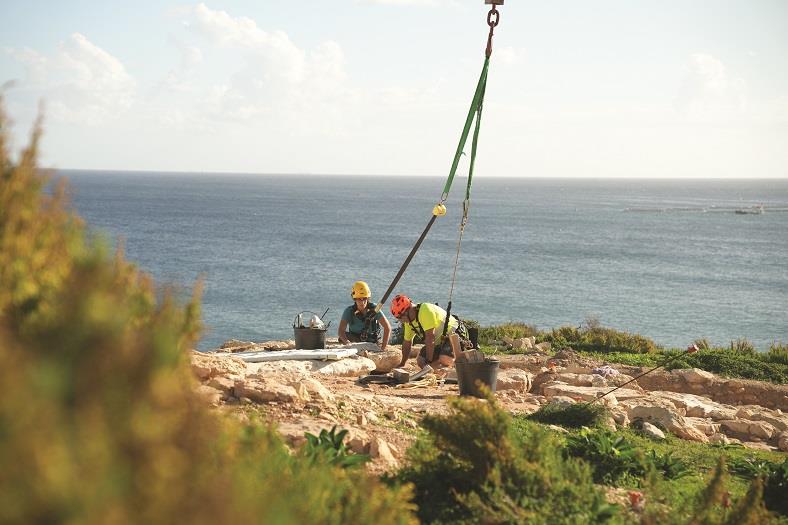

Heritage Malta has entered the final and most revealing phase of its four-year excavation project at Xrobb l-Għaġin, one of Malta’s most precariously positioned prehistoric sites.
The safe relocation of key architectural elements away from the eroding cliff edge has opened access to areas never studied, leading to significant new discoveries which the public will be able to experience in a new interpretation area set to open within Xrobb l-Għaġin Park by the end of next year, Heritage Malta said in a statement.
“Due to the site’s extreme geological instability, since 2021 Heritage Malta’s archaeologists have conducted their excavations while strapped to a tower crane to avoid danger should the cliff edge give way. Narrow trenches and later quadrant excavations revealed the structure definitively, allowing detailed manual, digital, and virtual documentation.”
Following a thorough condition assessment, six large stones were recently successfully relocated further inland from the receding cliff, namely the megaliths of the central passage, monumental paving stones, and other elements around the structure’s frame – the heaviest of which weighed 900kg, it said.
“This presented the archaeologists with a rare chance to expand the excavations in previously unreachable parts of the site, before their completion in December.”
A highlight during this process has been the discovery of a prehistoric stone mallet, confirming the archaeologists’ strong belief in the grounds’ potential to offer new findings. Soil and flooring samples have also been taken for optically stimulated luminescence (OSL) dating, which reveals the last time these materials were exposed to the sun – thus clarifying construction phases, of which at least 3 or 4 have already been identified by the archaeologists on site, it said.
The relocated elements will be recreated within a small interpretation area planned at Xrobb l-Għaġin Park, in collaboration with Nature Trust, the entity which manages the park. This space will enable visitors to engage with visuals of the earliest investigations and the latest findings from ongoing research.
The remains at Xrobb l-Għaġin were first investigated between 1913 and 1915 by Sir Temi Zammit and Thomas Ashby, who noted that parts of the structure had already collapsed into the sea and removed the few decorated elements they found. One of these – a horizontal stone from a table-like structure – is today displayed at the National Museum of Archaeology in Valletta.
Over the following decades, the rest of the structure was gradually concealed, likely through natural processes, and its precise location was lost until a century later, when researchers Ruben P. Borg and Reuben Grima (2015) identified it again using archival plans and modern aerial imaging. The site came under Heritage Malta’s care in 2017, after an advisory committee recommended relocating the surviving elements to safeguard them from further erosion and collapse.
“Although some fragile sections will inevitably succumb to the collapsing cliff, the site will remain protected and backfilled, keeping its saving an option should a solution be found before this natural erosion happens. Meanwhile, research continues, ensuring that as much knowledge as possible is preserved for future generations,” Heritage Malta said.