
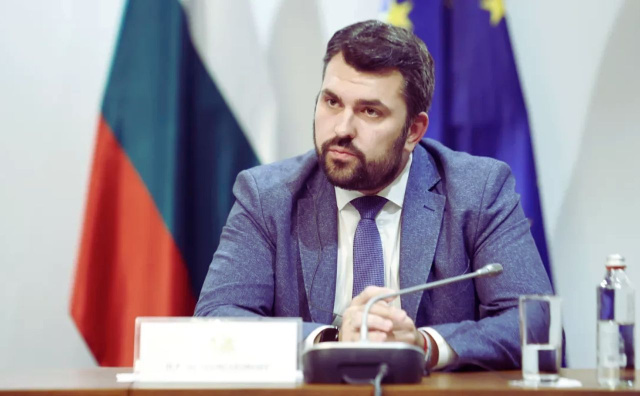
Foreign Minister Georg Georgiev
Foreign Minister Georg Georgiev told parliament that Bulgaria is following the situation of its communities across the Western Balkans with particular focus and, at times, concern. During the parliamentary control session, he explained that Sofia is monitoring developments affecting Bulgarians in Serbia and in the region more broadly. According to him, the Ministry of Foreign Affairs has already expressed its reservations, including during discussions on opening EU pre-accession clusters for Serbia. He was asked whether Bulgaria should continue supporting Belgrade’s European path without conditions, given the pressure faced by Bulgarian minorities in the Western Balkans. Georgiev underlined that Bulgaria has the mechanisms to respond whenever a clear issue is identified and stressed that the same attention applies not only to Serbia but to all countries in the region, as well as to places such as Ukraine and Moldova, where he said there are positive examples.
His remarks came a day after the anniversary of the Treaty of Neuilly, which transferred the Western Outlands to Serbia more than a century ago. At the time, nearly 100,000 Bulgarians lived there; today, only a few thousand remain, a decline that Bulgarian observers link to longstanding policies by Belgrade. In recent years, senior Serbian officials, including President Aleksandar Vučić and former interior minister Aleksandar Vulin, have made statements sharply critical of Bulgaria. According to BGNES, an organized campaign of hostile rhetoric continues, portraying Bulgarians in a negative light. Vulin has declared that Serbia should halt EU accession talks and move towards BRICS, and he has frequently promoted the idea of a “Serbian World”.
Meanwhile, North Macedonia’s Minister for European Affairs Orhan Murtezani, speaking in Skopje alongside Swedish Minister for European Affairs Jessica Rosenkrantz, said his government is trying to restore communication and trust with Bulgaria, working together with EU partners. Murtezani explained that dialogue is necessary before any solutions can be discussed. Rosenkrantz reaffirmed that once North Macedonia introduces the required constitutional changes, the EU and all member states must immediately open formal negotiations.
At the same briefing, Murtezani responded to questions about whether Skopje is preparing a third protocol with Bulgaria, as recently suggested by President Gordana Siljanovska-Davkova as a possible “creative” approach. Deputy Prime Minister Aleksandar Nikoloski has also stated that constitutional amendments cannot proceed “under Bulgarian dictate.” Murtezani said constitutional changes are obligatory for EU membership but added that discussions cannot move forward until all of North Macedonia’s concerns are addressed. He argued that rebuilding trust between the two countries is essential. He avoided specifying the exact unresolved issues, even though Bulgaria maintains that Skopje has not fulfilled its European commitments.
He repeated several times that dialogue and trust are prerequisites for progress, adding that efforts are already underway with the support of European partners. Rosenkrantz welcomed any constructive communication between neighbors but emphasized that constitutional amendments remain a formal requirement for moving ahead with accession.
In June 2022, North Macedonia accepted the so-called French proposal, endorsed by all EU member states. Under the Negotiating Framework, Skopje must add Bulgarians to the preamble of its constitution as a state-forming group before accession talks can begin. The country must also implement the 2017 Treaty of Friendship and the two existing bilateral protocols.
The second protocol, signed during the Joint Intergovernmental Conference by ministers Teodora Genchovska and Bujar Osmani, commits North Macedonia to holding the next conference only after the constitutional inclusion of Bulgarians. It also confirms that nothing in North Macedonia’s constitution may be interpreted as grounds for involvement in Bulgaria’s internal affairs regarding people who are not citizens of North Macedonia. This provision effectively blocks Skopje from making claims about a “Macedonian minority” in Bulgaria. Furthermore, the protocol outlines steps for countering hate speech against Bulgaria, supporting the rehabilitation of victims of the Yugoslav-era communist regime, and opening the archives of the former Yugoslav secret services.