
COMMENTARY: In a moment of unexpected grace at Carlo Acutis’ tomb, I learned the truth of Luke 12:12: ‘The Holy Spirit will give you the words to say when you need them.’
I grew up in a bilingual household. My Italian-born dad would routinely speak Italian, while my Bronx-born mom was able to seamlessly switch between fluent Italian and flawless English.
I myself spoke English day in and day out, and never made much of an effort to learn Italian. Still, I had picked up enough of the language to ace my high school Italian classes and do well in my Italian 101 college course.
So, when Mike and I went to Italy on our honeymoon in 1984, I felt pretty confident in my ability to communicate with the locals.
Our second day in Rome, Mike and I were sitting in a lovely “trattoria,” and I wanted to see the menu.
“Per favore, la lista delle vivande,” I said to our waiter.
He looked at me quizzically.
“La lista,” I faltered, “delle vivande.”
“Ah,” the waiter beamed, “il menu!”
This was a blow. It appeared that at least some of the vocabulary words in my Italian textbooks, although technically correct, were obsolete.
It also became obvious during our stay that my communication issues weren’t limited to Italian vocabulary. Even wordless symbols were a problem. I found that out when Mike and I innocently drove past a man holding a sign displaying a red circle, and were suddenly confronted by armed men in uniform. Turned out that we clueless “Americani” had cruised into a restricted area.
Those two incidents quashed any illusions I’d had of being something other than an average American tourist. Like water droplets from a Roman fountain, my self-assurance had evaporated.
So it’s no wonder that, when in 2023 I visited Italy with my daughter Rose, I was bothered by Rose’s insistence that I speak Italian at every opportunity, and that, where there wasn’t an opportunity, I should create one. After all, I had had little real-world success with “speaking Italian,” and besides, it had been nearly four decades since I‘d either heard Italian at home or spoken it in the classroom.
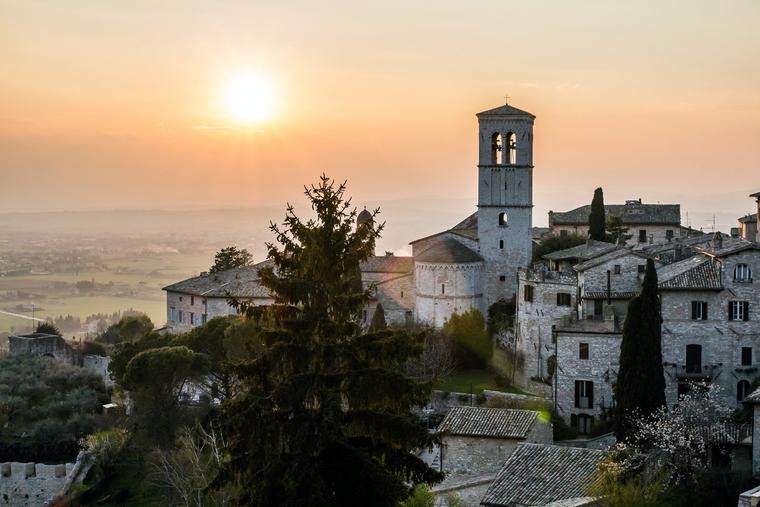
As Divine Providence would have it, the day that Rose and I were supposed to tour Assisi, I was stuck in bed with a migraine. It was evening by the time I managed to get up and walk shakily out the door of our hotel, determined to see Assisi before our scheduled departure early the next morning. Across a nearby piazza was the Church of St. Mary Major, where St. Francis once renounced his father’s wealth, and where the body of then-blessed Carlo Acutis was entombed.
It was almost dark when I arrived at the church. I had wanted to pray at Carlo’s tomb, but visiting hours had long ended. While I stood wondering what to do next, a Franciscan friar came hurrying along. The silence of the church was broken first by the sweep of the friar’s robe, and then by the sound of my voice.
“Scusi, per favore, posso entrare?”
The words had slipped out before I even realized what was happening. My Italian wasn’t perfect, but it didn’t have to be: With the friar’s hasty “Sì, sì,” accompanied by an impatient wave of the hand, I was granted the privilege of a quarter hour spent praying alone at the tomb of the young man who would be canonized “the first millennial saint.”
I never did manage to figure out how I’d found those Italian words at just the right time. But I was reminded of Luke 12:12, “ The Holy Spirit will give you the words to say at the moment when you need them.”
May the Holy Spirit move us all to speak as we should, when we should, and may St. Carlo Acutis, “God’s Influencer,” inspire us to always use our voices for God’s greater glory!