
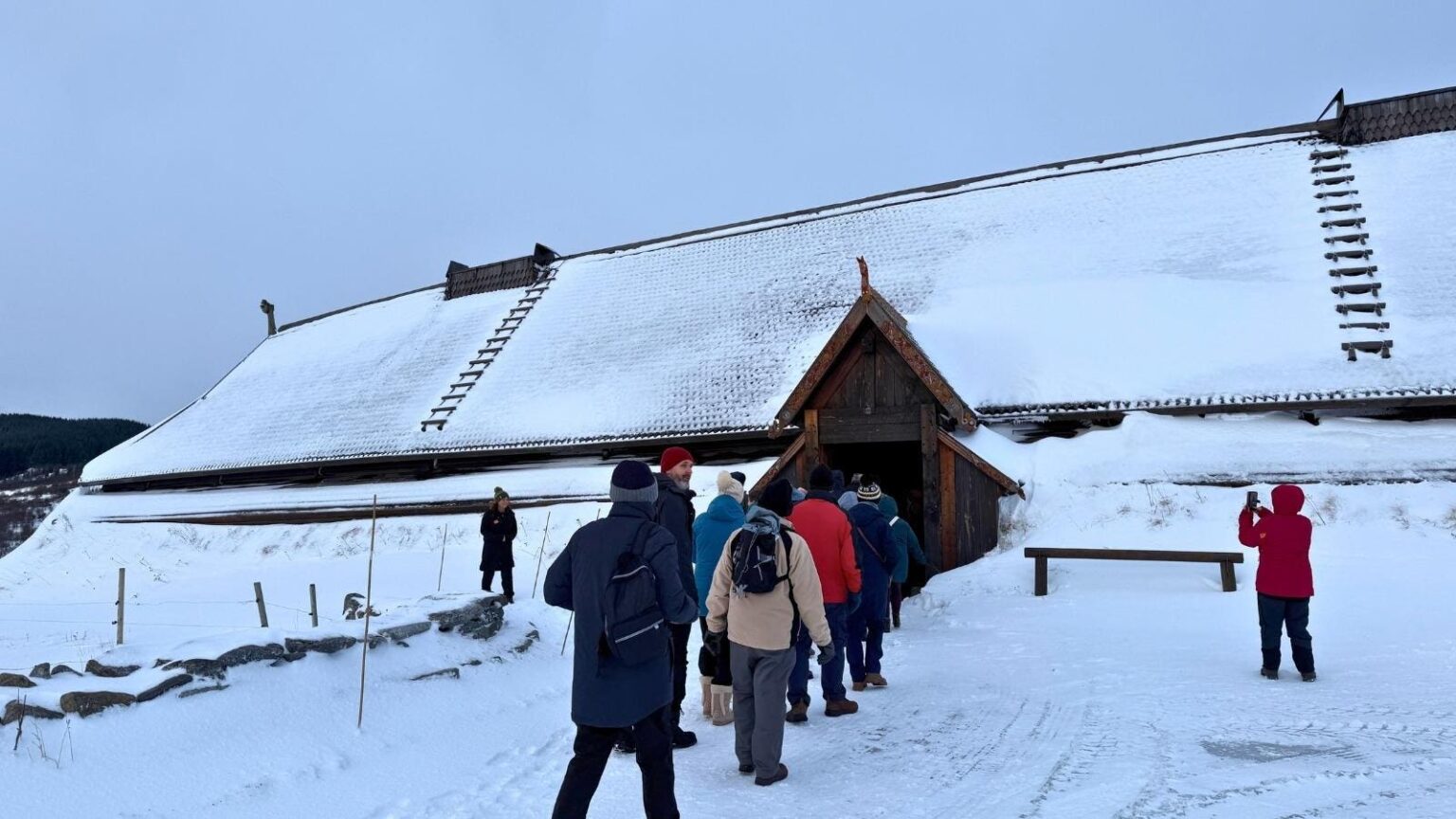
Visitors enter the reconstructed Viking Age longhouse at Lofotr Viking Museum in Lofoten, Norway.
David Nikel
The sagas describe chieftains who rose to prominence across Scandinavia, but only recent archaeological work has revealed how influential this region truly was in Viking history, and just how far north that power extended.
Centuries before modern travelers reached Norway’s Lofoten islands for the scenery, Viking chieftains settled here for fertile soil and rich fishing grounds.
Today the Lofotr Viking Museum brings that northern chapter vividly to life inside a full reconstruction of an Iron Age longhouse that once stood on this windswept peninsula.
Visitors do not enter a typical museum. They step into a working chieftain’s home where firelight softens the shadows, wool hangs from wooden beams and guides in traditional clothing introduce a culture shaped by trade, agriculture and resourceful innovation.
Winter visits add a cinematic quality. Snow softens the surrounding peaks and the longhouse glows with warm light, which makes the storytelling feel even more intimate.
A Lost Viking Settlement Rediscovered
For centuries no one knew that a powerful Viking chieftain once ruled this land. The longhouse had vanished and only the contours of a farm remained.
The story changed when a local farmer dug his potato field in the 1950s and struck something unusual. He found ceramic shards and glass fragments that he knew did not belong in the soil. The items were sent to the University of Tromsø where researchers dated them to the eighth century.
Even more remarkable was the discovery of imported objects. Glass production was unknown in the Nordic world at the time, yet the fragments found at Borg came from the Rhine region of Germany. Some had a blue tint while others had delicate gold engravings.
Archaeologists eventually found shards from fifteen glasses, which was an extraordinary sign of wealth. In this period glass was valued even more highly than gold because it represented a new and rare technology.
The reconstructed longhouse contains many objects that would have been used in the Viking Age.
David Nikel
Ceramics from northern Germany added another clue. The chieftain who lived here had trading networks that stretched deep into continental Europe.
Whoever ruled this estate was connected, wealthy and influential, and the abandoned longhouse eventually grew to more than 270 feet in length.
Viking History At The Edge Of The Arctic
Lofoten seems like an unlikely place for a prosperous Viking community, yet the islands were rich in resources. The Gulf Stream brings warm water to the region and creates conditions that are far milder than the latitude suggests.
Farmers could grow barley, rye, cabbage and peas during the brief summer, and they kept livestock on slopes that remain green long after other parts of northern Scandinavia turn barren.
The surrounding sea made the community even wealthier. Each winter millions of Arctic cod, known locally as skrei, migrate to the Vestfjord to spawn.
Viking communities harnessed this seasonal abundance and developed a drying technique that required no salt and produced stockfish that could last for years.
The process transformed the economy of northern Norway and the product became one of the most valuable exports of the Viking Age.
Other resources contributed to trade. Whale bone was used for tools and ornaments. Seal skins, sea eagle feathers and eider down were prized far beyond the Arctic. Fish oil illuminated homes and was sometimes used to waterproof wool clothing.
The result was a community with economic and cultural ties that stretched far beyond the Norwegian Sea.
Vikings’ Allies In The North
The museum also highlights the relationship between Norse settlers and the Indigenous Sami people. Many Viking stories overlook this connection, but the northern regions had long relied on cooperation.
Sami families provided reindeer skins, antlers and other high-value goods that chieftains later traded in Europe for glass, honey, salt and iron.
The relationship was part economic and part strategic, and it helped shape the character of northern Norway during the Viking Age.
Storytelling That Brings Viking History Alive
The longhouse is the heart of the Lofotr experience. Guided visits begin in the ceremonial hall where guests sit beneath soaring wooden beams as storytellers describe daily life, beliefs and the archaeological mysteries that brought the site back to life.
A local guide shares stories in the feast hall.
David Nikel
The space feels atmospheric rather than theatrical, which fits the museum’s focus on authenticity. After the introduction visitors move through the living quarters, storerooms and workspaces to see how people cooked, crafted tools and managed a large household.
Those who arrive on the Norwegian coastal route receive an even more immersive experience. Both Hurtigruten and Havila offer an evening feast at the longhouse, served by candlelight and accompanied by storytelling and traditional entertainment.
The menu references the ingredients of the era and the setting gives guests the sense of attending a chieftain’s gathering. It is a striking contrast to the more informational daytime tours, yet both experiences highlight how central storytelling was in the Viking world.
For travelers exploring northern Norway, especially in winter, Lofotr is a rare chance to step inside a reconstructed Viking home that feels lived in rather than staged.
It is a top cultural experience that pairs well with Lofoten’s dramatic landscapes and one that demonstrates how much remains to be discovered about the Vikings of the Arctic.
MORE FROM FORBESForbesViking Iceland: A Viking Age Travel GuideBy David NikelForbesNorway Is Building A New Viking Age Museum In OsloBy David NikelForbesHow To See This Incredible Viking Ship Reconstruction In NorwayBy David Nikel