
 Streaming Challenger Bogota MD live tennis
🎾 Barrientos/Kittay vs Martinez/Rodriguez
- Sign up with Bet365 here
- Make your first deposit of at least €5
- Go to the “Live” section and watch every match
Watch the match on Bet365
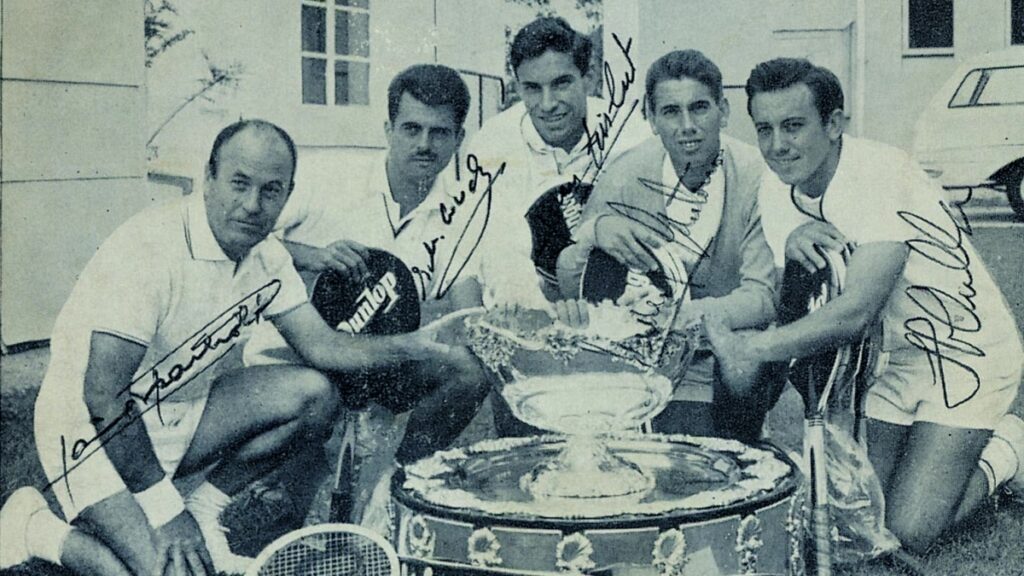
Just a week ago, Spain was counting down the hours to face Italy in the 2025 Davis Cup. And nearly 60 years ago, our team landed in a final for the first time, leaving an infinite legacy for all the players who came after.
There are still people who recite from memory the lineup: Juan Manuel Couder (1934), Manuel Santana (1938), José Luis Arilla (1941), and Juan Gisbert (1942). Let’s not forget the captain, Jaime Bartrolí (1918). It was Spain in 1965, Spain in black and white, the first Spain that managed to gather the team and talent to reach a Davis Cup final. A historic event that, six decades later, still moves us when we reminisce about it. How difficult it was to return from Australia without the title, but what a valuable experience it was to continue growing and now proudly display six trophies in our cabinet.
Long pursuing an opportunity of such caliber, Spain started the 1965 season with a feeling that something big could happen. They first defeated Greece (5-0), Chile (5-0), Germany (4-1), Czechoslovakia (4-1), and South Africa (4-1) in the European Zone. All ties, except the one in Prague, were played in our country. Later on, in the Inter-Zonal Zone, they had to defeat United States in August (4-1) and India in November (3-2). In total, seven ties were played, with six of them on the clay courts of RCTB 1899. It was the magic of Barcelona, an iconic place where the Armada always knew how to assert their dominance.
This led to the grand final, known as the Challenge Round, where Australia awaited. The format –also used in other sports– involved the reigning champion advancing directly to the final of the following year. An excessive privilege that would not expire until 1972, significantly opening up the competition and offering equal opportunities to all participants. However, that wasn’t the case in 1965, where after seeing 43 nations compete for the same goal, Spain boarded the plane to Sydney to challenge the current kings of the circuit.
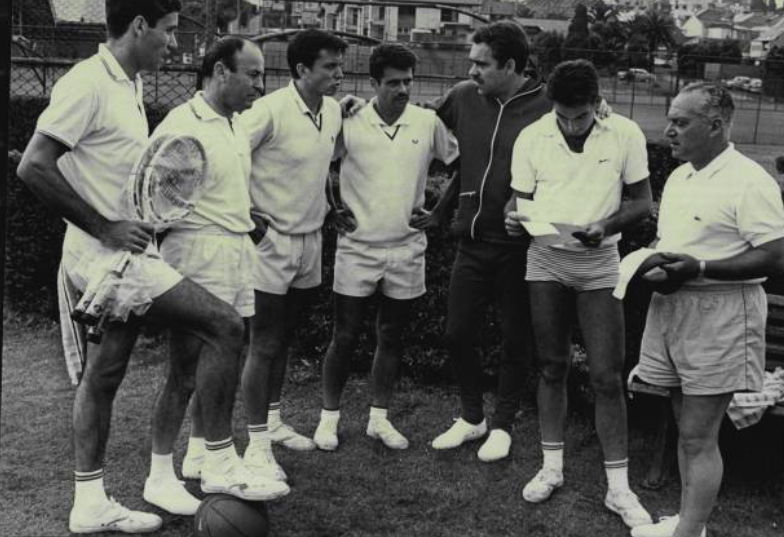
The final took place at the White City Stadium from the 27th to the 29th of December. The host country not only played at home but also chose the surface. Considering that Spain had been dominating all its opponents on clay courts, you can imagine the conditions they selected. For Santana and his team, it was already tough to have to fly almost 18,000 km to the destination, but what truly bothered them was having to compete for the title on grass. The challenge was immense, although the main adversities came from further back: while Spain had about 350 tennis courts at that time –none of them grass–, Australia had around 50,000. It sounds harsh, but that challenge was faced with the awareness that winning was impossible. There was nothing they could do.
But they had to try, of course, what else could they do after waiting for so many years. Manolo Santana, who had significantly increased his reputation within the circuit after winning his third Grand Slam title in Forest Hills months earlier –the fourth and final one would come at Wimbledon in 1966–, pulled some strings to ensure the Spanish team had top-notch sparring partners upon their arrival in the Antipodes. That’s how they decided to travel to Australia a few weeks earlier, where a certain Rod Laver and a certain Ken Rosewall were waiting for them. Both champions had turned professional, so they were prohibited from participating in the Davis Cup. It was the last thing the Aussie fan expected – seeing their two greatest legends training with the opposing team.
The scene made more than one person doubt their final prediction. What if Spain caused an upset? What if they weren’t so bad on grass? Could Santana lead the team by playing both singles and doubles? The man from Madrid was the main threat for Spain, the one who could slightly tip the balance, but also the player who would bear the most pressure. All these factors, the good and the bad, were evident right from the first match.
The First Davis Cup Final for Spain Unfolds
Fred Stolle and Manolo Santana opened the tie, with the Spaniard starting more confidently. With the score clearly in his favor (12-10, 6-3), Spain was just a set away from making a statement in the final. However, Santana succumbed to the pressure, faltered, and suffered a tortuous five-set comeback that he could never forget. “One of the most painful defeats of my career,” he wrote many years later in his autobiography.
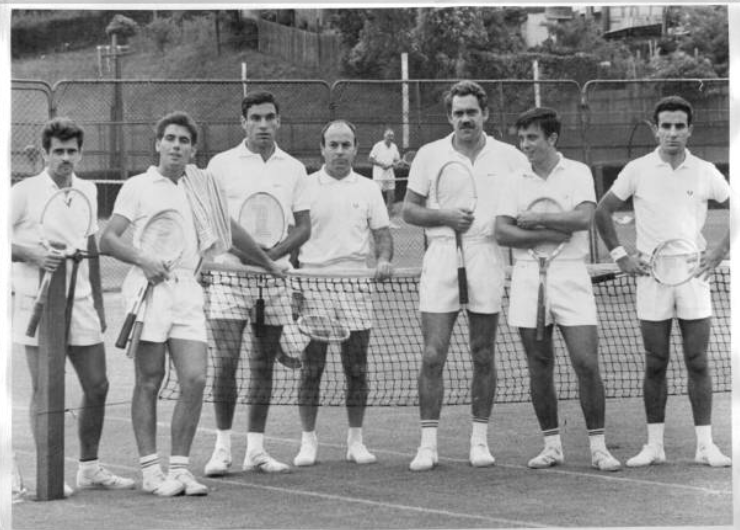
For many, that was the first and only moment of hope throughout the weekend, that brief instant when the Spanish fan thought, ‘It’s possible.’ Meanwhile, in Spain, the event was followed intensely, with several journalists sent on-site to cover it. Additionally, the Spanish embassy in Australia and the Ministry of Foreign Affairs did everything possible to ensure the Spanish community could attend the matches, feel our support, and cheer on. Some radio stations supported various initiatives to send their compatriots all kinds of flags, hats, and items to keep our colors alive in the stands. Sadly, it didn’t change much.
After losing the first point in five sets, Juan Gisbert’s defeat to Roy Emerson followed. And the next day, Santana-Arilla’s loss to Newcombe-Roche. This meant that the dream of winning our first Davis Cup had vanished in less than 24 hours. Juan Manuel Couder, the oldest member of the team, readily accepted his substitute role, performing other functions within the locker room that were also crucial for team cohesion. It is said that Juanito loved to travel, always carrying books with him, which eventually led him to pursue a degree in Industrial Engineering.
With the final outcome known, Santana still summoned the strength on the last day to secure Spain the point of honor. True, it didn’t change anything, but the triumph against Roy Emerson in four sets was celebrated among the Spanish audience as if it were a title. It was a way to redeem themselves, to demonstrate their competitive spirit, to enjoy without pressure on the court. At that moment, he didn’t know it, but that would end up being Emerson’s only individual defeat throughout his Davis Cup journey.
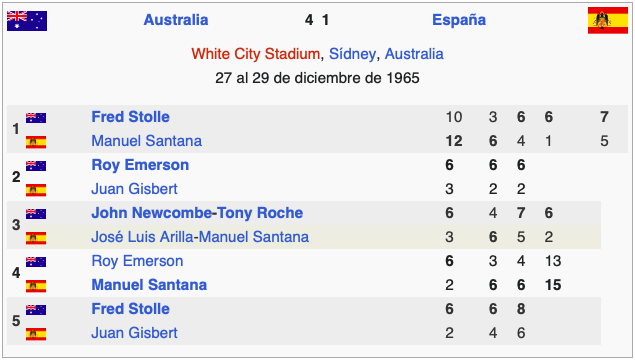
Australia, competing in its 34th final in the competition, claimed the title for the 20th time with a final score of 4-1. Spain, in its maiden final, suffered the injustices of the Challenge Round, a format that saw the United States and Australia dominate the Davis Cup titles between 1937 and 1970. The RFET had promised them a million pesetas to share among the whole team if they returned with the title. They didn’t get rich, but they paved the way to glory forever, a path that later generations like Costa, Ferrero, Corretja, and Balcells would walk.
By the way, one who did have a gesture towards the Spain of 1965 was Juan Antonio Samaranch, who gifted each of them a gold watch. Something is better than nothing.
This news is an automatic translation. You can read the original news, El primer “approach” de España a la Copa Davis