
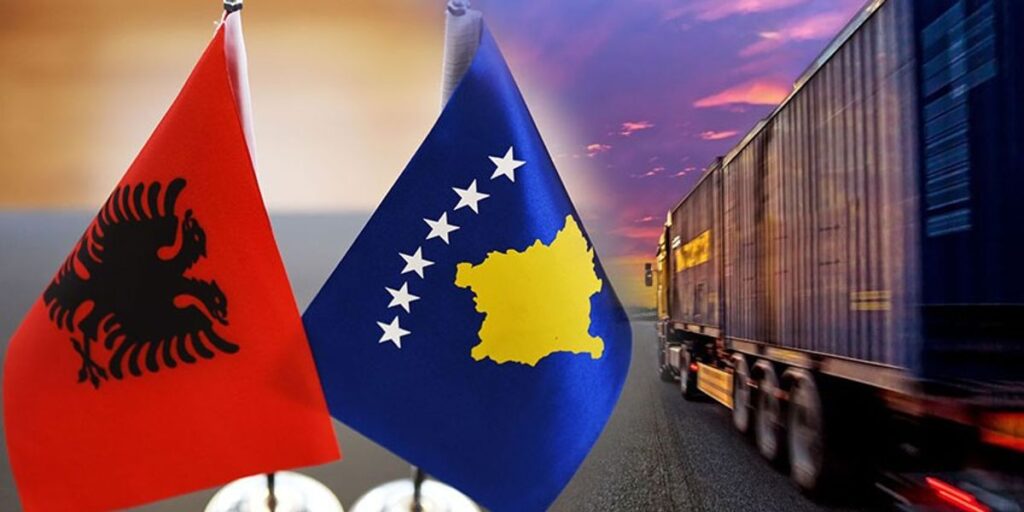
The retail market is a segment that is attracting large enterprises from Kosovo. The latter have more experience and have moved faster than Albania in organized retail trade and are rushing to exploit the free spaces in the market that speaks the same language.
Albania’s return to being a tourist destination, which has increased consumption by foreigners, is another attraction for Kosovo’s retail and service businesses.
At the end of March 2025, the Kosovo company, “Viva Fresh Store”, announced that it had reached an agreement to acquire “SPAR Albania” from the Albanian BALFIN Group.
The final value of the transaction was 36.4 million euros, according to the transaction registered at the National Business Center.
Following the announcement of the acquisition, the European Bank for Reconstruction and Development (EBRD) and the Enterprise Expansion Fund II (ENEF II), under the European Union’s Western Balkans Investment Framework (WBIF), announced that they will provide a loan of up to €25 million to partially cover the cost of the acquisition of SPAR Albania – with the EBRD contributing €22 million and ENEF II €3 million.
This is the largest loan the EBRD has ever provided to a local company in Kosovo. Following the acquisition, Viva Fresh plans to expand its operations in Albania by opening new stores and renovating existing SPAR outlets.
The company with capital from Kosovo, “Albi Holding”, purchased “Fashion Group Albania”, which was part of the BALFIN Group, in September 2025, for 7.6 million euros, according to the contract deposited with the Central Bank.
The acquiring company owns a network of fashion stores operating in Kosovo and the region, representing international brands such as: “Celio”, “Chaussea”, “Okaidi”, “Mango”, “Springfield”, “Ozdilek”, “Geox”, “Gant”, “Timberland”, “Hugo Boss”, “Sportina Armani Exchange”, “Tom Tailor”, “XYZ”, “UGG”, “Plein Sport”, “Orsay”, “Dan John”, “Parfois”, “Boggi”.
In October 2025, KAN, headquartered in Kosovo, which manages 35 quick-service restaurants and 1000 employees in the region (Kosovo, Albania, North Macedonia and Montenegro), officially announced the acquisition of ownership of the KFC network in Albania from “Global Fast Food Albania”, which until now had the rights to the global fast food brand, KFC for Albania.
The company said it plans to open 20 new KFC outlets throughout Albania.
KAN is a company registered in Kosovo, with sole owner businessman Fatmir Zymberi. His group was already present in Albania, through the company “Scandinavian Living”, which owns the rights to use the Danish brand “Jysk” for Albania and other countries in the region.
“Global Fast Food Albania” was owned by the United Arab Emirates-registered company, “TP Investment Limited”, while its controlling owners were businessmen from Georgia.
“Global Fast Food Albania” closed 2024 with a total turnover of 1.44 billion lek, an increase of 18% compared to the previous year. Net profit reached approximately 141 million lek, also increasing by 23% compared to 2023.
At the end of 2024, the company owned 13 active restaurants in Albania, of which 11 were under the KFC brand and two others under the “Pizza Hut” brand.
Why Kosovo companies are relocating to Albania
Ramiz Kelmendi, a well-known businessman in Kosovo, owner of the companies ELKOS and ETC, tells “Monitor” that the interest in investing by Kosovo businesses in Albania has always been great. According to him, this is a positive thing, since every business, whether large or small, aims to expand.
“We as ELKOS/ETC continue to invest in Albania. Currently, we are building a large business facility in Tirana.
Our goal and that of other businesses from Kosovo is to expand as much as possible and this expansion is happening in our neighboring country, Albania. So, our goal and that of businesses similar to mine, is to expand as much as possible, add to this the fact that we are not going far, but in our own country, which is Albania”, says Mr. Kelmendi.
He adds that the expansion of Kosovo businesses should continue and that there is potential in other countries such as Serbia, North Macedonia, Montenegro and beyond.
“There should be an expansion of Kosovo businesses, I believe there is, and then there is in Serbia, North Macedonia, Montenegro and further afield. But, one thing should be noted that some businesses are leaving Kosovo altogether and going to Albania. So, not expanding, but relocating.”
However, he says that Kosovo is currently going through an economically and politically uncertain period.
“Right now, we do not have functional institutions, we go from election to election, there is no stability and security.”
“The government and institutions should work for the good of businesses and create favorable conditions, but currently it seems as if they are working against them, forcing businesses to adapt to unfavorable rules,” concludes Mr. Kelmendi.
Kushtrim Ahmeti, director of the Kosovo Chamber of Commerce and Industry, tells “Monitor” that Albania has long been attractive to many companies from Kosovo.
“Albania has long been a point of interest for many companies from Kosovo. One of the main factors influencing this movement has to do with the need for our business to expand its activity, as our country unfortunately does not offer many opportunities.
Here, we should not ignore the increase in tourists, who are also increasing their purchases. Albania has been offering various incentives for Kosovo businesses for a long time, whether in an official or unofficial form.
“In addition to service companies, or even the well-known hypermarkets of Kosovo, manufacturing companies are also heading to Albania, due to the many problems they are facing in Kosovo.”
He emphasizes that the difficulties of doing business in Kosovo have increased in recent years, mainly due to institutional decisions issued without communication and cooperation with the business community.
“The difficulties of doing business have increased significantly in recent years. For example, we, as the Kosovo Chamber of Commerce and Industry, have been dealing with the unblocking of many companies for about two years, whose blockade was caused by the Law on Public Property.
“Business continues to feel the consequences of this blockade today.” He adds that the 16.1% increase in energy prices for regulated consumers and the subsequent misguided liberalization of the energy market have worsened the situation.
“Then we have the 16.1% increase in energy prices for regulated consumers and then immediately the wrong liberalization of the energy market.
From the beginning, we have warned of the consequences of these actions, but we have had no willingness from the institutions to overcome this situation.
So now we have increased product prices, increased production costs, several times more expensive energy bills, decreased production capacity, great uncertainty about the future, suspension and complete cancellation of investment plans, etc.
Investments and the number of companies increase
Bank of Albania data shows that the interest of Kosovo businesses to invest in Albania has been very high since the pandemic, while until 2019, the flow was almost non-existent. In 2024, investments from Kosovo reached a record of 96 million euros, up from 13 million euros in 2019.
In relation to total investments, the weight has reached 6%. The upward trend continued in the first half of 2025, with 63 million euros, an expansion of 50%.
According to data from the Institute of Statistics (INSTAT), at the end of 2024, 582 active enterprises with capital from Kosovo operated in Albania, including those with joint capital.
The number of enterprises with capital from Kosovo has increased by 12% compared to the previous year. Over the past decade, the number of these businesses has increased by 130%.
Interest also in the real estate market
There was also attention to the real estate market. Muhamet Bytyqi, who is also a real estate expert and owner of “Mars Real Estate”, says that in Kosovo, the construction market is saturated, especially in cities like Pristina and Ferizaj.
“In Albania, meanwhile, there is high demand for housing and property, especially from foreigners and the Albanian diaspora.
“This makes the Albanian market more dynamic and more open to investment, especially for construction companies that have experience and capital from Kosovo,” he claims.
Mr. Bytyqi adds that construction companies from Kosovo have purchased shares in Albanian companies to have legal convenience, to obtain construction permits faster, and to build with local partners.
There are also businesses in other fields, trade, energy, transport that are doing the same thing. The current political situation in Kosovo – the lack of a full government, uncertainty about strategic decisions and rising energy prices – has also created an uncertain environment for businesses.
“Political uncertainty causes investment decisions to be delayed or made more cautious. Businesses do not want to hold large amounts of capital in a market with unclear rules and stability.”Monitor.al