

Propaganda and disinformation are critical weapons in Russia’s war against Ukraine. Moscow’s strategies and tactics affect many who consider themselves impervious.
Kyiv Post talks to Dr. Ernest Wyciszkiewicz, director of the Mieroszewski Centre, which recently examined how Russian narratives infiltrate academic discourse and shape public debate.
Follow our coverage of the war on the @Kyivpost_official.
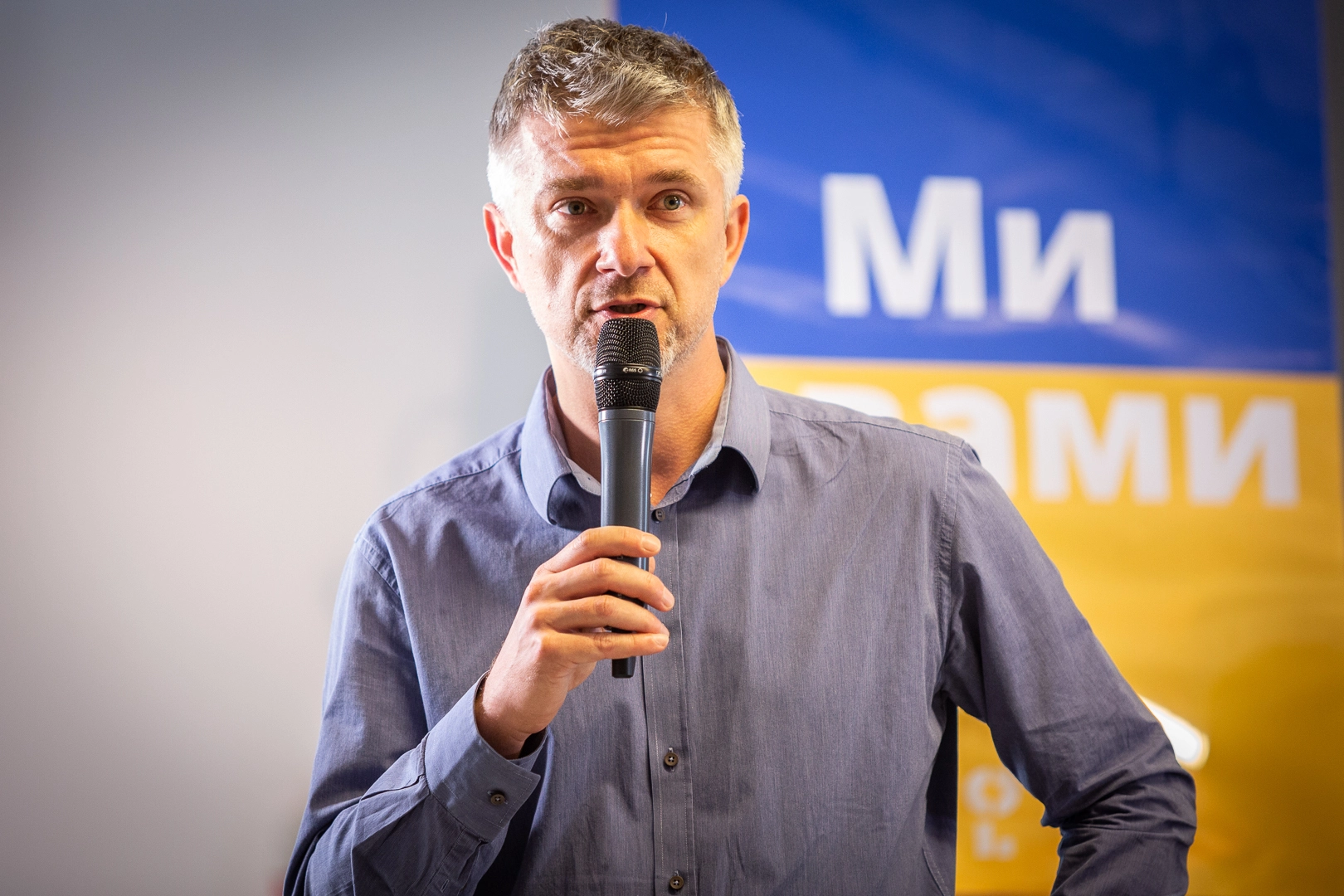
Michał Kujawski: To what extent is the statement “Polish officers died in Katyn” actually true? Where does it fall on the scale between truth and Russian propaganda?
Ernest Wyciszkiewicz: It’s tricky, because the statement itself is a fact – but the intention matters. It can be a shorthand used by someone who fully understands that the officers were murdered by the NKVD. But in another context, the very same sentence can be interpreted differently.
[The crime was committed by the NKVD, which executed nearly 22,000 Polish citizens in the spring of 1940. The USSR falsely claimed that the Germans were responsible; today, some groups in Russia are returning to that narrative]
MK: Someone unfamiliar with Polish history, hearing the word “officers,” might assume they died in battle or in an accident – not that they were executed with a shot to the back of the head.
Other Topics of Interest
Unexpected Turns: Peace Framework Shifts, Major Strikes, and Political Fallout
Welcome to Summary of the Week — your fast, clear recap of the key events shaping Ukraine and the world.
EW: Exactly – and this is where the audience comes in. Someone well-informed will understand the context immediately. Someone from outside the topic – especially from a different part of the world – won’t know why those officers died without additional explanation. Detached from context, information begins to live its own life and is interpreted through the lens of the recipient’s experience.
MK: So how important is wording?
EW: Fundamentally important. But there are many ways to approach this. I’m particularly interested in framing – not only what we say, but how we say it. And not from the author’s perspective, but the audience’s. Take this example: “Ukraine is corrupt.” Said without context, it becomes manipulation. What does it actually mean? That all Ukrainians, the entire state?
MK: But corruption scandals do erupt.
EW: Of course, which is why the sentence itself can be true – yet once taken out of context, it becomes false. It triggers a particular effect. Someone with general knowledge might simply accept it. An analyst will understand we’re talking about a certain phenomenon.
But if that sentence is extended into: “Ukraine is corrupt, so it has no chance of joining the EU, the state is failed and infiltrated by Nazi ideology,” then we begin with something real – the problem of corruption – and end up with claims straight out of Russian propaganda. That propaganda says “Ukraine is an artificial construct,” and therefore can be “reorganized.” A true premise is used to guide the audience toward a false conclusion.
MK: Let’s move to an anecdote. I once spoke with an elderly man from Ukraine, very pro-Ukrainian, who remembered Soviet times well. He said that “life was good then” – young people didn’t leave small towns en masse, public services worked, and it was easy to see a doctor. Does this kind of sentiment feed into Russian narratives?
EW: No. It’s just nostalgia for one’s youth. Someone is describing how things were and how they are now, and they have every right to do that. Only context lets us judge whether we’re hearing the memories of an older man idealizing his youth, or someone deliberately trying to convince younger people that “things were better back then” and that the old system should return. What matters is: who says it, when, and with what intention. The same sentence spoken by a pro-Russian figure or a comedian will carry a completely different tone. The problem arises when someone takes a sentence out of context and assigns motives to its author.
MK: To what extent do Russian narratives and mental shortcuts circulate among us – even among people who are not pro-Russian?
EW: I increasingly hear the phrase “the collective West.” Few people know it’s a Russian invention from about a dozen years ago. Previously, nobody used it. And the phrase is absurd – the West is by definition a collective of states. Yet the term has entered mainstream vocabulary.
MK: Maybe that’s why in 2022 many people mocked Russian claims about “mercenaries from the collective West fighting in Ukraine.” By debunking these fakes, did we help spread them? Did Russia spread them – or was it… us?
EW: Both Russia and us. There is no single massive machine pumping out disinformation. The advantage of disinformation ecosystems lies elsewhere: their messages don’t need to be consistent. They can even contradict one another because they’re aimed at different groups – young, old, right-wing, left-wing.
For such content to work, though, it must fall on fertile ground. Effective disinformation identifies sensitive points. In Poland today, these include interpretations of the war in Ukraine and Polish-Ukrainian relations. For example: the phrase “Crimea was and is Russian” – it appears even in academic publications, usually with commentary. But the idea is present.
MK: And how does time affect this? Circumstances change, so the same sentence may sound different years later.
EW: Exactly. Someone might have said something in a specific reality, based on the knowledge they had then. Transposing that statement into today’s context without accounting for time can be manipulation. It’s a common trick: comparing someone’s words from years ago with what they say now and claiming contradictions. Reality changes – people can change their views too.
The mechanism of propaganda isn’t to “infect” everyone – just a few who will spread the narrative further.
MK: When we think of “Russian propaganda and disinformation,” we picture media, deepfakes, or bots. But it turns out the phenomenon also touches academia – as shown in the latest report by the Mieroszewski Centre, which you co-authored. How did this emerge, and how big is the problem?
EW: We analyzed Polish academic journals from the last 10 years – mainly in the social sciences and humanities – roughly 40% of all publications. It’s a large sample, though not exhaustive. After over 20 years in this field, I expected a bigger problem, because in my analytical bubble Russian narratives were very present. But it turned out that most scholars approach the topic critically and analytically. Take the thesis that “Ukraine is divided into east and west” – it appeared in research, but was examined properly. The problem emerges when someone uses that division to claim: “Since Ukraine is divided, it’s dysfunctional, so Russia can intervene and annex the east.” These rare cases in academia can nonetheless reach wide audiences, especially through social media.
MK: But academia is hermetic – it’s not a place for mass audiences.
EW: True, scholars operate within a niche. But on social media, emotions are key, and authority helps amplify messages. A professor or researcher provides that “stamp of credibility.” An influencer quoting an expert reinforces the message: “Professor X said it, so it must be true.”
MK: A biology professor says COVID is fake?
EW: It only takes a few researchers repeating such claims – even if 99% of scholars disagree. The positive news is that only a small minority in academia amplify Russian narratives. The filters within the academic environment work quite well; there’s very little explicitly pro-Russian content. The mechanism of propaganda isn’t to “infect” everyone – just a few who will spread the narrative further.
MK: In the humanities and social sciences there’s more room for interpretation than in the hard sciences. Is Russia even interested in academia beyond these few useful cases?
EW: Not really – propaganda has limited resources. Social media is the priority because it offers mass outreach. Academia is a secondary tool. We shouldn’t imagine propaganda as a giant machine with agents everywhere – though of course such individuals exist. Cognitive warfare is about ideas and how they are injected into the public sphere.
In Poland, for instance, Russia can’t effectively use figures like [Vladimir] Solovyov – he’s mocked here. So it looks for other fields, stoking emotions and antagonisms, such as Polish-Ukrainian tensions. Last year, the FSB published documents on the Volhynia massacre showing NKVD units reporting on the killings of Poles by the UPA. It was released intentionally – with full awareness that it could inflame Polish-Ukrainian tensions.
MK: What narratives are most commonly replicated in Polish academia?
EW: Four main patterns: Ukraine as divided, corrupt, a failed state, and a puppet of the West. These aim to undermine Ukraine’s legitimacy and credibility as a state. To a lesser extent, we see narratives portraying Ukraine as artificial, “Banderite,” or inherently anti-Russian – the particularly Putinist line present in Poland. Others include “the Russian world,” which gives Russia the supposed right to intervene in post-Soviet areas, or narratives about “protecting Russian and Russian-speaking populations,” analogous to the USSR’s justification on Sept. 17, 1939. There are also themes related to Crimea, including historical analogies and comparisons to Kosovo.
MK: What is the purpose of these narratives?
EW: Primarily to delegitimize Ukraine and to build disinformation messages online, legitimized by academic authority. Even a critical analysis of such content by a researcher can unintentionally help disseminate it.
Our report calls for “strategic silence” – meaning not to analyze obvious falsehoods, similar to how we treat Holocaust denial. In practice, this is hard when it comes to Ukraine. For example, the phrase “Nazi Ukraine” is widely rejected in Poland, but references to Bandera or certain elements of WWII-era Ukrainian nationalism sometimes get used to build parallels with today’s war – though rarely.
MK: Have Kremlin narratives taken hold in Poland and in Polish academia?
EW: Academia is relatively resistant. In the media, however, there’s growing popularity of people opposing the mainstream and monetizing the belief that “everyone is lying.” In the social sciences, though, there’s a strong consensus – stepping outside of it generates visibility. Some texts we analyzed don’t deserve to be called academic.
The paradox is that the authors hold academic titles, but their work wouldn’t withstand scrutiny from an experienced journalist. Those who have published a few articles and have media skills can push their theses into the public sphere – for example, on YouTube. What matters there are media soundbites, not academic articles.
MK: And looking at explicitly pro-Russian circles that repeat absurd claims – like CIA biolabs in Ukraine – what is their aim? To distract from more subtle narratives?
EW: After the annexation of Crimea, I asked myself the same question. Two mechanisms stand out. First, sloppiness and laziness – the people running pro-Russian projects simply need to spend their budgets, organizing trips of “journalists” to Crimea or Abkhazia. These are often individuals in closed pro-Russian bubbles, lacking professionalism.
The second mechanism is the strategic façade. Absurd actions attract media attention and distract from those who advance the Kremlin’s agenda subtly. Flooding the information environment with data and spam is one thing; infiltrating the environment – media, journalists, scholars – is another.
Regarding academia, the question concerns pro-Russian lecturers and what they teach students. Universities have autonomy, and students should think critically, though teaching quality varies. Simple slogans like: “Ukraine has always been divided” can become entrenched, especially when repeated on TikTok or in social media. The scale of this phenomenon requires further research.