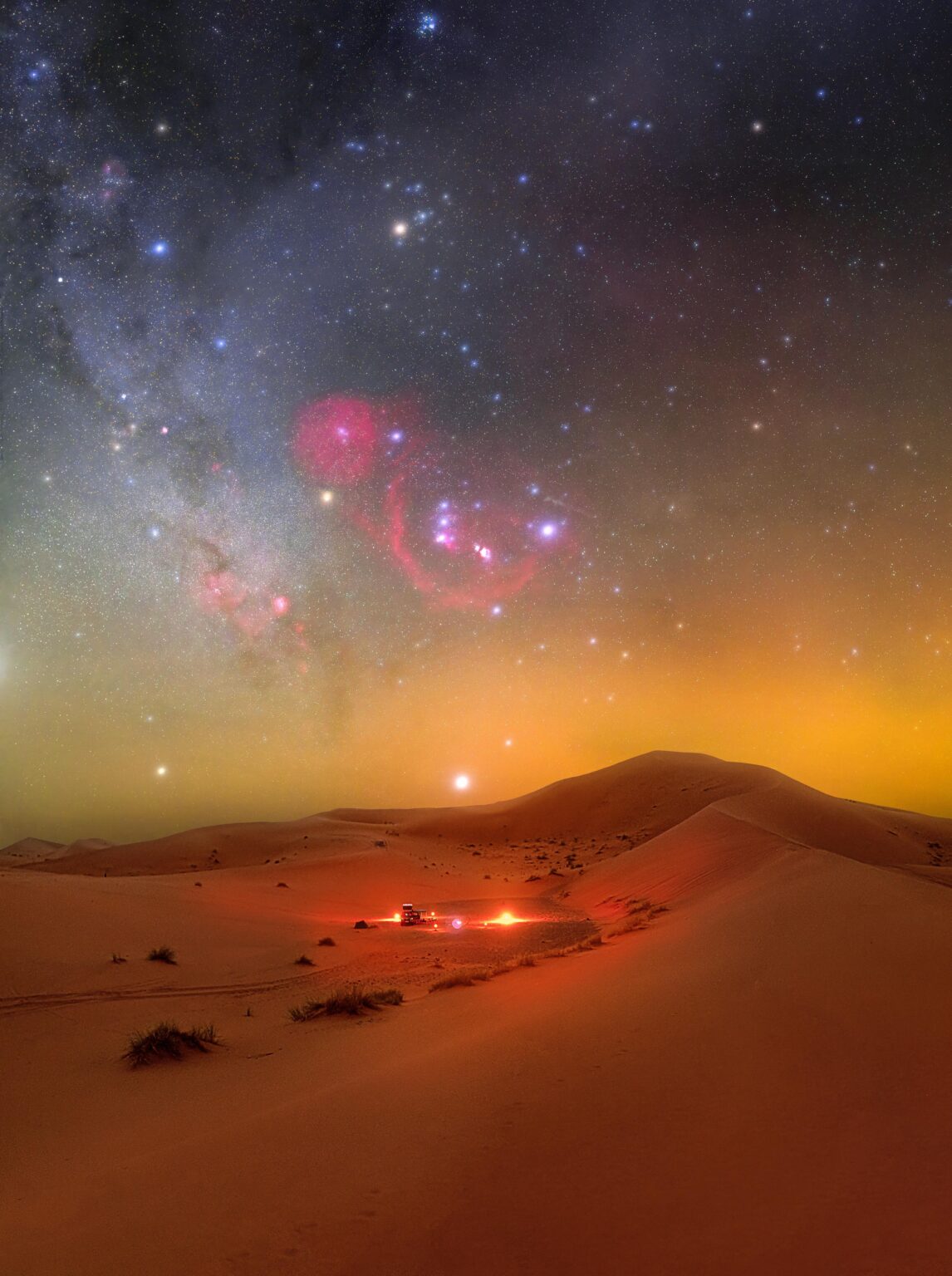
I shot this picture in the eastern part of Morocco, near the Algerian border, during an astrophotography trip. The sky there was extremely pure, with absolutely no light pollution (Bortle 1). The only visible light was a small glow coming from a distant military base, hundreds meters or kilometers away.
This shot was taken during the second night of my trip. We reached this desert by 4×4, driving off-road through remote landscapes, and found the perfect place to set up camp at the bottom of a huge dune. The scenery was truly amazing.
In this picture you can see the Orion constellation, also called Amanar by Amazigh people (local communities). It is also written as ⴰⵎⴰⵏⴰⵔ
The panorama was captured with a 35 mm lens. It is made of 11 tiles for the sky and 6 for the foreground.
Each tile of the sky consists of a stack of two pictures with 30 second exposures, plus another 30 second exposure using a glow filter. Depending on the area of the sky, I also captured additional frames with an Ha filter to bring out the red nebulae. I used an equatorial mount to be able to track the sky with the 35mm lens without star trails.
As a riminder : with the naked eye, the sky looks very different from what the camera captures. You can clearly see the shape of Orion and some of the brighter nebula regions as soft, faint glows, but not the deep reds or the detailed structures. The colors only appear through long exposures, because the sensor is far more sensitive than our eyes. Still, even without the vivid colors, standing under a Bortle 1 sky is an unforgettable experience, with the Milky Way stretching overhead and the constellations shining with incredible clarity.
—-
📷
Canon 6D (astro-modded) – Skywatcher Star Adventurer – Sigma ART 35mm
Settings: ISO 2500– f/1.8 – 30s
JoeBhoy69 on
Forgive my ignorance, but what is the more faint larger red cloud around Orion’s Belt?
milliwot on
Beautiful photo and nice description. Thanks!
geospacedman on
Tell those idiots down there to turn their lights off 🙂 Amazing pic, I’ve been out in the southern Moroccan desert and in Oman and the skies are alive. I’ve never really seen constellations look so much like their characters. Everyone should see skies like that and be humbled.
UnionFeatures on
This is absolutely stunning.
hondashadowguy2000 on
No it’s not. Thats what Orion looks like when photographed with professional equipment, and edited/processed heavily.
SundayJan2017 on
Ethereal. This is a place worth resting one’s soul.

7 Comments
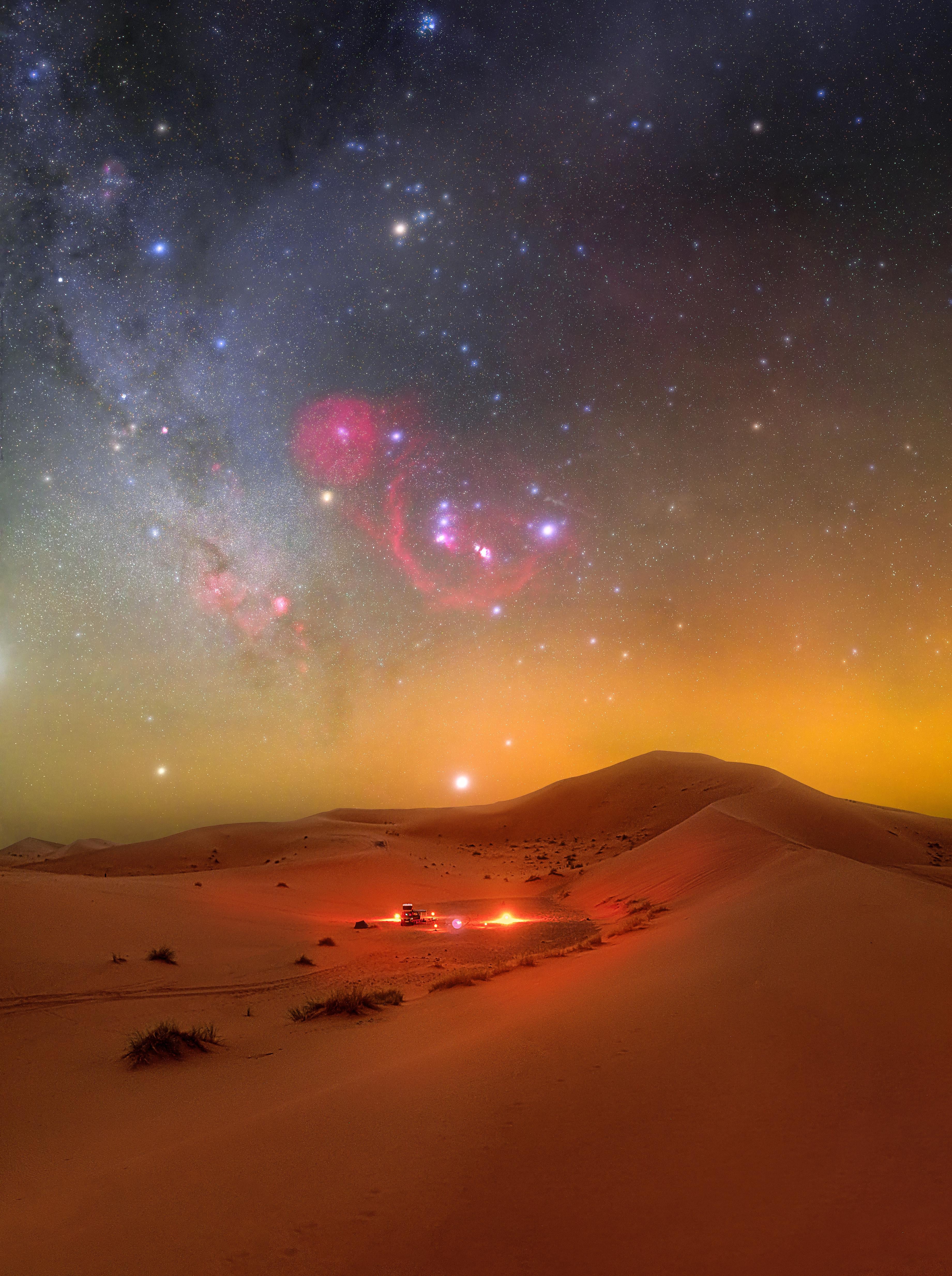
I shot this picture in the eastern part of Morocco, near the Algerian border, during an astrophotography trip. The sky there was extremely pure, with absolutely no light pollution (Bortle 1). The only visible light was a small glow coming from a distant military base, hundreds meters or kilometers away.
If you’re interested, you can find more of my work on [Instagram](https://www.instagram.com/tinmar_g/).
This shot was taken during the second night of my trip. We reached this desert by 4×4, driving off-road through remote landscapes, and found the perfect place to set up camp at the bottom of a huge dune. The scenery was truly amazing.
In this picture you can see the Orion constellation, also called Amanar by Amazigh people (local communities). It is also written as ⴰⵎⴰⵏⴰⵔ
The panorama was captured with a 35 mm lens. It is made of 11 tiles for the sky and 6 for the foreground.
Each tile of the sky consists of a stack of two pictures with 30 second exposures, plus another 30 second exposure using a glow filter. Depending on the area of the sky, I also captured additional frames with an Ha filter to bring out the red nebulae. I used an equatorial mount to be able to track the sky with the 35mm lens without star trails.
As a riminder : with the naked eye, the sky looks very different from what the camera captures. You can clearly see the shape of Orion and some of the brighter nebula regions as soft, faint glows, but not the deep reds or the detailed structures. The colors only appear through long exposures, because the sensor is far more sensitive than our eyes. Still, even without the vivid colors, standing under a Bortle 1 sky is an unforgettable experience, with the Milky Way stretching overhead and the constellations shining with incredible clarity.
—-
📷
Canon 6D (astro-modded) – Skywatcher Star Adventurer – Sigma ART 35mm
Settings: ISO 2500– f/1.8 – 30s
Forgive my ignorance, but what is the more faint larger red cloud around Orion’s Belt?
Beautiful photo and nice description. Thanks!
Tell those idiots down there to turn their lights off 🙂 Amazing pic, I’ve been out in the southern Moroccan desert and in Oman and the skies are alive. I’ve never really seen constellations look so much like their characters. Everyone should see skies like that and be humbled.
This is absolutely stunning.
No it’s not. Thats what Orion looks like when photographed with professional equipment, and edited/processed heavily.
Ethereal. This is a place worth resting one’s soul.