
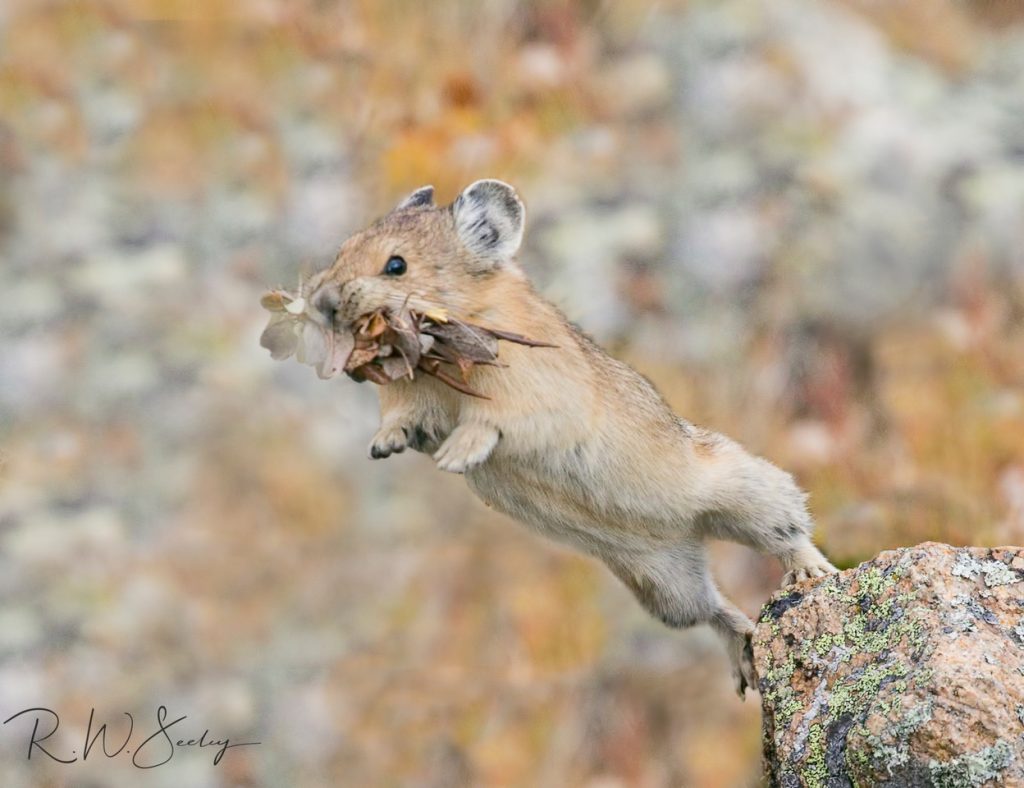
 A pika leaps from a rock while carrying a load of plants in Summit County. A University of Colorado study published in a peer-reviewed journal on Oct. 31, 2025, found that juvenile pika recruitment has declined by over 50% at a long-term research site near Rocky Mountain National Park. The lead author of the study said that the findings raise further concerns about the impacts of climate change on pikas.
Richard Seeley/Courtesy photo
A new study by the University of Colorado Boulder adds to growing concerns that one of the Rocky Mountains’ most iconic species — the American pika — may be disappearing as a result of climate change.
Pikas are small, fluffy, mountain-dwelling mammals that live in talus — or slopes of broken rocks — above the tree line. The beloved creatures are known for greeting hikers in the Colorado High Country with loud squeaks.
“They’re so conspicuous. When we’re out in the mountains hiking, we hear pika calls, and it really enriches our experience,” said Chris Ray, the lead author of the study. “We don’t want to see them disappear from the landscape.”
Researchers have studied pika populations at the Niwot Ridge Long Term Ecological Research site, which Ray described as an “absolutely gorgeous” location about 10 miles south of Rocky Mountain National Park, since the 1980s. To analyze long-term trends in the pika population, the new study integrated historical data with more recent data collected through 2020.
Published in the peer-reviewed journal Arctic, Antarctica, and Alpine Research last month, the study found that juvenile pika recruitment has declined dramatically — over 50% — in the past 40 years at the research site. In other words, according to researchers, this pika population is becoming dominated by older adults, with fewer juvenile pikas born or migrating to take their place.
Ray said she and her colleagues can’t yet pinpoint the reason pika recruitment may be declining at this site, but summers have been growing warmer at sites in the Rocky Mountains.
“Climate variables have always been important in explaining the range of American pikas,” Ray said. “So, we can learn about the places that are experiencing changes in climate by studying pikas.”
Pikas are a useful “indicator species” because they are easy to locate anywhere they are found and the species lives exclusively in the cryosphere — the region of the earth’s surface where water is in the form of ice or snow, Ray said.
Several previous studies have shown that pika populations have declined in recent decades, Ray said. Because pikas are adapted to the cold and sensitive to heat, scientists believe that global warming is driving the species’ decline.
One 2016 study compared species distribution models and used projected climate models to predict that pikas could disappear entirely from Rocky Mountain National Park by the end of the century.
Ray said her research team set out specifically to understand whether long-term data would refute or support that prediction.
“We can’t refute this prediction of loss of pikas from Rocky Mountain National Park this century,” she concluded.
For pikas, Ray said the two most important variables for survival are overwinter snow cover and summer temperature — both of which are impacted by climate change.
Snow cover is important because it helps insulate the talus where the pikas live and helps keep temperatures suitable for pikas. If the snowpack is thin, it would be much colder and inhospitable for pikas.
Summer temperatures matter because pikas are very sensitive to the heat. To survive in the summer, pikas cool down among the rocks of talus, where temperatures are colder.
When juvenile pikas are between about three and 12 months old, they have to find their own territory, Ray said. If there is no space in the talus field where the pika was born, it has to migrate to another talus field where there is space — a process known as “recruitment.”
Genetic studies have previously shown that when searching for a new talus field, juvenile pikas only travel a few kilometers from the talus field where they were born, Ray said. Research has also shown that it is more difficult for these small animals to cross south-facing slopes — where the sun’s heat is stronger — and lower elevations, where it is warmer.
“So they’re kind of moving randomly across the landscape and some of them are going to have to traverse warmer areas,” Ray said. “That’s difficult for pikas because they’re very sensitive to heat exposure, even to temperatures that are quite comfortable to us.”
Ray said rising temperatures, which scientists agree are caused by burning fossil fuels that release greenhouse gases and trap heat in the atmosphere, is influencing climate patterns across the globe — including in Colorado.
Statewide, annual average temperatures warmed by 2.3 degrees Fahrenheit from 1980 to 2022, and are expected to rise another 1 to 4 degrees by 2025, according to a Climate Change in Colorado report published by the state government.
Niwot Ridge has not seen a loss in snow cover as a result of climate change, although other places in the West have. Ray said the site has experienced a clear pattern of warming, with recent years being significantly warmer than previous decades.
“A more sinister problem is, if pikas disappear from the landscape it could be that the other resources that taluses are harboring are also disappearing,” Ray said. “That would be our permafrost and our seasonal ice. If that stuff disappears, that means that we’ll have trouble filling our reservoirs near the end of our summer season, so this is a big deal for humans.”