
Eurostat data published on December 1st show that over the decade from 2013 to 2023, Latvia increased its electricity generating capacity and reduced the amount of electricity it consumes.
During the period covering 2013 to 2023, there was a decrease of 4.9% in the level of EU net electricity generation. The largest overall increases were registered in Lithuania (28.2%), Croatia (24.5%) and Cyprus (23.5%) but Latvia too recorded an increase.
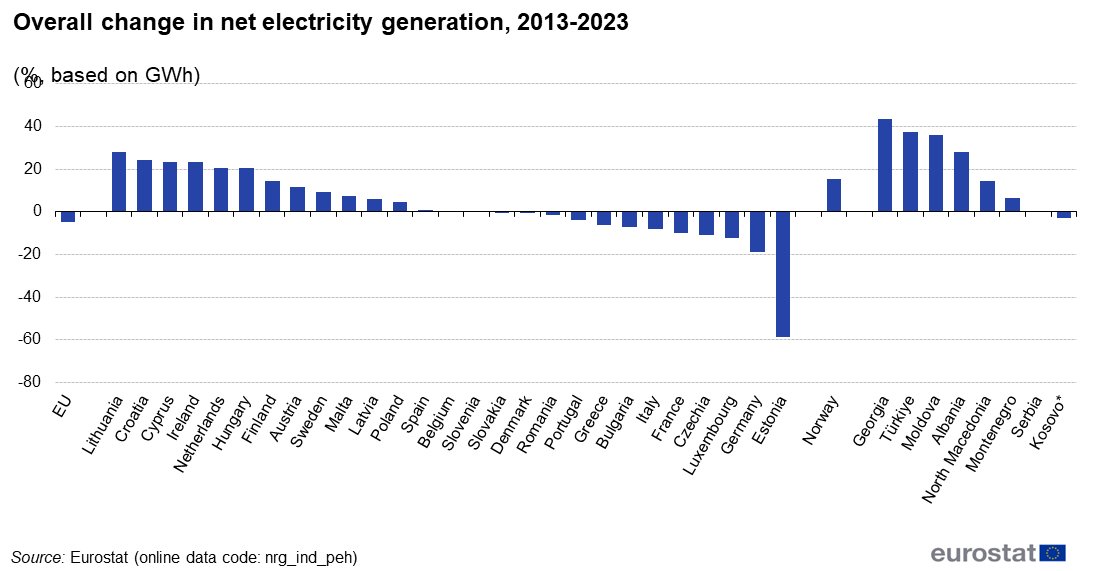
Electricity generation 2013-2023
Photo: Eurostat
Interestingly, between 2022 and 2023, the largest annual increase in electricity generation was recorded for Latvia (27.8%). At the other end of the scale, the largest reduction was observed in Estonia (-34.8%).
During the 10-year period from 2013 to 2023, the consumption of electricity by households decreased in the EU by 3.3%.
Electricity consumption by households rose at a much faster rate than the EU average between 2013 and 2023 in Malta (where the overall increase was 63.6%), while an increase of 26.3% was recorded in Lithuania and 24.2% in Slovakia. At the other end of the scale, household electricity consumption fell in 3 of the EU countries by a double digit percentage (Belgium -17.4%, Greece -13.3% and Sweden -10.3%). Latvia was not far behind with a fall of around 8%.
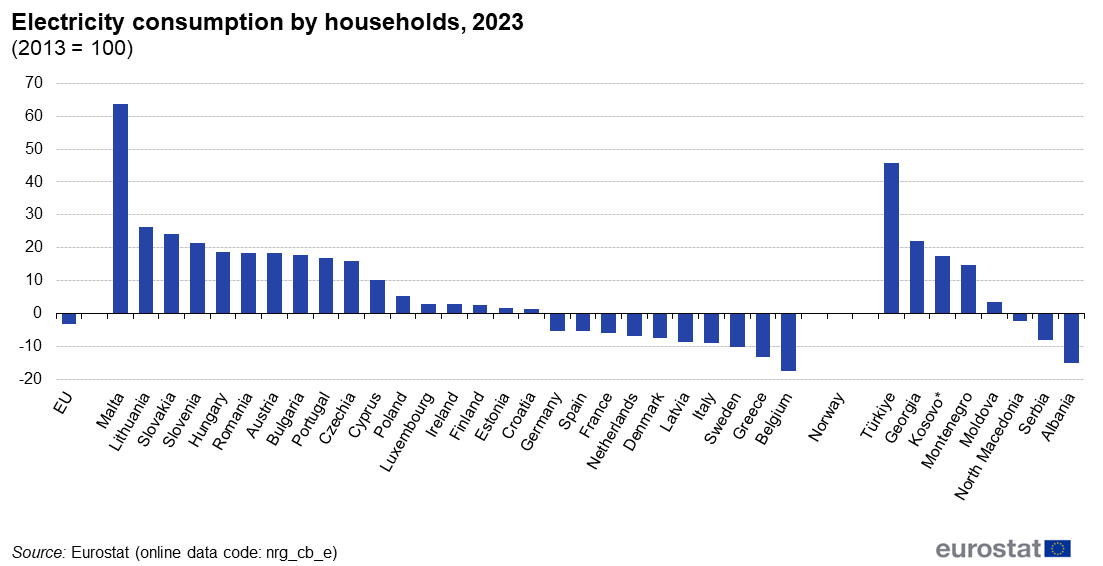
Electricity consumption by households, 2023
Photo: Eurostat
“These figures on overall household electricity consumption are likely to be influenced, in part, by the average number of persons living in each household and by the total number of households, both of which are linked to demographic events. Other influences include the extent of ownership and use of electrical household appliances and consumer goods as well as the use of energy saving devices,” said Eurostat.
Select text and press Ctrl+Enter to send a suggested correction to the editor
Select text and press Report a mistake to send a suggested correction to the editor
Tell us about a mistake