
![[OC] Total Damages Overview vs Tax Revenue in Germany](https://www.byteseu.com/wp-content/uploads/2025/12/nrokqe9opt4g1-1536x1149.png "[OC] Total Damages Overview vs Tax Revenue in Germany")
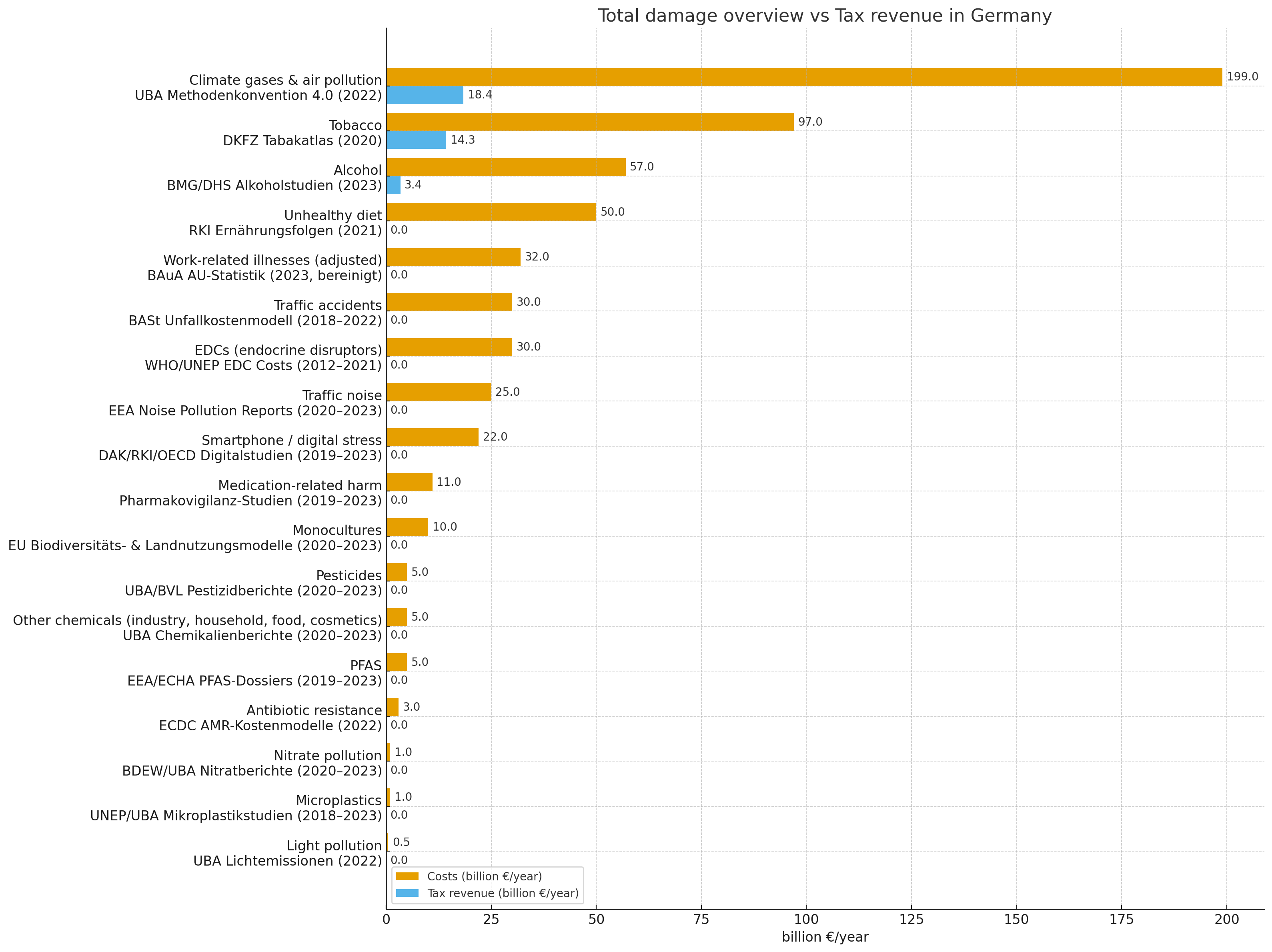
The chart shows the annual external damage costs of major health- and environment-related risk factors in Germany, compared with their related tax revenues (where applicable).
Key insights
Climate gases & air pollution produce by far the highest annual damage costs (€199 bn), with moderate tax revenue (€18 bn).
Tobacco causes ~€97 bn in costs, while generating ~€14 bn in tax revenue — meaning damages exceed revenues by a factor of about 7.
Alcohol causes ~€57 bn in damages versus ~€3 bn in tax revenue.
Unhealthy diet, work-related illnesses, traffic accidents, endocrine disruptors, digital stress, medication harms, and several environmental pollutants also contribute substantial costs.
Many categories (e.g., PFAS, pesticides, microplastics, noise, nitrate) generate no tax revenue at all, meaning the burden falls fully on society.
Only a few categories have significant tax revenue, and even for those, revenues are dramatically lower than the societal damages.
Overall conclusion:
Across all categories, external damages vastly exceed related tax revenues — showing a large economic imbalance between societal costs and the government’s fiscal intake from harmful products or activities.
Full List of Sources Used in the Dataset
Below is the complete list of sources exactly as they appear in your dataset:
UBA Methodenkonvention 4.0 (2022)
DKFZ Tabakatlas (2020)
BMG/DHS Alkoholstudien (2023)
RKI Ernährungsfolgen (2021)
BAuA AU-Statistik (2023, bereinigt)
BASt Unfallkostenmodell (2018–2022)
WHO/UNEP EDC Costs (2012–2021)
EEA Noise Pollution Reports (2020–2023)
DAK/RKI/OECD Digitalstudien (2019–2023)
Pharmakovigilanz-Studien (2019–2023)
EU Biodiversitäts- & Landnutzungsmodelle (2020–2023)
UBA/BVL Pestizidberichte (2020–2023)
UBA Chemikalienberichte (2020–2023)
EEA/ECHA PFAS-Dossiers (2019–2023)
ECDC AMR-Kostenmodelle (2022)
BDEW/UBA Nitratberichte (2020–2023)
UNEP/UBA Mikroplastikstudien (2018–2023)
UBA Lichtemissionen (2022)
Posted by LuigiMederti
9 Comments
Looks like they need to about 12x their taxes to be climate neutral.
So I guess that would mean the average german pays around 350% tax.
This methodology is clearly terrible and designed to push an agenda. For instance, it is obviously untrue that Germany gets zero tax revenue from pesticides or smartphones, considering it collects at a very minimum the 19% VAT on sales of these products. That calls into question literally everything else about the calculations, which appear to be just sublimated whining instead of an honest attempt to address costs and benefits (e.g. traffic noise has costs, but is also necessary if you don’t want society to grind to a halt).
I’m curious so I appreciate you posted the sources.
After a first look at some of those studies I can confidently say that there are German words in them.
;D
If you already invest this much time into creating a graph and doing all the research, at least try to formulate your own conclusions without using ChatGPT 😛
Mal frei mit ai übersetzt:
For a more realistic representation, it should be taken into account that in Germany there are no earmarked taxes. The societal costs are certainly well illustrated here, but they are offset by revenues from the respective industries.
For example, the costs arising from monocultures, pesticides, and nitrate pollution can be contrasted with the value-added tax revenues from agriculture. In the case of unhealthy diets, revenues from the food industry and retail trade, and perhaps even from gastronomy, would need to be considered.
Of course, it would be desirable for every company and every individual to pay levies corresponding to the societal costs they cause. With wastewater charges and waste disposal fees, this is already partially in place. At present, however, there is little political interest in implementing this more broadly, and due to the complexity of the issue, it is difficult to put into practice.
Note how nuclear power isn’t on the list, yet was the one that had to go first.
Okay, raise those taxes and eliminate ones that have no damage, such as income tax, property tax, capital gains tax, etc.
Tax unhealthy diet and traffic accidents immediately, they can’t get away with it!
We need to tax income and investment less, and pollution more.