
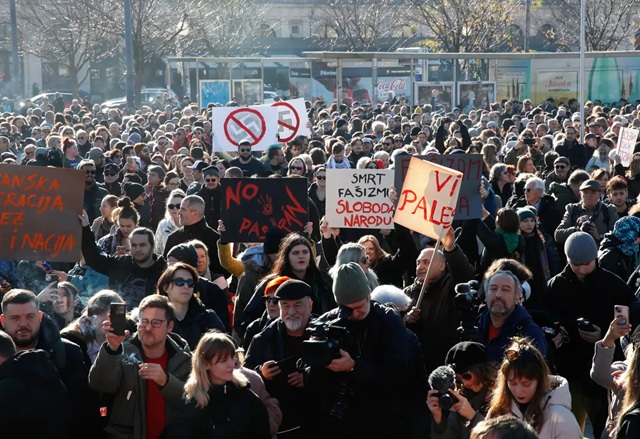
Thousands of Croats gathered on November 30, 2025, to join protest marches in Croatia against a surging far right, following a series of incidents that have fuelled both ethnic and political tensions in the European Union country. Demonstrations under the banner “United against fascism” drew crowds in four major cities: the capital Zagreb, Rijeka, Zadar, and Pula. Protesters chanted in unison, “We are all antifascists!” and demanded authorities curb far-right groups using pro-Nazi Ustaše or Ustasha symbols from Croatia’s World War II regime, which operated concentration camps killing tens of thousands of Serbs, Jews, Roma, and antifascist Croats. Journalist Maja Sever addressed the Zagreb rally, warning of dangers to democracy and vowing to fight for it. A protest declaration stated: “We will not agree to treating national minorities as a provocation and to an idea of patriotism that draws its symbols from the darkest episode of our history.”
The crisis erupted following a series of disturbing incidents starting on November 3, 2025, in Split, where around 50 masked hooligans, a majorly from Hajduk Split’s Torcida fan group, dressed in black, stormed the Serbian Cultural Center, shouting Ustaše salutes like “Za dom spremni” (“For the homeland – ready”) and forcing the cancellation of a youth folklore and theatre performance by Novi Sad’s Prosvjeta (Education) society to launch the Days of Serbian Culture festival; no injuries occurred, but nine suspects were arrested for violent behaviour and violating freedom of expression, prompting a Torcida protest on November 8. On November 7, in Zagreb, dozens to a hundred masked men in black gathered outside the Serbian Cultural Center, chanting “Croatia, an independent state” and Ustaše slogans, while threatening and insulting Serbs during the opening of an exhibition on art historian Dejan Medakovic, until police dispersed them without major violence. Further, Croatian political circles requested the cancellation of the “Serbian Women” exhibition in Vukovar, scheduled for November 11, dedicated to the role of Serbian women in the First World War. These attacks, alongside multiple incidents targeting liberals, have alarmed many as they rekindled fears of ethnic violence decades after the Serb-Croat war of the 1990s (1991-1995).
The significance of this protest is rooted in the historical context of Croatia’s turbulent 20th-century history. During World War II, Croatia was ruled by the Independent State of Croatia (NDH), a fascist regime led by the Ustaše movement under Ante Pavelic. The NDH allied with Nazi Germany and Fascist Italy and pursued brutal policies of ethnic cleansing and genocide against Serbs, Jews, Roma, and antifascist Croats, operating concentration camps where tens of thousands were murdered. The far-right’s present use of Ustaše symbols evokes this dark past. The Serb minority’s rebellion and territorial control sparked a conflict with Croatia, claiming over 10,000 lives.
The recent political climate has also led to this potential change, as the conservative government led by Prime Minister Andrej Plenkovic, after the 2024 elections, formed a coalition with a far-right party [Homeland Movement (DP)], excluding an ethnic Serb party (Serb minority party SDSS) from the government for the first time in years. This political shift is seen as a catalyst for rising far-right activity and a tacit tolerance of extremist symbols rooted in the Ustaše legacy. Despite the government’s denial that it was ignoring the extremist surge, protesters argue that far-right groups use pro-fascist symbols freely, spread fear among minorities and silence dissent.
On November 11, 2025, however, in a symbolic step, Zagreb’s municipal assembly adopted a decision banning the use of Ustaša symbols during concerts, rallies and other public events held in facilities managed by the municipality. This decision came amid continuing ideological tensions, which erupted after far-right folk-rock singer Marko Perkovic Thompson held a concert in Zagreb in front of around half a million people in July 2025, which slowly but steadily normalised the public use of pro-fascist symbols, songs, and greetings.
This wave of protests is significant as it marks a unified civil society response to counter both ethnic hatred and historical revisionism. They prove that Croatia’s social cohesion and democratic values, which they embraced upon joining the EU, will not be undermined by ultra-nationalist rhetoric. But, the far-right sentiment remains visible, organised, and capable of confrontation, and the fact that the current government under Andrej Plenkovic has already allied with a far-right party makes any systemic crackdown more difficult. While some symbolic steps like the local ban in Zagreb are being taken, the protests have not produced a comprehensive national-level legal or enforcement response so far. Without broader legislation, prosecutions, or sustained enforcement, extremist groups may continue to operate, limiting how much the protests can disarm them. Worse, there is a risk that the protests and counter-protests deepen polarisation. Far-right groups may use perceived threats to rally supporters, further hardening ideological divides.