
Norway has undertaken one of the most advanced engineering challenges in recent history: a 17-mile twin-tube tunnel that will become the world’s longest and deepest undersea road tunnel once completed.
Skanska AB, a construction firm from Sweden, is currently building the Rogfast tunnel (Rogaland fastforbindelse) under a contract worth approximately USD 495 million (NOK 5 billion), awarded by the Norwegian Public Roads Administration.
The project aims to create a record-breaking undersea route beneath Norway’s rugged coastline, ultimately providing a direct, ferry-free connection between Stavanger and Bergen. Upon completion, the new link is expected to cut travel time between the two cities by up to 40 minutes.
Stretching 16.6 miles (26.7 kilometers) and plunging 1,280 feet (390 meters) below sea level, the tunnel is set to transform transportation across western Norway by creating a faster, more direct undersea link.
Stavanger–Bergen link
Part of the E39 highway, which spans 830 miles through Norway and Denmark, Rogfast will be a crucial component in the region’s infrastructure. It will form an important part of the west coast corridor, which connects major Norwegian cities including Kristiansand, Stavanger, Haugesund, and Bergen.
The tunnel’s construction began in early 2018, but was temporarily halted due to rising costs and contract issues before resuming in late 2021. The project is now on track for completion in 2033, at an estimated cost of NOK 25 billion (USD 2.4 billion).
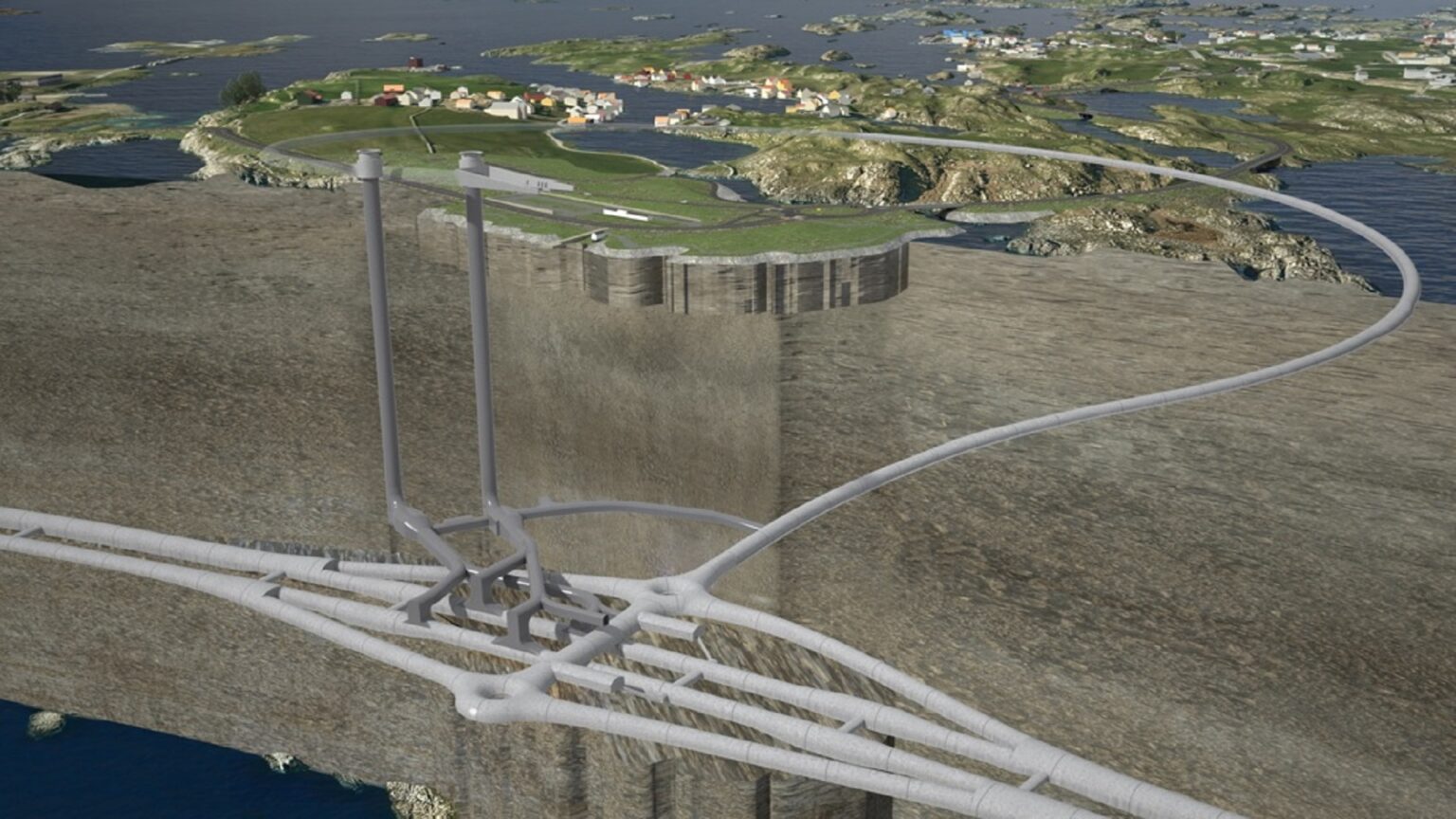
 The tunnel will have two tubes, each with two lanes for road traffic, and will reach a depth of 392 meters below sea level.
Credit: Skanska
Despite the delay, the project still aims to deliver faster travel, better connectivity, and lower emissions along Norway’s coastal corridor. Its design features two parallel tubes. Each carries two lanes of traffic, with cross passages and a central emergency corridor.
About halfway through the tunnel, drivers will encounter a vast underground double roundabout located 853 feet (260 meters) below sea level. It will provide access to the island of Kvitsøy, which is the nation’s smallest municipality.
“The tunnel will significantly improve connectivity along the Norwegian west coast, by creating a faster and more reliable link between the Stavanger and Haugesund regions,” Anne Brit Moen, Skanska’s project manager, told CNN.
Europe’s deepest tunnel
Engineers are using advanced technology to construct the tunnel. This includes laser scanners, which help achieve near-perfect alignment between segments excavated from both ends.
The precision required, within just 1.97 inches (five centimeters), makes Rogfast one of the most exacting tunnel projects ever attempted. These digital scans create a real-time “digital twin” of the tunnel, helping teams detect even the smallest deviations.
Crews working on the Rogfast project face major challenges as they operate deep below sea level under intense pressure and constant risk of saltwater leakage. To keep the tunnel dry and stable, engineers have developed advanced grouting and sealing methods.
Meanwhile, to protect motorists from air pollution, Rogfast will use a longitudinal ventilation system powered by jet fans and supported by a vertical shaft extending to Kvitsøy. Completion is not expected before 2050.
“We are now 984 feet (300 meters) below sea level, and we have already had quite extensive saltwater leaks in the tunnel system,” Moen said. “Since we are going all the way down to 1,286 feet (392 meters) below sea level, we’re focusing on finding the best methods to maintain safe and efficient working conditions for everyone.”