
A textbook for the modern prince should indeed contain, in addition to Machiavelli’s classic chapters, extensive new sections on the most efficient use of quotas, exchange controls, capital investment, and other instruments of economic warfare.
A response to the past few years of economic warfare between China, the U.S., Europe, and Russia? No—from Albert Hirschman’s classic 1945 book National Power and the Structure of Foreign Trade.
Many analysts (myself included) have written about the new age of economic warfare. Yet the use economic tools as political levers is of course not new. I’ve been rereading some classics from the 1930s and 1940s, when the allies thought the Germans were using trade dependency to subjugate Eastern Europe. The Germans, for their part, saw pursuit of Lebensraum as a means to avoid potential economic asphyxiation by the Royal Navy.
Some representative titles from the period were Antonin Basch’s The New Economic Warfare and Paul Einzig’s Bloodless Invasion, which argued that Eastern European countries’ political dependence on Germany stemmed from their trade dependence on it.
Hirschman set out to analyze what conditions were necessary for economic warfare to work. Some of his conclusions remain highly relevant. He quoted Adam Smith that “defence is of much more importance than opulence,” while noting that mainstream Anglo-American economists of the 1930s struggled to implement power politics into their theories, not unlike economists today. Yet both the newly industrialized powers like Germany and smaller or poorer agrarian countries all seemed to think trade and politics were inevitably intertwined.
The Germans worried about access to raw materials. Hirschman quoted one German economist describing the “terror of becoming a predominantly industrial state”—terrifying because it implied reliance on imported food and minerals, and thus reliance on maritime supply chains that the Royal Navy policed. Agricultural protection and farm subsidies were therefore a form of geopolitical insurance.
Smaller ag exporters also found it impossible to disentangle trade from politics, because they were small and needed export market access. Hirschman writes: “The concentration of exports has a tendency to be stronger—and often markedly stronger—than the concentration of imports.” This mattered for ag exporters because he believed it would be relatively harder for them to find new export markets if they were cut off.
Hirschman noted: “New Zealand butter, Philippine sugar, and Bulgarian tobacco were not, in general, marketed in ‘industrial countries,’ but they were very specifically marketed in England, The United States, and Germany.” Smaller countries in generally found it harder to adjust: “Not only is it more difficult for Bulgaria than for Germany to shift trade, but it is also harder for Bulgaria to dispense entirely with the trade conducted with German, because this trade is much more ‘essential’ to her.”
Why were export markets harder to shift than import markets? I’m not sure. Hirschman argues this an empirical fact. He also notes, accurately, that the economists who assume free trade, take no account “of the time which is involved in changing the productive structure.” In other words—elasticities are determinants of political power. Whichever party has higher elasticity can adjust faster and more effectively exert political influence by cutting off trade.
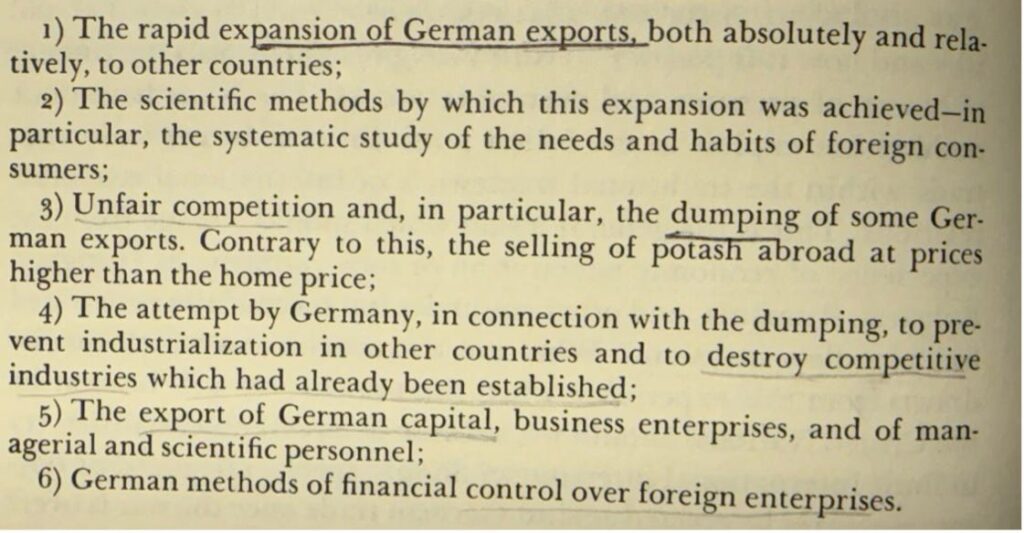
Hirschman and others believed that Germany tried to instill long-term dependence by preventing agrarian countries from industrializing.
A country trying to make the most out of its strategic position with respect to its own trade will try precisely to create conditions which make the interruption of trade of much graver concern to its trading partners than to itself…
Germany could never have hampered or prevented the industrialization of the Danubian countries if she had not had an initial political and economic ascendancy over them, and the prevention of industrialization in turn served to enhance or maintain Germany’s initial power position.
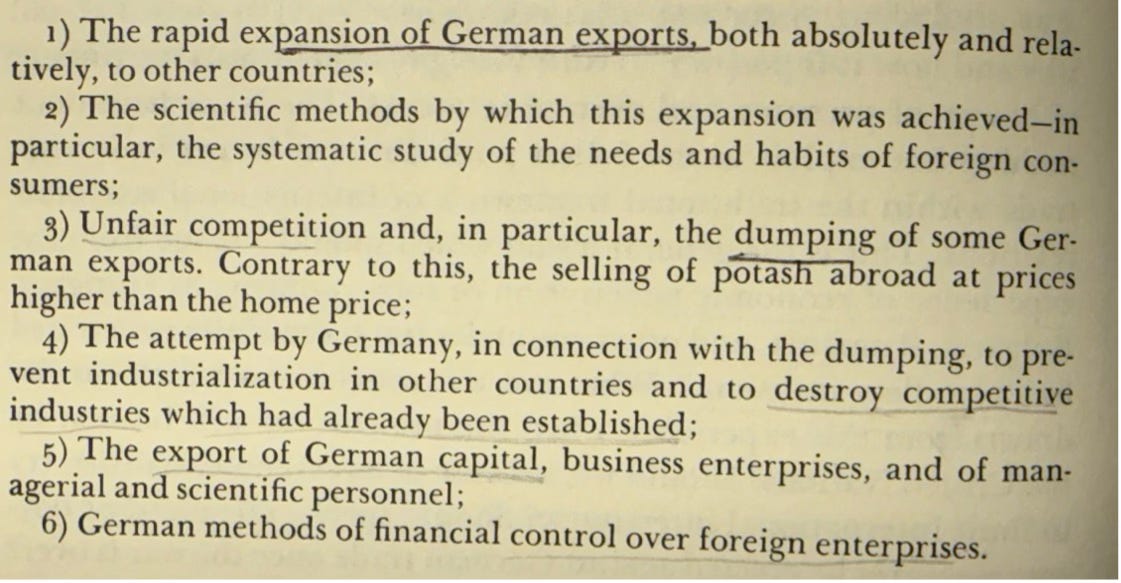
Hirschman noted Italy’s WWI-era debate about how Germany allegedly undermined Italian industrialization, eg by buying Italian banks and funneling Italian savings into German firms rather than Italian ones. I hadn’t fully connected this debate from early 20th century Europe with the “dependencia” thesis in 1970s Latin America. I now see a direct through line to today’s debate in India and Southeast Asia about ways Chinese policy undermines their own industrialization efforts. Here’s Hirschman’s list of how Germany undermined Eastern Europe’s industrialization:
Was the economic warfare of the 1930s effective? Hirschman dismissed the optimists from Montesquieu to Norman Angell who believed that interdependence inevitably guaranteed peace, never stopping to ask who was more dependent on whom. Yet Hirschman also noted that dependence was as much a political as an economic dynamic—and the political magnitudes were hard to measure. “The ability to inflict deprivation is more easily quantified than the willingness to accept it for the sake of, say, freedom from domination,” he noted.
What was to be done? For security of supply, Hirschman noted, there were three methods that would allow continued foreign trade, at least with friends.

Option number 3 would today be called “friendshoring.”
A second approach, which he attributed to German economist Herbert Wergo, was “the division of the national economy into two parts, a protected one, considered as ‘essential,’ and a free part, the aim of which would be to secure a cheap and plentiful supply of nonessential goods.’” This raises the question of what is “essential”—the 1930s version of the debate about what belongs in the “small yard” surrounded by a “high fence.”
For an industrial economy in the 1930s—as agriculture rapidly receded as a share of GDP—it was increasingly possible to fund generous farm subsidies to enable food self-sufficiency. My colleague Joseph de Weck has asked whether today’s service-heavy economies may choose to subsidize manufacturing like we subsidized ag a century ago.
Hirschman saw two main challenges to the implementation of such “economic security” policies. (Interestingly, he didn’t focus on the potentially high cost.) First was a “commercial fifth column” domestically that would undermine political consensus—something we also see today. Second, “economic defense….is very often indistinguishable from economic warfare.” This posed the risk of an economic security dilemma spiral that students of escalation dynamics in the military sphere would immediately recognize.
Thinking about the post-WWII era, Hirschman thought the allies could return to free trade so long as they controlled the commanding heights of the industrial economy. He wrote:
The crucial importance of gasoline as a raw material, of the airplane as a weapon, and of the machine-tool industry as the industrial basis of modern warfare points to the possibility that a gith control in a few strategic points within a country’s economy might paralyze its power to prepare for war without impairing its capacity to produce for the purposes of civilian consumption.
What would a similar list look like today? Semiconductor manufacturing would certainly be one.
What would it require to depoliticize foreign trade, and prevent the Germans from exercising dominance over Eastern Europe?
1) The complete autonomy of national commercial policies must be effectively limited…[not only] impacting a few restricted fields of action, but the whole of international economic relations; 2) the institutional framework of foreign trade (consular services, champers of. Commerce, import-and export banks…etc) must be drafted on international or supranational lines.
This was, very roughly, what the trade deals between the US, Europe, and Japan in the postwar period aimed at. Hirschman noted that centrally planned economies would struggle to commit to such deals (as indeed China’s state directed credit system has.)
A lot of this analysis is still relevant. What is different now? First, Hirschman’s belief in the “greater difficulty which is generally experienced in diverting exports,” no longer seems right. China has had no difficulty thus far at diverting exports or rerouting via Southeast Asia. The U.S., China, Japan, and Europe are far more concerned about access to specialized imports, whether chips, batteries, or magnets.
This speaks to the second key difference: Hirschman’s world was defined by raw material production in some countries and industrial production in others. There were no supply chains and no countries that specialized in intermediate goods. National Power and the Structure of Foreign Trade was a reasonable title for a book in the 1940s. Today’s version would need a different title: National Power and the Structure of International Supply Chains.
Read more here.