
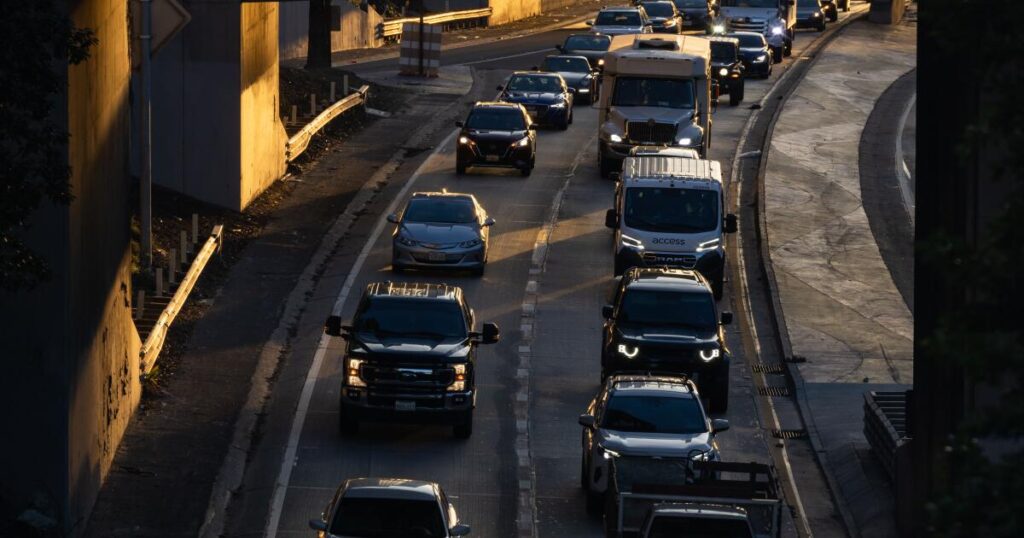
President Trump on Wednesday announced a proposal to weaken vehicle mileage rules for the auto industry, loosening pressure on automakers to control pollution from gasoline-powered cars and trucks.
The plan, expected to be finalized next year, would significantly reduce fuel efficiency standards for new vehicles in model year 2031.
At that time, the average for new light-duty vehicles would be roughly 34.5 miles per gallon. Under Biden, automakers would have been required to average about 50 miles per gallon of gas for light duty vehicles by 2031. That compares with about 39 miles per gallon today.
The proposal could enable carmakers to manufacture and sell larger, heavier and less fuel-efficient vehicles across the country — including in California. Although the state has been allowed to regulate vehicle tailpipe emissions, it cannot set fuel economy standards — the distance a car can drive on a gallon of fuel.
Under the Trump plan, vehicles are likely to produce more planet-warming carbon emissions and air pollution, making it increasingly difficult for California policymakers to reduce smog in Los Angeles and take action to stave off severe climate change.
In a news conference Wednesday, Trump joined several executives from Ford, General Motors and Stellantis in the Oval Office, saying the proposal will allow car companies to produce more affordable cars and give consumers a broader choice of gas-powered models.
“Today, my administration is taking historic action to lower costs for American consumers, protect American auto jobs and make buying a car much more affordable for countless American families,” Trump said. “We’re officially terminating Joe Biden’s ridiculously burdensome, horrible … standards to impose expensive restrictions and all sorts of problems to automakers.”
“Donald Trump is handing his Big Oil campaign donors even more opportunities to screw over Americans at the pump and poison our air,” Gov. Gavin Newsom wrote on X. “Strong fuel economy standards save Californians money and protect our health, and we’ll fight tooth and nail to defend them.”
When the Clean Air Act passed more than half a century ago, California already had its own air pollution-fighting efforts. So it became the only state with the authority to adopt tailpipe pollution more stringent than the federal government. For years, California — and a bloc of Democrat-led states that has chosen to follow its regulations — has influenced the lineup of vehicles manufactured and sold by American automakers.
This move is the latest action by the Trump administration to eliminate this influence and reverse Biden-era policies that encouraged cleaner-running cars and trucks, including electric vehicles. Burning gasoline for vehicles is a major contributor to planet-warming greenhouse gas emissions.
Since taking office in January, Trump has relaxed auto tailpipe emissions rules, repealed fines for automakers that do not meet federal mileage standards and terminated consumer credits of up to $7,500 for EV purchases. Trump’s “One Big Beautiful Bill” also effectively eliminated financial penalties levied against car companies that fail to comply with federal fuel economy standards.
Earlier this year, Trump signed a law that invalidated California’s pace-setting zero-emission vehicle requirements that would’ve effectively banned the sale of new, gas-powered cars in California by 2035.
In September, the California Air Resources Board voted to reinstate auto emission standards that are more stringent than federal standards — in hopes of preventing carmakers from regressing and putting heavier-polluting vehicles on the roads.
Rescinding fuel-economy standards will also make Americans more vulnerable to price shocks from gasoline and diesel. As this fuel is burnt, it releases the pollutants that harm public health and contribute to climate change, said Jason Schwartz, legal director at the Institute for Policy Integrity at NYU School of Law, in a statement.
He noted that the most recent fuel-economy standards finalized by the National Highway Traffic Safety Administration last year were projected to save consumers more than $80 billion in fuel costs and reduce more than $125 billion in climate change damages.
The proposed repeal “will further pinch the wallets of consumers who are already stretched thin,” Schwartz said.
Experts say the latest decision could further complicate California’s ambitious targets to reduce greenhouse gases and adopt electric vehicles, as well as its considerable progress on air quality and pollution.
Kathy Harris, director of clean vehicles at the Natural Resources Defense Council, said automakers could meet the more stringent miles-per-gallon standards set by the Biden administration even without EVs, just by making gasoline and hybrid vehicles more efficient. She rejected the argument from some automakers who say stronger fuel-economy requirements raise prices for consumers, and said it is reminiscent of when the industry fought against new seatbelt regulations in the 1960s.
“History proves the opposite,” she said. “Strong regulations don’t increase costs. They will cut fuel bills and deliver real benefits for drivers across the country.”
But Ford CEO Jim Farley said in a statement Wednesday that the planned rollback was “a win for customers and common sense.”
“As America’s largest auto producer, we appreciate President Trump’s leadership in aligning fuel economy standards with market realities. We can make real progress on carbon emissions and energy efficiency while still giving customers choice and affordability,” Farley said.
Stellantis CEO Antonio Filosa said the automaker appreciates the administration’s actions to “realign” the standards.
The Biden administration was increasing fuel-economy requirements 2% each year for light-duty vehicles from 2027 to 2031, and 2% per year for SUVs and other light trucks from 2029 to 2031. At the same time, it called for stringent tailpipe rules meant to encourage EV adoption.
The auto industry has complained that both Biden-era rules were difficult to meet.
Mileage rules have been implemented since the 1970s energy crisis, and after a 20-year period without progress, automakers have been gradually increasing their vehicles’ average efficiency.
The Trump administration’s actions could also result in a return to smoggier conditions for the Golden state, according to Will Barrett, assistant vice president for nationwide clean air policy at the American Lung Assn. While the standards set under the Biden administration were designed to make vehicles more efficient, they also had the benefit of reducing harmful emissions.
“Ultimately, weaker standards will translate to more unhealthy emissions from the vehicle sector, and that’s a major challenge for California and its ability to continue to protect the progress we’ve made through clean vehicle standards,” Barrett said.
The Associated Press contributed to this report.