its silly to think we have arrived at absolute truths. everything is just theories and a general model consensus that fits those theories at the time. humans once believed the heavens were static and permanent. we spent a long time with models that thought that everything orbited the earth.
we very likely will go through quite a few more revolutions that completely redefine the models we use to understand the universe.
Rob-Top on
We tend to make up rules to fit the current theroy, Einstein did it and we have done it with inflation to fit the standard model. I think we are in an exicting time, we could get the next Einstein from it, although I think now it’s more teams than individuals taking the credit
notveryamused_ on
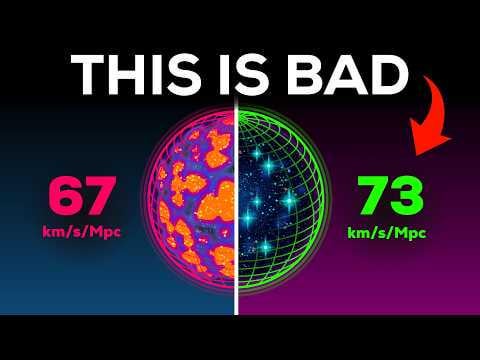
I really love their videos, especially the ones on space, but this one seemed a bit… undercooked? From the somewhat clickbaity beginning (this is simply how science works…) to the essence of the problem, which was left only hinted at – every time I got excited they immediately changed the subject lol. I’d love it to be much more in-depth actually.
jethroguardian on
It seems pretty clear that the less precise supernova results are very likely also the less accurate method. Results are out that show when accounting for galaxy age and rotation in GR models, the supernova results lower into agreement with the others, but they seem pretty new. I expect it’ll be a few years until consensus but it makes sense.
confuzzledfather on
The exciting thing for me is that solving the crisis in cosmology seems like it’s going to have to lead to some pretty fundamental aspect of our understanding of reality to be rewritten, like what it means to measure something, or the constancy of the speed of light, or some such, that promises to leverage open some huge new realm of science previous closed off from us.
Analog_Astronaut on
Science is such a paradox. It’s simultanously used to “prove” that something is correct while also constantly being proven wrong. At one point the scientific consensus among the smartest people on the planet was that the Earth was flat. I wonder what the “flat earths” of 2025 will be? Can’t wait for people 1000 years from now to laugh at all of us.
ArizonaHomegrow on
Check out the Infinte Universe Theory – Glenn Borchardt. Presents an interesting argument that physics is regressed because of Einstein’s rejection of Aether (due to the Michelson-Morley experiment, which was poorly done.) and lead to Untired Light Theory which Borchardt disputes. When you bring Aether back into the equation, reject the Big Bang(a theory that came from a Jesuit priest) and see the universe as Infinte (all directions) then you no longer need special relativity to explain anything.

8 Comments
its silly to think we have arrived at absolute truths. everything is just theories and a general model consensus that fits those theories at the time. humans once believed the heavens were static and permanent. we spent a long time with models that thought that everything orbited the earth.
we very likely will go through quite a few more revolutions that completely redefine the models we use to understand the universe.
We tend to make up rules to fit the current theroy, Einstein did it and we have done it with inflation to fit the standard model. I think we are in an exicting time, we could get the next Einstein from it, although I think now it’s more teams than individuals taking the credit
I really love their videos, especially the ones on space, but this one seemed a bit… undercooked? From the somewhat clickbaity beginning (this is simply how science works…) to the essence of the problem, which was left only hinted at – every time I got excited they immediately changed the subject lol. I’d love it to be much more in-depth actually.
It seems pretty clear that the less precise supernova results are very likely also the less accurate method. Results are out that show when accounting for galaxy age and rotation in GR models, the supernova results lower into agreement with the others, but they seem pretty new. I expect it’ll be a few years until consensus but it makes sense.
The exciting thing for me is that solving the crisis in cosmology seems like it’s going to have to lead to some pretty fundamental aspect of our understanding of reality to be rewritten, like what it means to measure something, or the constancy of the speed of light, or some such, that promises to leverage open some huge new realm of science previous closed off from us.
Science is such a paradox. It’s simultanously used to “prove” that something is correct while also constantly being proven wrong. At one point the scientific consensus among the smartest people on the planet was that the Earth was flat. I wonder what the “flat earths” of 2025 will be? Can’t wait for people 1000 years from now to laugh at all of us.
Check out the Infinte Universe Theory – Glenn Borchardt. Presents an interesting argument that physics is regressed because of Einstein’s rejection of Aether (due to the Michelson-Morley experiment, which was poorly done.) and lead to Untired Light Theory which Borchardt disputes. When you bring Aether back into the equation, reject the Big Bang(a theory that came from a Jesuit priest) and see the universe as Infinte (all directions) then you no longer need special relativity to explain anything.
This sounds like a job for Hari Seldon.