
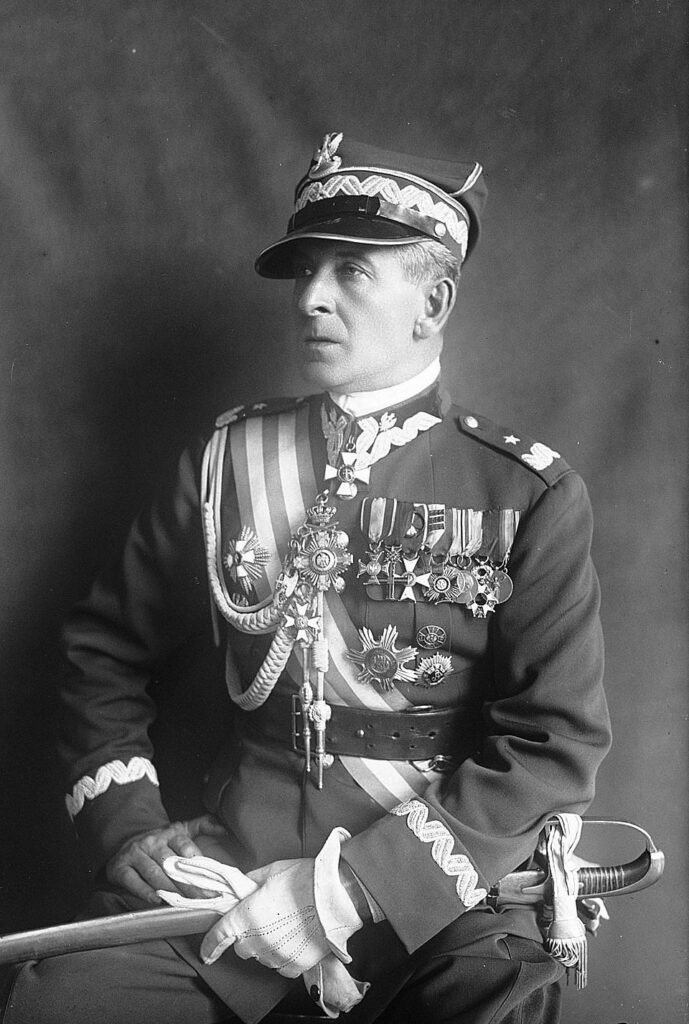
Throughout the interwar years, I was a key figure in Warsaw literary and social life. I had a table reserved at the mezzanine of the cafe Mala Ziemianska. In an anecdote, Aleksander Wat recounts how, when Wat was imprisoned, by the government of the Second Polish Republic for his literary activities, he received in prison a hamper of vodka and caviar from Wieniawa. The purpose of that story, in Wat’s memoirs “My century,” is to contrast his treatment at the hands of the Second Polish Republic with the vicious and barbaric treatment I was to receive in Soviet prisons during the war.
In November 1921, I became the Polish military attache in Bucharest, Romania. I was associated with making the Polish Romanian convention which was signed in 1922. In 1926 I passed my exams in High War School. I soon became a commander of 1 Pulk Szwolezerow Jozefa Pilsudskiego, the most prestigious and representative Polish cavalry division, which I commanded until 1930.
During the May Coup of 1926, I was one of Pilsudski’s officers who helped him to organize the coup.
In 1930-1932, I was commander of I Cavalry Division and, for some time, of II Cavalry Division. In 1932, I was promoted by President Ignacy Moscicki to the rank of brigadier general. I was commander of the II Cavalry Division, from 1932 to May 14, 1938. In 1938, I was promoted to major general. From 1938 to June 13, 1940, I was the Polish ambassador in Rome.
On Sept. 17, 1939, I was nominated president of Poland by the retiring President Ignacy Moscicki. On the same day, Poland was invaded by the Soviet Union, and I took the train from Rome to Paris to take on my new role. My appointment was published in the official journal Monitor Polski on Sept. 25, 1939. My appointment was black balled by the French Third Republic and opposed by Wladyslaw Sikorski. After the capitulation of France, I emigrated to New York city travelling via Lisbon.
Many sources did not list me as president but merely as “designated successor.” However, according to the constitution, when the president cannot execute his powers, the designated successor automatically became president. (To be continued.)
LANDMARK/JOURNEY. A day in Manhattan once again found yours truly at the only remaining 18th century farmhouse in Manhattan – the Dyckman House on Broadway at the corner of 204th Street. A typically Dutch house accurately furnished with many of the original family items handed down from one generation to another during the past two centuries. This two-story white building, with lower walls of fieldstone, brick and wood, and the upper story of clapboard, was built in 1783 by William Dyckman, a stalwart patriot, whose previous home (built in 1748) had been burned by the British during the Revolution. He had inherited the large upper Manhattan estate from his grandfather. Descendants purchased and reconditioned the present house and in 1915 presented it to the city as a museum of Dutch and English Colonial furniture and curios. A number of the things on display were brought to the Dyckman House from other old but more recently built residences and include the Bible, family portraits and numerous kitchen utensils and household articles mirroring 18th century farm life, The house is open to the public. For details visit http://www. Dyckmanfarmhouse.org.
POL INTEREST. Are you aware that Poland inspires American poets. The most eloquent proof of American sympathies for Poland are the numerous poems dedicated to her and her heroes by American poets. Some of them circulated throughout the country and were eagerly reprinted by newspapers and magazines. Of course, not all of them are masterpieces of poetic art, but they are a precious bequest left to posterity on account of the sentiments they express.
CURIOUS. To understand the importance of candles in the world of superstitions, one has to understand something about evil spirits. Whenever people are having fun, whenever there is an important occasion of any kind, evil spirits are going to come to help you celebrate whether they are invited or not.
An evil spirit isn’t likely to come into a brightly lit room. It prefers dark, intimate places. Throughout most of history, candles were the only means of lighting. They became all important for keeping evil spirits away from happy events.
In Ireland, people light 12 candles in a circle around a dead body, as double protection. Evil spirits can’t cross into a circle, and they are deterred by the lighted candles. Candles are very big in witchcraft and voodoo. A candle can be used as a voodoo doll. To call a lover, for instance, stick two pins through the candle. By the time the candle burns down to the pins, your lover should have arrived!