
At the conclusion of two days of debate, Latvia’s parliament, the Saeima, on the evening of December 4th managed to pass the 2026 budget.
The budget was approved by 52 votes to 42 just before 21:30.
Winding up the debate, Finance Minister Arvils Ašeradens offered thanks to all who had helped to draft the budget and said the budget would “help make the nation and its inhabitants safer in the future.”
Prime Minister Evika Siliņa also offered thanks to her “ministerial team” and to other political parties for their constructive and “quite clear” criticism during the debates and also stressed the increased funding for defence “towards 5% of GDP” as well as what she said was increased financial support for families.
“This is the coalition’s third budget and we will work together further,” she promised.
The leisurely pace of the debate noticeably quickened through the day as deputies clearly realised that they might have to come back for a third day on Friday and so upped the tempo. As the nominal 9 p.m. deadline loomed, proposed amendments to the legislation flashed past at lightning speed.
Latvia state budget 2026
Photo: Ministry of Finance
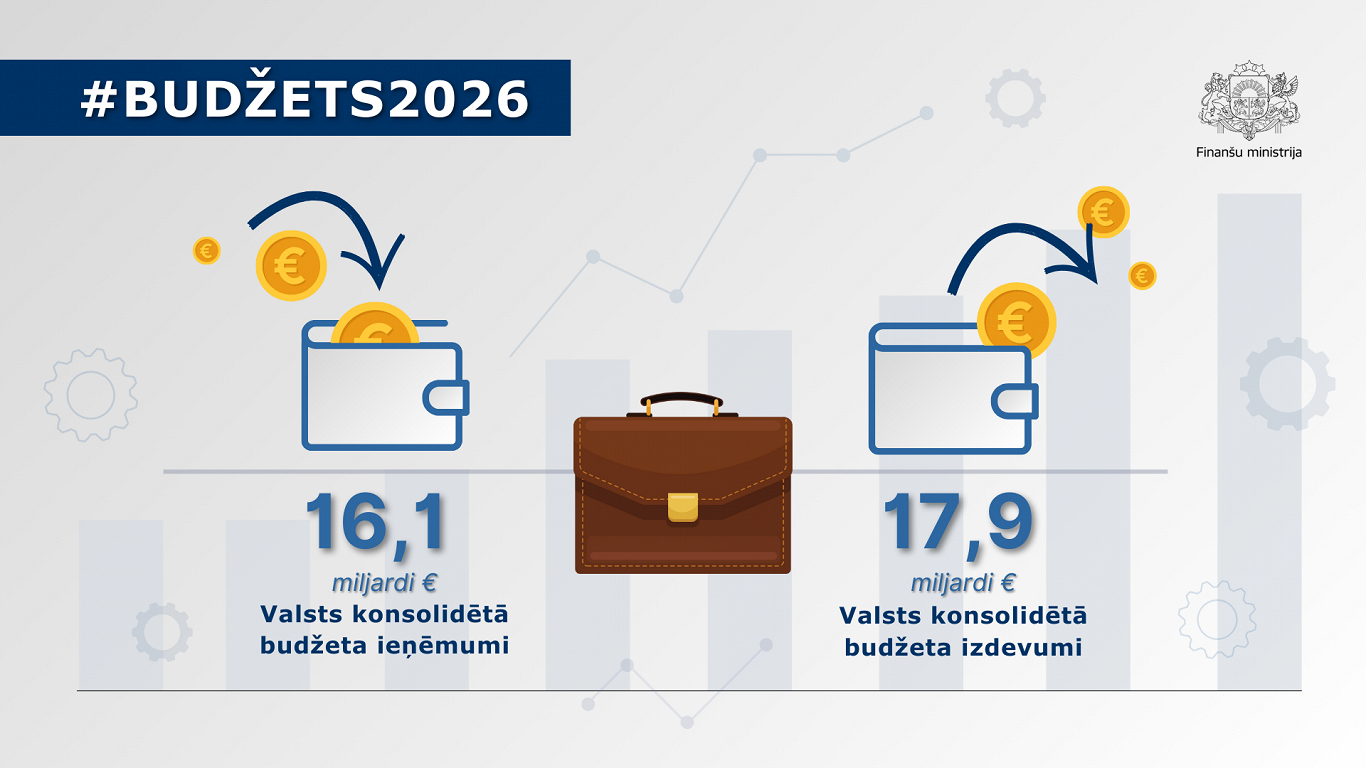
As previously reported, next year, the consolidated state budget revenue is planned to be 16.1 billion euros, while expenditure is planned to be 17.9 billion euros. Compared to the 2025 budget, next year’s planned state revenue is planned to be 944.6 million euros higher, while expenditure is planned to be 804.3 million euros higher.
The budget deficit next year is planned at 3.3 percent of gross domestic product, and its increase compared to the projected deficit of 2.9 percent this year is mainly determined by a significant increase in funding for strengthening national defence, long-term support for Ukraine, and investments in strengthening public safety.
Taking into account the geopolitical situation, an additional 448.3 million euros are planned to be allocated to strengthening national security next year, and this funding includes not only strengthening military capabilities, but also investments in national internal security and cybersecurity. Defence spending as a whole will be close to 5% of GDP.
Select text and press Ctrl+Enter to send a suggested correction to the editor
Select text and press Report a mistake to send a suggested correction to the editor
Tell us about a mistake