
Key Points
- The Arizona Corporation Commission approved an energy supply agreement between Tucson Electric Power and the developers of a controversial data center
- Developers of the data center have been scrutinized for the project’s secrecy
- The vote comes after Tucson City Council rejected the project earlier this year
The Arizona Corporation Commission voted on Dec. 3 to approve an energy supply agreement between Tucson Electric Power and the developers behind a controversial proposed data center dubbed “Project Blue.”
The data center is planned for development on unincorporated land in Pima County by Beale Infrastructure and Humphrey’s Peak Power. It has been the center of controversy in southern Arizona for most of 2025 in part due to the developers’ secrecy, their attempts to use water from the city of Tucson and Amazon Web Services’ recent exit from the project.
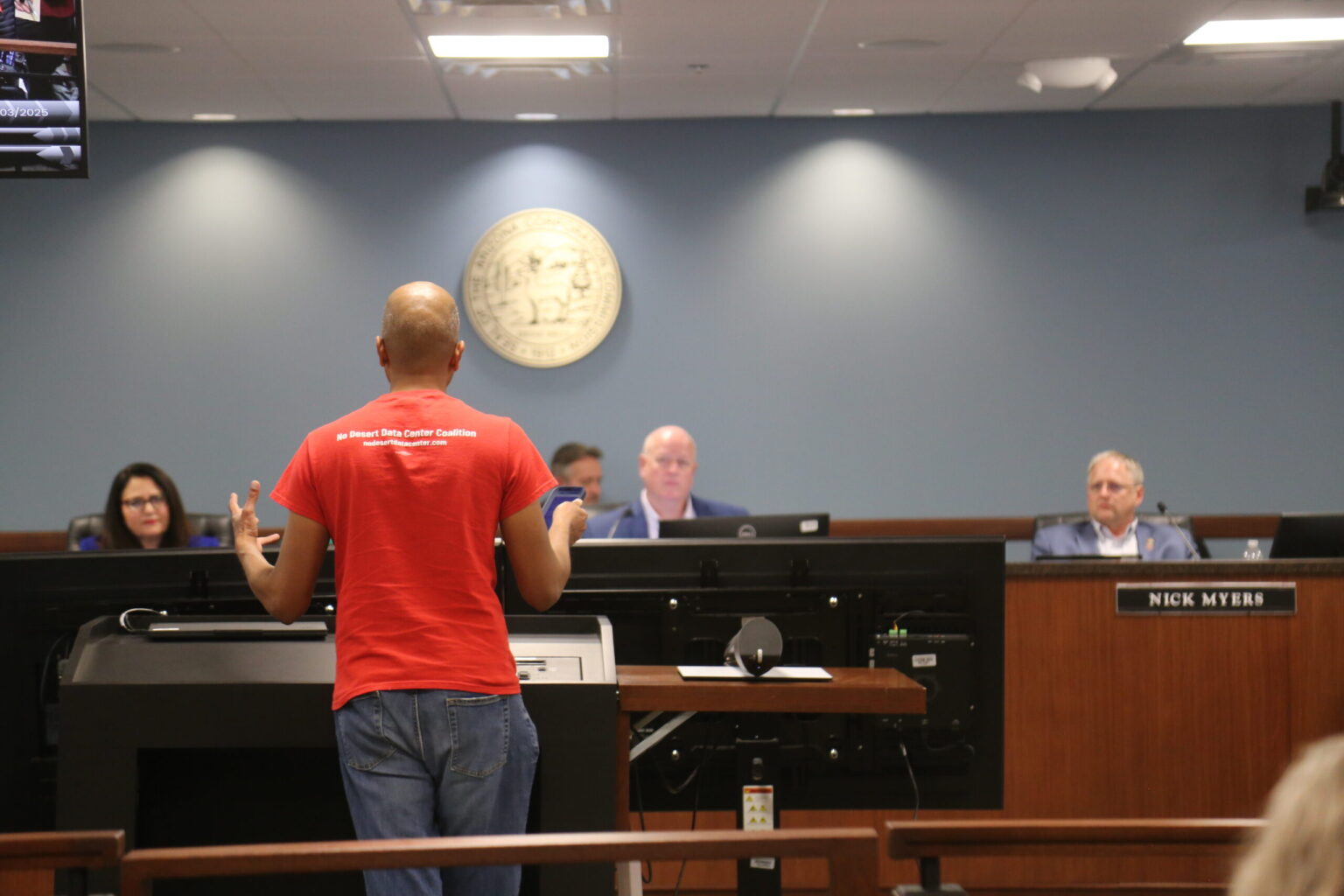
After more than three hours of discussion and nearly two dozen members of the public urging a no vote during a Dec. 3 meeting, four of the five commissioners voted in favor of the energy supply agreement, which will allow TEP to provide electricity to the data center starting in 2027.
However, Commissioner Lea Márquez Peterson — the only commissioner who lives in southern Arizona — and Commissioner Rachel Walden both raised questions about Project Blue and TEP’s plans to protect residential utility customers from costs. Márquez Peterson ultimately voted in favor of the agreement alongside Commissioners Kevin Thompson, Nick Myers and René Lopez, while Walden was the lone vote against it.
“I’m still wary about whether or not there is a data center at the end of this,” Walden said during the meeting.
Given the immense public interest in the issue, commissioners noted that their vote was not on Project Blue as a whole, but on whether TEP is permitted to provide the data center with the electric generation it will require. At one point, Commissioner René Lopez seemed to scold members of the public in attendance for being wholly against data centers.
“Data centers are not the enemy,” Lopez said. “I know that they’ve become a pariah recently, but data centers are used by all of us.”
Thompson and other commissioners said they believe TEP has crafted adequate guardrails to protect residential customers in the event that the project does not come to fruition, and pledged to hold the company accountable if it attempts to pass costs on to those ratepayers.
“I will be the first one to cry foul in the event that that happens,” Thompson said.
According to an Aug. 25 filing from TEP, the data center is expected to come online in May 2027 and use 286 megawatts of energy daily by 2028. One megawatt is enough energy to power around 225 homes in Arizona, according to local utility companies.
Prior to the Dec. 3 vote, Walden, Márquez Peterson and Myers sent three letters to TEP requesting clarification on how the company would power the data center while ensuring costs are not passed on to residential utility customers. Staff for TEP wrote that the data center will be billed as a “high-load factor customer,” with special provisions outlined in the energy supply agreement that will protect residential customers.
Those include minimum billing requirements regardless of energy usage, a contract termination fee and a capacity ramp-up schedule. Beale Infrastructure has also pledged to pay for two new transmission lines that will be needed to provide electricity to the data center.
TEP executives said during the Dec. 3 meeting that the data center customer will ultimately decrease rates for other customers because it will “make a larger revenue contribution than the actual cost of the project.”
“We believe that we’ve got the gold standard special contract for a data center with existing resources and existing capacity that’s available,” said Erik Bakken, senior vice president and chief administrative officer at TEP.
TEP asked the ACC to approve the energy supply agreement just weeks after the Tucson City Council voted against annexing the land purchased by Beale Infrastructure for development of the data center. Tucson residents rallied against the annexation, which would have allowed the data center to use the city’s water supply to cool the building and equipment.
Before the annexation vote reached the Tucson City Council, the developers of the data center were criticized for attempting to move the project forward in secrecy. Project Blue discussions between Pima County and the developers have been ongoing since 2023, and the county has been under a non-disclosure agreement since 2024.
Part of that non-disclosure agreement meant members of the Pima County Board of Supervisors could not publicly say which company would ultimately use the data center. Public records first obtained by Arizona Luminaria revealed in July that Amazon Web Services was behind Project Blue.
However, Amazon Web Services will no longer use the data center after the project switched to air-cooling rather than water-cooling, following the Tucson City Council vote. Representatives for Beale Infrastructure told commissioners they are confident they will find a user by the time the data center goes online in 2027.
The project does have some supporters, including the Arizona Commerce Authority, the Arizona Chamber of Commerce and Industry, and the Chamber of Southern Arizona. Those groups say the approval of Project Blue will create jobs and attract more businesses — and data centers — to the state.
If the data center expands in the future, which developers say is not out of the realm of possibility, TEP and any eventual customer will need to come before the commission for a new energy supply agreement.
No tags for this post.