
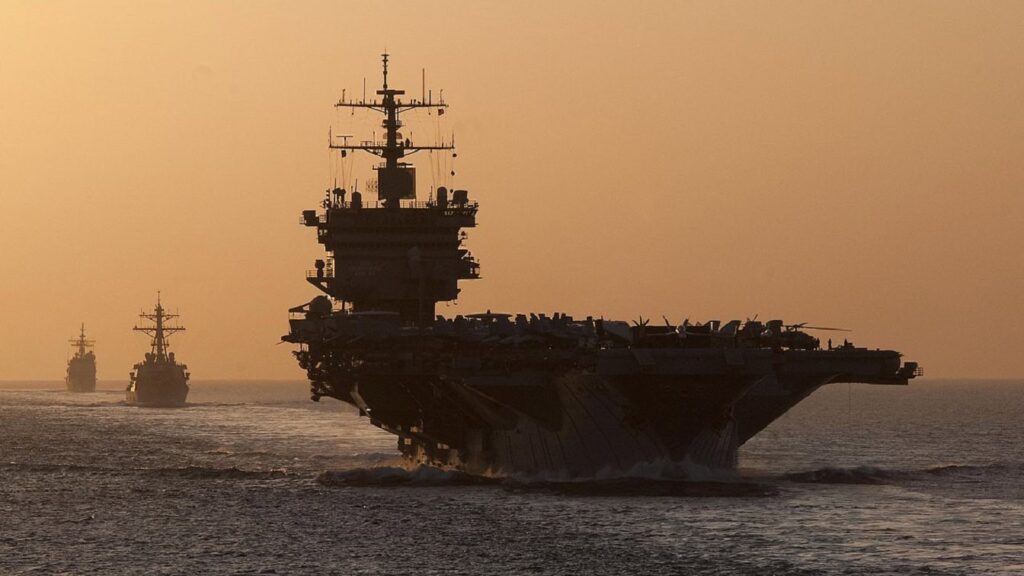
Key Points and Summary – On January 14, 1969, the nuclear-powered carrier USS Enterprise suffered a devastating flight deck fire while preparing for combat operations near Hawaii.
-Hot exhaust from a “huffer” ignited a Zuni rocket on an F-4, triggering a chain reaction of explosions, ruptured fuel tanks, and burning JP-5 pouring through the deck.
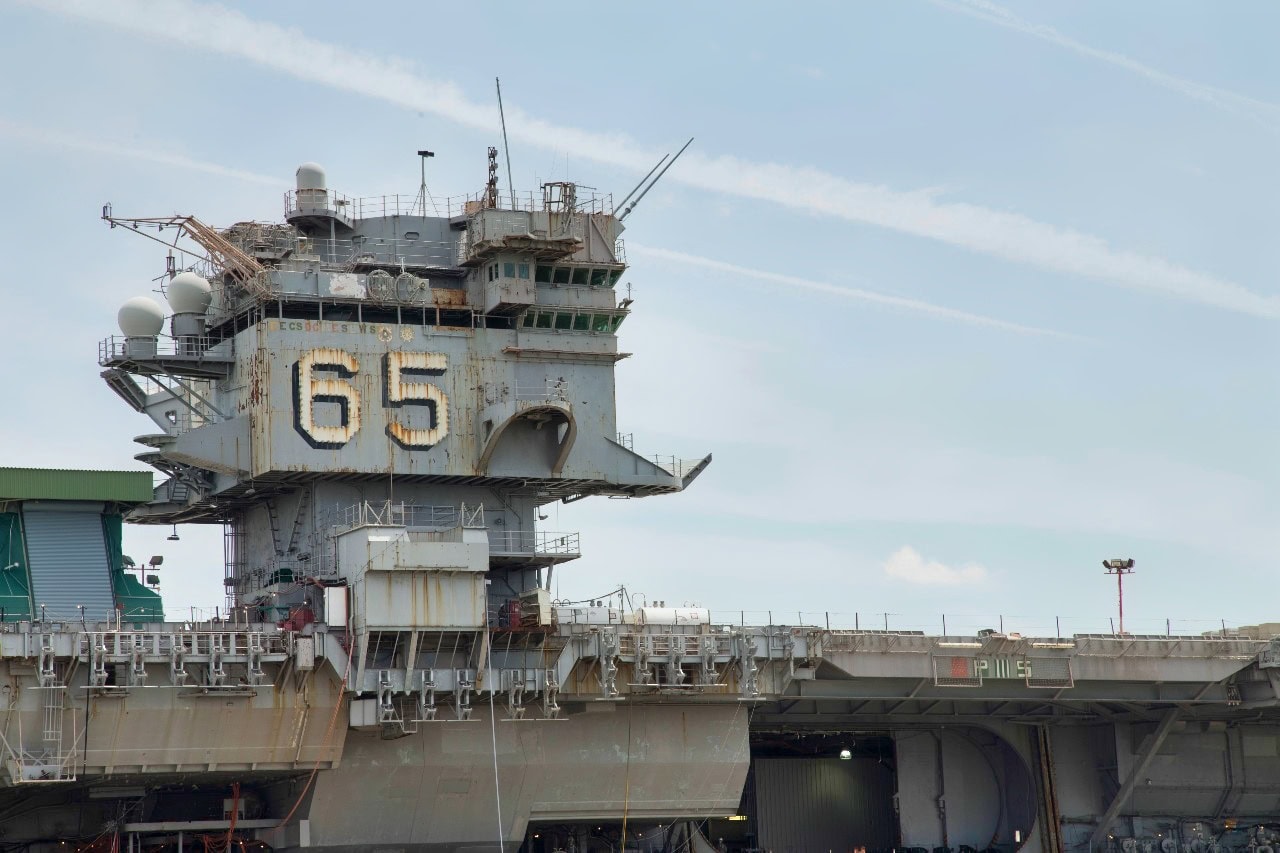
NEWPORT NEWS, Va. (July 15, 2018) — USS Enterprise (CVN 65) sits pierside at Newport News Shipbuilding following its decommissioning in February 2017. (U.S. Navy photo by Mass Communication Specialist 2nd Class Cat Campbell/RELEASED)
-Eighteen blasts tore five large holes in the flight deck, killing 28 sailors, injuring 314, and destroying multiple aircraft.
-Quick action by Captain Kent Lee and unusually high firefighting training levels prevented a far worse catastrophe. Enterprise was repaired, served for decades, and her name will live on in CVN-80.
How a Single Rocket Nearly Doomed the Navy Aircraft Carrier USS Enterprise in 1969
One of the worst things that can befall a warship (or any waterborne vessel, for that matter) is a shipboard fire, whether set intentionally (internal sabotage or external strikes by enemy ordnance) or unintentionally.
Accordingly, every United States Navy sailor is taught basic firefighting fundamentals during their seven weeks of boot camp.
One of the most infamous unintentional fires to befall the USN during the Vietnam War was that of the USS Forrestal (CVA-59) fire killed 134 men, injured 161, and destroyed 21 aircraft on July 29, 1967, besides the tragic scope of death & destruction, the Forrestal fire also stands out in history by virtue of the fact that one of the Naval Aviators aboard was future United States Senator John S. McCain III.
However, Forrestal wasn’t the only “flattop” to suffer a shipboard fire in the late 1960s; the iconic USS Enterprise (CVN-65) suffered one a year and a half later.
USS Enterprise (CVN-65) Initial History and Tech Specs
Affectionately nicknamed the “Big E,” like her World War II predecessor (CV-6), CVN-65 made history as (1) the world’s first nuclear-powered aircraft carrier and (2) the longest naval vessel in the world (a record that still stands today), with a hull length of 1,123 feet (342 meters).
Her displacement of 93,284 long tons (94,781 metric tons) ranked her as the 11th heaviest supercarrier, following the 10 supercarriers of the Nimitz class.

Naval Station Norfolk, Va. (Feb. 29, 2004) – Sailors aboard the nuclear powered aircraft carrier USS Enterprise (CVN 65) “man the rails” as the carrier approaches its pier at her homeport of Naval Station Norfolk, Va. The carrier and its strike group are returning after completing a six-month deployment in support of the global war of terrorism, including Operations Iraqi Freedom and Enduring Freedom. U.S. Navy photo by Photographer’s Mate 3rd Class Sondra Howett. (RELEASED)
Her gargantuan size accommodated roughly 4,600 commissioned officers and enlisted seamen as well as potentially up to 90 aircraft (though the standard aircraft loadout was 60).
Initially designated CVA(N)-65, USS Enterprise was laid down at Newport News Shipbuilding and Drydock on February 4, 1958, launched on September 24, 1960 (sponsored by the wife of then-Secretary of the Navy William Birrell Franke), and commissioned on November 25, 1961.
She embarked on her maiden voyage (a shakedown cruise) on January 12, 1962.
Big E’s Big Aircraft Carrier Tragedy
The tragedy transpired on January 14, 1969, when the “Big E” was operating about 70 nautical miles southwest of Pearl Harbor, Hawaii, conducting a final battle drill and Operational Readiness Inspection (ORI) before heading off for her fourth deployment to Vietnam.
At 0830 Local Time (1830 UTC AKA “Zulu Time”) on that fateful day, she was prepping for the launch of six F-4 Phantom II fighters, seven A-7 Corsair II (AKA the “SLUF”) light attack jets, one RA-5C Vigilante photo-reconnaissance aircraft, one EKA-3B Skywarrior tanker (AKA the “Whale”), and one E-2A Hawkeye airborne early warning aircraft of Air Wing NINE (CVW-9).
Twelve minutes before the scheduled launch time, as the venerable vessel was commencing a turn to port into the wind, an explosion occurred on the port quarter of the flight deck outside the landing area.
An MD-3A aircraft starter unit (“huffer”) had been positioned so that hot exhaust was blowing on the warhead of a MK-32 5-inch Zuni rocket, which packed 15 lbs. (6.8 kg) of Composition B explosive.
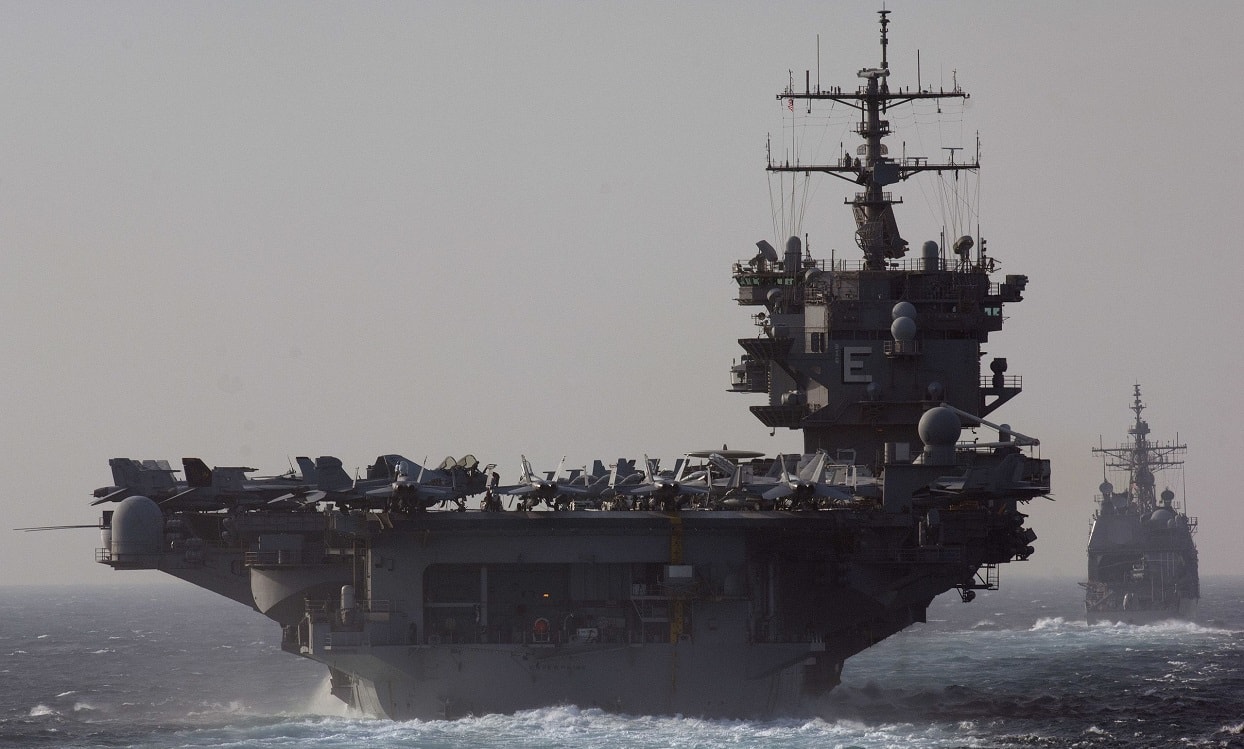
Image: Creative Commons.
The huffer’s exhaust temperature could reach 590 degrees Fahrenheit at a 2-foot distance, and a mere 358 degrees was sufficient to cook off the Zuni’s warhead in about 78 seconds (per the subsequent investigation).
This particular Zuni rocket was mounted in a pod of four rockets on the starboard wing (No. 8 station) of an F-4J belonging to Fighter Squadron NINETY-SIX (VF-96); that same Phantom was also carrying two wing fuel tanks (one on the starboard wing outboard of the Zuni rockets) and six Mark 82 500-lb. bombs.
In other words, it was a perfect storm of perdition.
A junior airman apprentice attempted to sound the alarm about the pending danger, but his warning was either misunderstood or drowned out by the din of jet noise.
The subsequent investigation determined that the warning was likely too late anyway.
The Zuni warhead exploded, triggering a chain reaction: shrapnel perforated the external fuel tanks and ignited a JP-5 fire.
About one minute later, the other three Zuni rockets on that forlorn Phantom were fired, blowing holes in the flight deck through which burning JP-5 flowed into the O-3 level.
All in all, a total of 18 explosions occurred, blowing five large holes in the flight deck, claiming the lives of 28 of Big E’s crewmen and injuring 314 others. Materiel-wise, eight F-4s, six A-7s, and the Skywarrior tanker were destroyed.
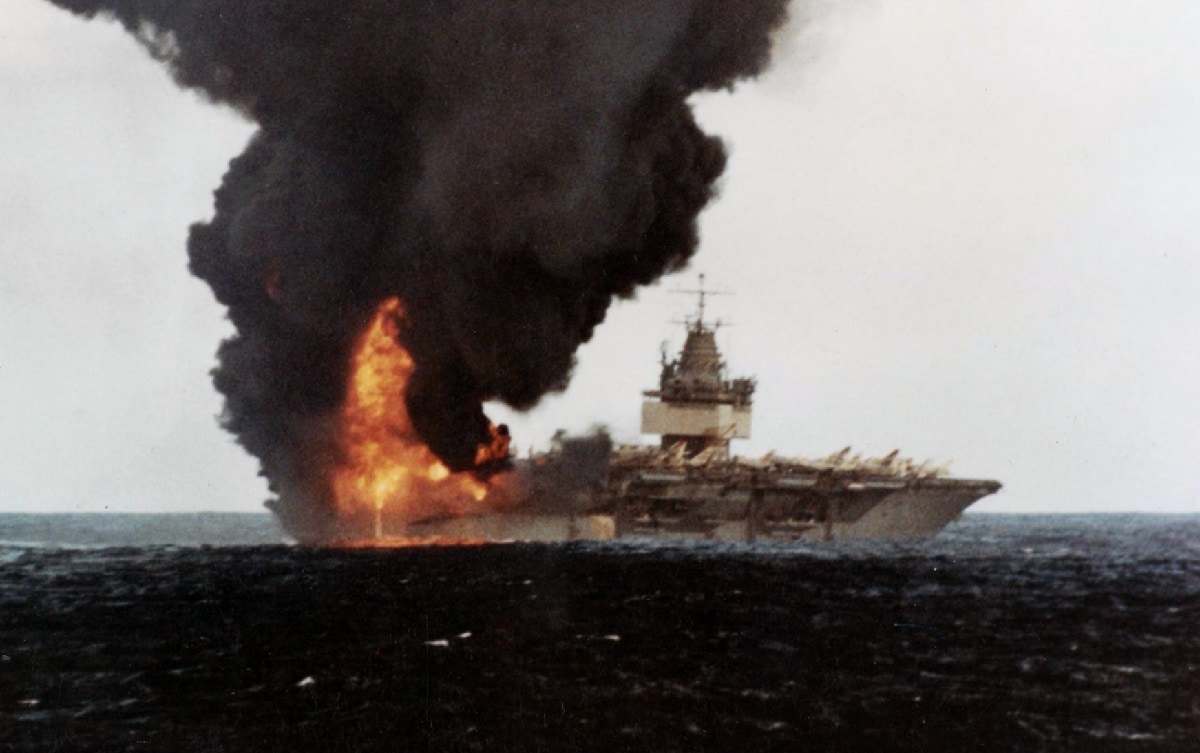
Image: Creative Commons.
As tragic as this incident was, it could’ve been worse. Two important factors mitigated the death and destruction upon the Enterprise:
-The quick thinking of the ship’s skipper, then-Captain Kent Lee (future Vice Admiral and Commander of Naval Air Systems Command), who promptly steered the boat so that the wind blew smoke and flames off the flight deck, and
-As noted by Naval History and Heritage Command, “Despite the casualties, a big difference between the fires of Enterprise and Forrestal (see H-Gram 008) was that on Enterprise 96 percent of ship’s company and 86 percent of air wing personnel had received formal firefighting training, whereas on Forrestal only 50 percent of the crew and none of the air wing had been trained.”
Where Is She Now?
CVN-65 was eventually repaired and returned to service. She continued to serve in the Navy faithfully until finally being decommissioned on February 3, 2017, and stricken from the Naval Register that same day.
Unfortunately, there are no plans to convert her into a floating museum; ergo, she awaits recycling at the HII Shipyard in Newport News, Virginia.
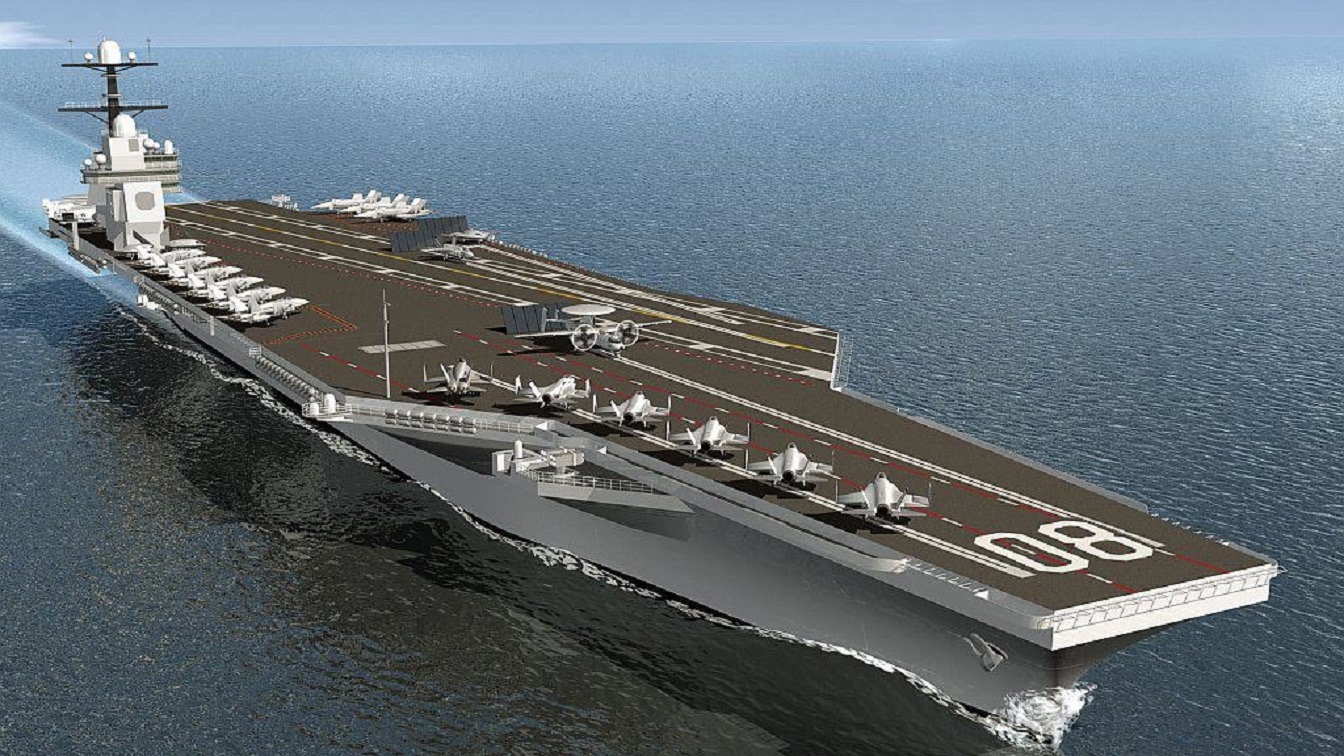
A graphic showing what the future USS ENTERPRISE (CVN 80) is expected to look like when she joins the fleet after 2025. The aircraft are F-35C Lightning II Joint Strike Fighters, F/A-18 E and F Super Hornet strike fighters, E-2D Hawkeye electronic warfare planes, and an unmanned strike jet modeled on the X-47B sitting on the No. 4 catapult. Pennant number orientation on flight deck has been corrected.
Fortunately, her proud name will be carried on by the Gerald R. Ford-class supercarrier USS Enterprise (CVN-80), which was laid down in August 2022 and is projected to be delivered sometime in 2030.
CVN-80 will be the ninth USN vessel to bear the Enterprise moniker.
Fair winds and following seas, sailors of the USS Enterprise, we have the watch.
About the Author: Christian D. Orr, Defense Expert
Christian D. Orr is a Senior Defense Editor. He is a former Air Force Security Forces officer, Federal law enforcement officer, and private military contractor (with assignments worked in Iraq, the United Arab Emirates, Kosovo, Japan, Germany, and the Pentagon). Chris holds a B.A. in International Relations from the University of Southern California (USC) and an M.A. in Intelligence Studies (concentration in Terrorism Studies) from American Military University (AMU). He is also the author of the newly published book “Five Decades of a Fabulous Firearm: Celebrating the 50th Anniversary of the Beretta 92 Pistol Series.”