
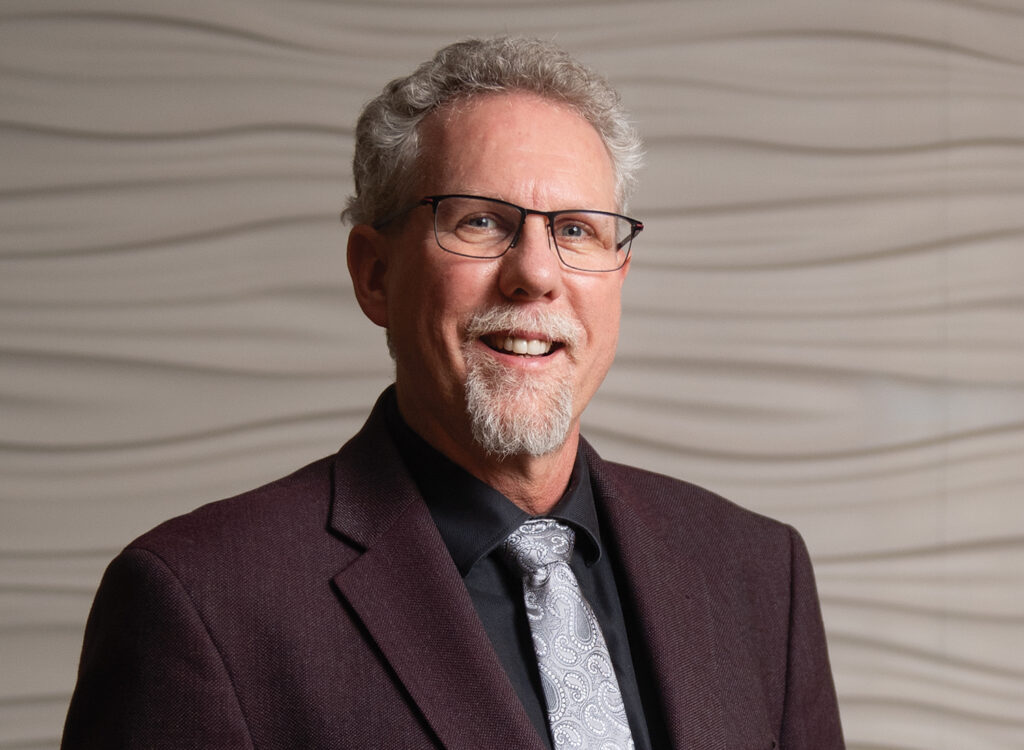
Tasked with meeting the goal of increasing domestic energy sources, a long-time energy leader has taken a top post on the Iowa State University campus.
Karl Mueller is the new director of the U.S. Department of Energy’s Ames National Laboratory. He succeeds Adam Schwartz, who had served as director since 2014, before stepping down earlier this year.
The Ames Lab, as it’s commonly called, is one of 17 national laboratories across the country overseen by the energy department, with the mission of advancing science to discover and analyze new materials, novel chemistries and other tools to help address various global challenges.
Established in 1947 as part of the Manhattan Project, the Ames Lab is operated by, partnered with and located on Iowa State’s campus.
Mueller served most recently as the director of the program development office for the Physical and Computational Sciences Directorate at the Pacific Northwest National Laboratory in Richland, Wash. Before that, he was chief science and technology officer for the directorate for six years. He went to Richland after serving as a chemistry professor at Penn State University. He has written 195 peer-reviewed papers and has earned two degrees in chemistry, a doctorate from the University of California, Berkeley and a bachelor of science from the University of Rochester in New York.
Mueller started at ISU on June 1, and soon after hosted the new U.S. Secretary of Energy Chris Wright, who said he wants the Ames Lab to utilize materials science to develop next-generation energy production technology.
We recently sat down with Mueller to find out more about his career, interests and goals for his new position.
This Q&A has been lightly edited for clarity and brevity.
Is the work you were performing at the Pacific Northwest National Laboratory similar to what you will be doing here at the Ames Lab, or are they different enough that the work will be different?
They’re different enough. At the Pacific Northwest National Lab, I was still working primarily with the Office of Science, which is one part of the Department of Energy, and the Office of Science is also the sponsor of Ames National Laboratory, so we’re in the same part of the Department of Energy. There, we focused more on chemistry. Here, we focus a little bit more on materials.
There, we also had big programs in advanced scientific computing, which are just sort of nascent at the lab here. And there, they did a lot more work in biological and environmental research, which we are now, again here, really moving up our game in that particular space. But still, I’m dealing with a lot of the same people back in Washington, D.C., which is part of the reason that I think Ames was interested in me, is because of the connections that I have back in D.C. It’s a long trip from the West Coast to D.C. This is not as far. You can get there on one plane.
You were on the coast for a long time. What brought you to Iowa?
It was the opportunity to actually direct this particular laboratory. I’ve known this laboratory for a long time, probably about 20 to 25 years that I’ve known of it. I’ve known people who have worked here for a very long time, both at Iowa State University and at Ames National Lab.
I first learned of Ames Lab probably when I was a professor at Penn State, still back in the 1990s. I was there at Penn State all the way until 2010 until I moved out to the [Pacific Northwest] national lab. Having that mix in my background, of being at a land grant university, one where research was very, very important to the university, then coupling that with my 15 years of experience at the national laboratory, the last seven or eight of which I spent in really close contact with sponsors back at the Department of Energy, made it a natural move.
To answer the question about why I would come to Iowa, the science here and the technology that’s being developed in the Critical Materials Innovation Hub, within some of the core research programs that are going on, and evolutions that are taking place in fusion energy. All those things make it a very exciting place to be, and a place where I think that I can add my ability both to be strategic about science and technology, as well as to form partnerships. A big part of what I did in my previous job was the formation of partnerships across the national laboratory system, across academia but also with industry. The idea of bringing more lab-adjacent industry or companies of one type or another to the Central Iowa area is a big goal.
Are there any specific types of companies you would like to attract here?
I would love it to be in new energy technologies that could probably be around the nuclear fusion space, a space that I think is really growing and that we have great opportunities in. Also, of course, in critical materials and critical mineral space. We already have a lot of strengths and a lot of smaller companies and some bigger companies now that we’re working with adjacent to the lab. And the other thing that’s been pretty exciting lately has been the transformation of waste into fuels and other chemicals, but primarily into fuels. We have a set of projects where we take waste plastic and can actually turn that into – probably the most exciting one is diesel fuel – but we can make jet fuel as well. We can make very size-selective organic molecules that are used as fuels.
I’ve been hearing more references to jet fuel production here in Iowa. Can you talk more about that?
The thing about jet fuel is it’s a very specific mixture of molecules that you can have in there. You have to be really good at cutting up big molecules or assembling small molecules to the very right length to get them certified for jet fuel, and we can do that with the catalyst that we’ve developed here at the lab. When I say ‘we,’ I mean all the great researchers here that have been doing it for years before I got here.
You mentioned what the lab has been good at. What has the new administration meant for the lab’s overall direction?
National priorities change and the important thing is for a lab to be flexible, that we have some agility. One of the great things about the Ames National Lab is for one, it is the smallest national laboratory. It’s also very agile and very good at the things that we do. We are the leaders in critical minerals and materials, and that’s a really important supply chain issue right now for the United States.
That work, which is actually a continuation of work that’s been going on since the 1940s when we first became a national laboratory, that will continue to be important. We will continue to lead both the DOE Complex and the nation in research around critical materials. And that has a number of components to it that include recycling, reuse or finding substitutes, so that we don’t have to use expensive metals that come out of supply chains from countries that may not necessarily be friendly to us and that could cut off that supply chain at any time. Being able to do both the fundamental research around finding substitutes, or finding new ways to recycle, finding new ways to extract and then pairing that with the actual end-case usage, which we are now doing at our advanced magnet facility, where we’re trying to bring back onshoring, or American manufacturing of magnets.
Can you explain why the lab is important to the business community?
We are a contractor for the Department of Energy. The lab is government owned and contractor operated, and the contractor for this lab is Iowa State University. We are Iowa State University employees but work for the Ames National Laboratory. We primarily do our work with funds that are allocated by the Department of Energy on a competitive basis. About 13 or 14 years ago, for example, they had a big call out, and they said, ‘We’re going to form a critical materials hub.’ All these different labs could write proposals and say why they should be chosen, what their ideas were, how they were going to make breakthroughs in the area. The Ames Lab won that.
Many of our other funding streams are from other parts of the Department of Energy. The renewable energy part of the Department of Energy, the Office of Energy Efficiency and Renewable Energy, funds the CMI Hub. The Office of Science funds a number of our other programs, including two Energy Frontier Research Centers, which are a big deal. They’re rather large proposals, large amounts of money that we are awarded on a four-year basis, and you can renew some of those. But one of those is around the upcycling of polymers, so this waste plastic-to-energy carriers, like fuels. Another one is around the materials that you use to make quantum computers, so we have a strong materials component in a lot of our programs, and especially in areas of national needs like understanding quantum materials.
We deliver critical materials solutions to the nation; that is our tagline. But it has a two-sided meaning. We do critical materials work, which is looking at the supply chain, the pipeline of all the minerals and materials that we need for really critical parts of our energy infrastructure. Also there are other materials problems that are really critical, like the quantum problem. Our annual budget is about $60 million or so. A lot of that funding is spent in the [geographical] area and it’s salaries, it’s equipment that we buy, it’s supplies. It’s an important economic engine that’s connected to Iowa State University.
When Secretary Wright came to visit the Ames Lab, he was talking about new federal priorities for energy spending, such as finding alternative sources for energy domestically through materials development, mining and other means. Did that shift priorities for the lab or were you already doing those things?
They pretty much telegraphed their priorities at the end of the last Trump administration, so we knew what they were interested in. Quantum was one of them, critical materials and artificial intelligence, which continued on over the next administration. But we had a really good idea that there was going to be a really big push forward in new novel energy sources, like securing the critical materials and mineral supply chain, using artificial intelligence to double the impact of every dollar that comes into research at the Department of Energy, so we’ve been pushing along those particular lines. I’m working very hard on a new initiative around artificial intelligence at the laboratory, both in operations and to solve science problems.
Can you talk a little bit more about that?
The main goal is to find ways to free up our researchers to do more with the capabilities that they can get from using machine learning algorithms to taking a lot of very complex data and pull out the interesting and important information in it, or using these reasoning models that are coming out now to be a copilot along with the researcher. You can ask questions and get quick answers. It can help you actually logically put together workflows of ideas. We’re beginning to do that in some of our research projects. I’ve got a big push toward that, where we’re going to be doing training around that over the next year, we’re going to start using it in a number of our research projects. We’re really looking to, with the same amount of research funding, be more impactful, or do it more quickly.
Does it take awhile to get that all up and running?
We’ve already started putting together a really good infrastructure within the laboratory for being able to access those types of models, but that’s just to get the raw models, the GPT-3, or GPT-5 and other large language models and reasoning models.
Now, to start putting that into an infrastructure, that’s where the scientists are on a good learning curve. Everyone is learning to use these and are going up a pretty steep learning curve. We’re trying to capitalize on and exploit the use of those to be able to do the research faster. I already use it in a lot of my day-to-day routines, if I’m trying to think about what would be the best way to set up a meeting around [a] topic and give us some examples of meetings I’ve run before that were successful, and it’ll come up with a schedule where, instead of spending a half an hour thinking of something like that, it’s done in 5 minutes. Then I can refine it. I’ve already got it done and I’ve got someone helping me along with it. That’s a really unique kind of assistant to have.
Then, when you delve into scientific problems, it’s similar. It’s like, here’s the work that we’ve done in the past, here’s ideas that we have. We’re really looking for a breakthrough to, say, reduce the cost here or increase the efficiency here. We ask it what it can find in the literature, very quickly, that the model was trained on, that would allow you to then make a decision about what’s the next thing to try.
These large language models, if you build the right system, they can even come up with a way to get a robot to do that next experiment, because there’s codes that run robots that are all open source. You can then send the robot off to do work while you’re doing other work and thinking. We’ve got some automated laboratories now in our laboratory where we’re using artificial intelligence to actually screen things a lot faster. To get this case, it’s a separations problem, or trying to separate different types of elements from one another, and we’re able to do that with on the fly artificial intelligence.
Tell me more about your background. How did you get into science?
I was a big fan of doing home chemistry experiments, and my dad was a chemist. He worked for a local company that made fiber products. He was an analytical chemist, and so he brought that love of discovery and solving problems to his kids. Two of us became chemists. My brother is also a chemist. He’s a professor at University of California, Riverside. I was a professor at Penn State University at the same time, when I was younger. My dad was never a prompter. I mean, he was just absolutely thrilled. My sisters went more into finance and legal kinds of things, so they were the money makers in the family.
It was a very supportive family for basically academics and science, and so we grew up tight knit, four kids, all in high school pretty much at the same time, and it was a really great place to be if you wanted to be serious about learning things. And I loved math. Math is probably my bigger love, even than chemistry. That’s why I get more into the physics side of things, because physics is a lot of mathematics. I just loved math and I had math teachers that challenged me all the time, and still to this day, I watch math videos on YouTube when I’m bored.
How do we get kids more involved in science?
There are a lot of things for today’s kids to be interested in, and to get interested in, and to take their attention. It’s really, how do you get their attention? And I really think that’s where it’s very important for scientists to get out there in the community, to have events like Science Bowl or other community outreach events where the Ames Lab shows up and are showing young adults a floating magnet or some demonstration of the science in action that is interesting; it goes a long way. When I used to teach chemistry to freshmen, the very first day I would blow something up loudly, and they would all want to come back to the next class.
You’re a highly skilled person, do you have any insights on how Iowa can attract more people like you to the state?
A lot of that is a quality of life issue. And I’ll say, I like Des Moines. My wife and I, especially if one of us is traveling back through the Des Moines airport on a weekend or Friday night, we’ll just stay in the city, because we like the city. We like going to clubs. We went to the Melissa Etheridge concert a couple [months] ago just because we could. It’s here. It’s easy to do. And you guys have a Trader Joe’s and a Whole Foods. Where I lived last it was two and a half hours to the nearest Trader Joe’s. Three and a half hours to the nearest Whole Foods. So, quality of life, health care, schools to bring your kids up in, universities. The universities in Iowa are really strong.
Is there anything else you want the business community to know?
We should be working together. Partnerships are an important part of making progress; public-private partnerships, other types of partnerships, community partnerships, those things will make a difference and will make things happen, and will help to boost the region economically. It’s one of my goals that by the time I finish my job here, that I’ve helped bring in adjacent industries, adjacent companies, but also help those that are here with any issues that they may have or things that they’ve been thinking about.
At a glance
Hometown: Buffalo, N.Y.
Education: Bachelor of science degree in chemistry from the University of Rochester in New York; doctorate degree in chemistry from the University of California, Berkeley
Family: Wife and five cats, Goo, Hellion, Tom, T2 and Wolfie
Email: karlm@iastate.edu