
Ed Miliband has announced the government will produce an implementation plan for the recommendations that have arisen from Nuclear Regulatory Taskforce’s recent review within three months.
Released in November, the report, authored by John Fingleton and the taskforce, discussed how the UK has become the “most expensive” nation in the world to construct new nuclear projects and an overhaul to planning was needed to remedy this.
Speaking at the Nuclear Industry Association’s (NIA’s) annual conference, energy secretary Ed Miliband said: “Our starting point is that you can’t have energy sovereignty and abundance without making it easier to build things in this country.
“And as the Prime Minster said on Monday, we are accepting the Fingleton recommendations, we think the principle of all of them is right and we are determined to make building nuclear power quicker and cheaper.
“My department has already begun implementing recommendations in the review, including on risk management and proportionality.
“And the government will produce our full implementation plan within three months.”
Prime minister Kier Starmer set up the Nuclear Regulatory Taskforce in February to propose radical reforms to an industry which is suffering from complex regulation.
The resultant report was released last month and concluded there is a “systemic problem” within the UK’s nuclear industry causing huge cost overruns and delays to construction projects. Included in the report was also 46 recommendations for how the UK’s nuclear industry should be reformed.
The report was a point of focus for recent budget announcements related to the nuclear sector where one of the recommendations the government specifically announced it will look to implement intends to take steps to align regulatory structures and incentives.
This includes plans to explore the idea of consolidating defence and civil nuclear regulatory functions. Starmer will also legislate to give the Office of Nuclear Regulation (ONR) the ability to consider “overall strategic factors such as energy and national security imperatives in the delivery of its statutory purposes”.
Miliband continued during his keynote address: “There is an important lesson in the Fingleton review for our wider approach to infrastructure. That if we want prosperity in this country, we have to be prepared to build.
“This government is willing to have that discussion with the public. We are willing to have it on renewables and nuclear.
“This does not mean ripping up red tape for the sake of it, or valorising deregulation at all costs.
“Appropriate regulation has an important role to play in ensuring safety, environmental protection and accountability.
Miliband made it clear that a balance was needed between the desire to build nuclear projects that abide by the strictest safety rules with the requirement for new projects to be constructed quickly.
“We shouldn’t accept the stagnation and delay that is all too often built into our planning system,” he said.
“Stagnation and delay which does not serve energy security, does not serve jobs and does not serve the British people. And doesn’t serve nature either. The biggest threat is not clean energy infrastructure but the climate crisis.”
Along with the implementation plan for Fingleton’s recommendations, the government also plans to publish a report intended to outline routes for nuclear projects to be built with private finance.
Miliband said: “We will soon, you won’t have to wait too long I hope, publish a framework for privately funded advanced nuclear projects.
“As we set out at the Spending Review, Great British Energy-Nuclear (GBE-N) has been tasked with assessing proposals, working with the National Wealth Fund and helping government break down the barriers.
“And the government will use GBE-N’s assessment to give early “in principle” endorsements that can help credible privately led projects mobilise the capital they need.
“We are really serious about these privately led routes to markets.
“In a way the framework will bless what we will already do, speed really matters, there is a race on and we want to lead the global race.”
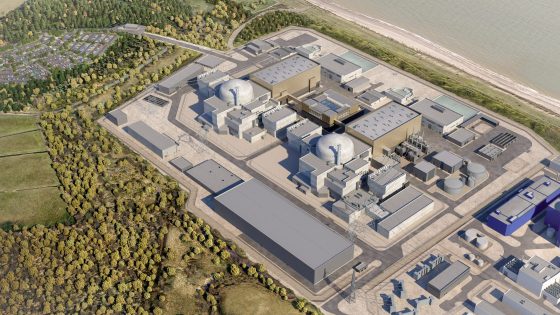
The next large scale nuclear project to be built in the UK will be Sizewell C.
Last month, Sizewell C reached financial close with a £5bn funding injection from 13 banks paving the way for full-scale construction.
The deal secured around £5.5bn of new financing consisting of a £5bn export credit‑backed facility arranged by Bpifrance Assurance‑Export (BpifranceAE) with support from Sfil, and a separate £500M working capital facility.
These facilities sit alongside a term loan provided by the UK’s National Wealth Fund and the equity that was raised earlier this year following a Final Investment Decision for the Suffolk nuclear power plant in July.
Like what you’ve read? To receive New Civil Engineer’s daily and weekly newsletters click here.