Azerbaijan, a leader member of the Non-Aligned Movement (NAM) and Organisation of Turkic States (OTC), is a relatively new addition to the small number of secular Islamic states in the world alongside Türkiye, Indonesia and Pakistan. It is strategically important the US, which helped to broker peace agreements between India and Pakistan and Azerbaijan and Armenia, harness these secular Islamic to counter Iranian-backed separatism, extremism, and terrorism.
It is no coincidence Azerbaijan, Türkiye, Indonesia, Pakistan and Egypt are leading contenders for the International Stabilisation Force (ISF) that would coordinate reconstruction and security during a transition to an independent Palestinian Gaza state free of the Iranian-backed terrorist organisation Hamas (Islamic Resistance Movement).
Azerbaijan became an independent state in 1991 on the ruins of the USSR. Like other countries, such as neighbouring Georgia and Ukraine across the Black Sea, their attempts at forging independent states on the ruins of the Russian Empire in 1917 were thwarted by Russian Bolshevik imperialism.
The Azerbaijan Democratic Republic, also known as the Azerbaijan People’s Republic, was the first secular democratic republic in the Turkic and Muslim worlds. Founded by the Azerbaijani National Council in Tiflis in May 1918 it was crushed by a Russian invasion two years later. The Azerbaijan Democratic Republic was the first Islamic state in the world to grant women equal rights with men and extending suffrage to women. Most Western democracies extended suffrage to women at the same time; although France, the home of the revolutionary slogan ‘Liberty-Equality- Fraternity,’ waited until the end of World War II.
On the ruins of the Soviet empire the most brutal conflict took place in 1988-1992 between Azerbaijan and Armenia. Both sides undertook ethnic cleansing, deportations and expulsions. After defeat in the First Karabakh War, nearly one million Azerbaijan’s were forced from their homes in Armenia and the fifth of Azerbaijan occupied by Armenia for nearly two decades.
An important critical juncture took place in 2020 when Azerbaijan won the Second Karabakh War and retook most of its occupied territories. Although we are all aware of how the Russian-Ukrainian war is transforming military warfare it was the Second Karabakh War that should be classified as the first drone war in history.
In 1969, Azerbaijani Communist Party leader Heydar Aliyev was instrumental in receiving permission from Moscow to establish the Jamshid Nakhchivanski Military Academy in Baku. ‘This institution fostered a new generation of Azerbaijani officers,’ one report stated. Proving Azerbaijan to be a secular Islamic state is the little-known fact is the bulk of its military equipment until 2015 came from Israel.
From then, Türkiye overtook Israel as the main supplier and in more recent times also Pakistan. A major cause of Armenia’s defeat was it relied on Russian weapons and Soviet-Russian military training. Armenia is a founding member of the Russian-led CSTO (Collective Security Treaty Organisation), has two Russian military bases and until 2024-2025, Russian border guards guarded its airports and borders.
These were no match for Israeli and Turkish modern military equipment and NATO-level training. One focus has been receiving Turkish training from the Turkish Special Forces Command and building Azerbaijani ‘blue beret commando’ special forces; special forces played a key role in capturing Shusha in Karabakh during the Second Karabakh War which de facto ended the conflict.
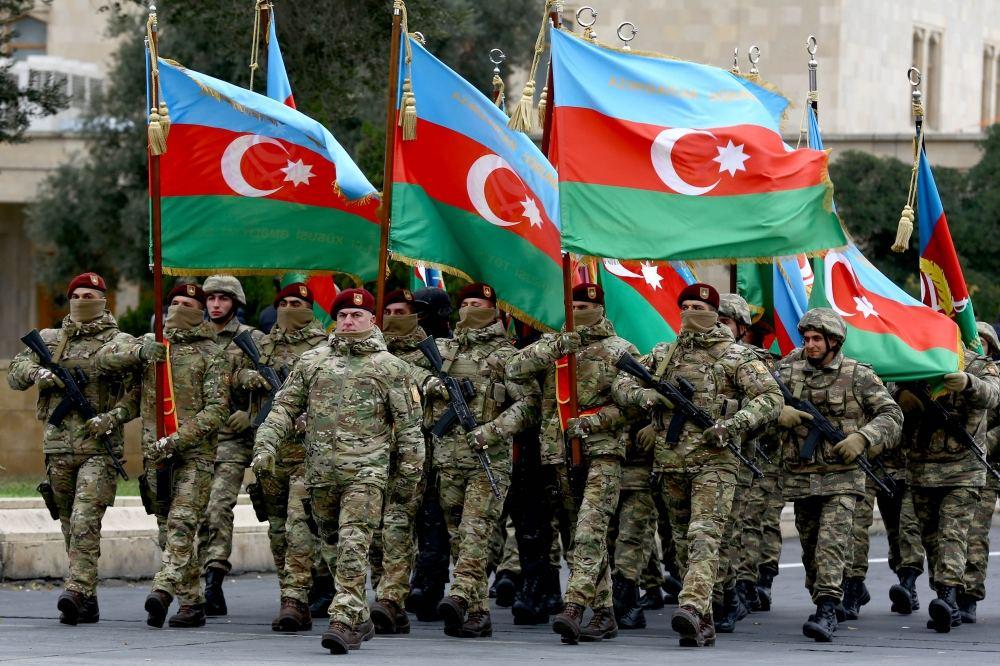
Since 2020, Azerbaijan has continued to develop and grow its military forces. This was clear at the annual parade on November 8 to commemorate victory in the Second Karabakh War. Pakistani military participated in the parade for the first time. President Ilham Aliyev told the parade that victory five years earlier was a ‘manifestation of the unity of the peoples and armies of three countries: Azerbaijan, Türkiye and Pakistan.’ In 2021, Azerbaijan, Türkiye and Pakistan signed the Trilateral Islamabad Declaration and held joint military exercises. Armenia meanwhile is cooperating militarily with India and Iran.
The military equipment at the parade revealed how Azerbaijan had become a regional military power. One report stated ‘the Azerbaijani army of the 2020 model, which surprised many five years ago with its actions in Karabakh and became a trendsetter at the tactical and operational-tactical level, has changed significantly by 2025 in technological terms.’
Azerbaijan ‘revolutionised regional warfare by using Bayraktar TB2s, Israeli Harop loitering munitions, and real-time surveillance to dominate the 2020 conflict.’ Azerbaijan ranks 46th in the 2025 Military Power Rankings (MPR). ‘As a Caspian Sea powerwith volatile land borders and complex relations with Armenia and Iran,’ Azerbaijan ‘has built a force structure cantered on territorial defence, precision strike capability, and drone-based network-centric warfare.’ Azerbaijan has the ‘most technologically adaptive military in the Caucasus region.’
Azerbaijan’s armed forces (army, air force and navy) number 80,000 troops. Its security forces – national guard, internal troops, and border guards – number another 20,000; or a combined forces structure of 100,000 forces. Azerbaijan spends nearly $3 billion annually on defence and national security or 5.5% of GDP. According to SIPRI (Stockholm International Peace Research Institute) Azerbaijan is the fifth-highest military spender in the world.
Azerbaijan inherited a small military industrial complex from the USSR. In the last two decades its defence sector has expanded to produce military equipment under license from Israel and Türkiye and in cooperation with other countries, such as Pakistan and Ukraine. Azerbaijan produces some types of drones, grenade launchers, MLRS systems, and Cobra 4×4 vehicles and modernised APCs. The country’s main military companies include RPE Iglim (aviation and ship building), Radiogurashdirma (communications and radio-electronics), RPE Neftgazavtomat (automation systems), RPE Automatic Lines (electro technical and machine engineering), Avia-Agregat (conductors, radiators, heat exchangers and ventilators).
Azerbaijan has nearly 200 T-72 tanks that were upgraded by the Israeli company Elbit Systems that specialises in modernising Soviet military equipment. Modernisation ‘incorporated recent lessons from the deadly Ukrainian war’ such as adding screens and protection to the upper parts of the T72 tank and Israeli built fire control, sighting and enhanced reactive armour. Azerbaijan has another 160 T-80 tanks, 600 APC’s (armoured personnel carriers) and 270 artillery pieces.
Last month’s parade showcased cutting edge Israeli Orbiter, Aerostar, Hero, SkyStriker, Harop, Hermes, Harop, and Searcher drones, and world class Turkish Bayraktar, Anka-S and Kayra and Kayra drones. Turkish drones were important in the early years of the Russian-Ukrainian war in allowing Ukraine to impose crushing military defeats on the Russian invading forces.
Also, on display were Pakistani-made JF-17 Thunder multirole fighters and MFI-395 Super Mushshak training aircraft. The JF-17 was developed by the Pakistani Aeronautical Complex Kamra and the Chinese company CAC (Chengdu Aircraft Corporation). In October 2024, Azerbaijan and Pakistan signed a $1.6 billion deal for the JF-17 jets.
On parade was the multi-calibre modular MLRS PULS, manufactured by the Israeli company Elbit Systems, is a universal multiple launch rocket system. Sea Breaker, produced by the Israeli company Rafael Advanced Defence Systems, is a long-range anti-ship and land-based missile system to protect Azerbaijan’s coastline in the Caspian Sea.
Türkiye and Indonesia are well known because of their long history as independent states and large populations. Azerbaijan, an energy and military power and leading member of the NAM and OTC, possesses a sizeable military force that has been trained to NATO standards and equipped with leading military equipment. As bring peace and security to Gaza shows, secular Islamic states such as Azerbaijan, Türkiye and Indonesia are strategic partners of the US and Europe in combating Iranian-backed extremism and terrorism.
Taras Kuzio is a professor of political science at the National University of Kyiv Mohyla Academy.