
E+E Leader Team
The authors of The Economic Commitment of Climate Change have withdrawn their 2024 Nature paper after determining that the revisions needed were too extensive for a standard correction. Two issues triggered the retraction. First, subnational economic data for Uzbekistan from 1995–1999 were converted using market exchange rates instead of purchasing-power-parity rates, producing artificial swings in reported growth. Second, the original uncertainty estimates did not fully capture spatial autocorrelation—an essential factor when climate and economic conditions tend to move together across neighboring regions.
Once these problems were identified, the research team rebuilt the analysis. They corrected the underlying data, added region-specific quadratic time trends to prevent spurious correlations, applied Conley standard errors to account for geographically clustered shocks, and removed observations affected by data-source transitions.
Because these changes touched core model architecture, the authors decided a full retraction was the only responsible option. An updated version, which has not yet undergone peer review, is now publicly available.
Inequity Remains Even After Major Corrections
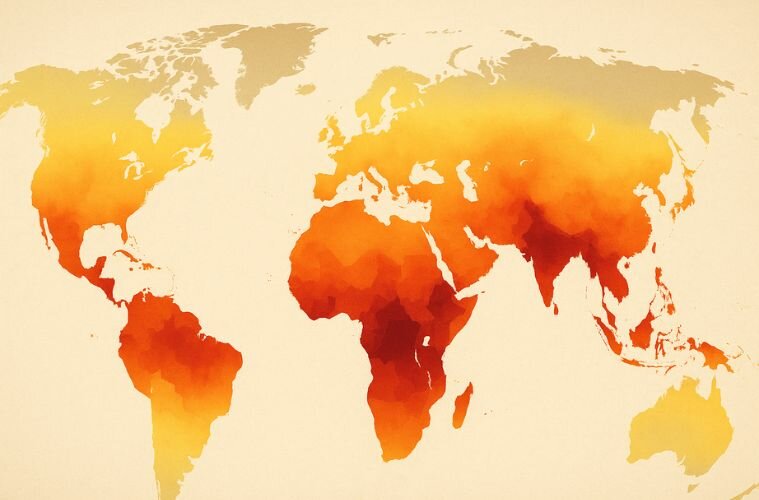
While the updated analysis widens the uncertainty range and nudges the central estimates downward, the distribution of climate impacts remains strikingly similar to the original study. The regions projected to experience the greatest economic losses are still those with the lowest historical emissions and the highest exposure to heat and climate variability. This pattern persists even under the more conservative specifications introduced after the retraction.
The revised figures again show the same stark mismatch: high-income, high-emitting countries face smaller proportional losses, while lower-income regions—particularly in the tropics and subtropics—absorb the steepest declines. These outcomes reflect underlying structural realities rather than modeling quirks. Many of the most vulnerable economies rely heavily on climate-sensitive labor, have limited adaptive capacity, and face elevated exposure to extreme heat and precipitation. Even with corrected data and stronger statistical controls, the inequity signal does not weaken; if anything, its persistence across methodologies reinforces its credibility.
What This Means for Policy and Business
For companies, investors, and policymakers, the implications are difficult to overlook. Correcting the data did not change the basic story: climate damages are unevenly distributed, and the places facing the greatest risks are often the least equipped to absorb them. This has direct relevance for supply chains, workforce planning, and market stability, particularly for global operations anchored in emerging economies.
It also sharpens the case for expanding adaptation finance. If the updated analysis—rebuilt under scrutiny and independently validated against alternative specifications—continues to show disproportionate harm for low-emitting countries, then existing financing mechanisms and resilience strategies remain misaligned with where the greatest economic impacts are expected to fall.
The authors publicly thanked the researchers who identified the original errors and noted that all coauthors agreed to the retraction. They plan to submit the revised manuscript for peer review and will update the retraction notice once a new publication is available. In the interim, the open-access release provides transparency into both the corrected data and the methodology behind the new findings.
Even with broader uncertainty and more cautious modeling choices, the conclusion holds: those least responsible for global emissions continue to face the highest economic costs of a warming world. The updated analysis—born out of scientific correction rather than theoretical rethinking—makes that inequity harder to dismiss.
Final Opportunity to Apply
Help the industry learn from your results, insights, and innovations.
Entries close December 31, 2025.