
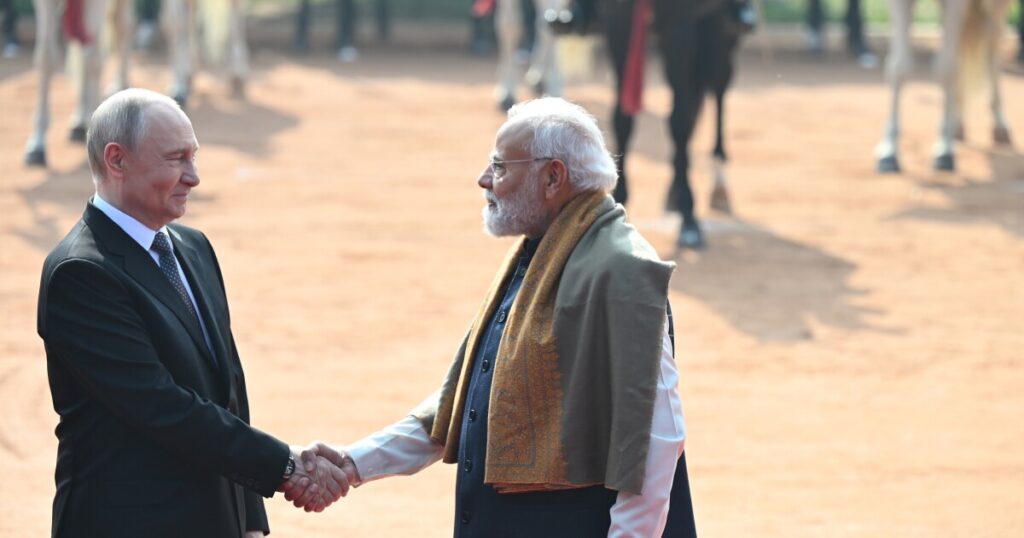
India, the top consumer of Russian seaborne crude oil, rolled out the red carpet for Russian President Vladimir Putin during his two-day visit to New Delhi, which concluded Friday with no announcements of any megadeals on energy, defense or investment.
However, preliminary agreements were signed on fertilizer supplies, investments in civil nuclear energy and critical minerals, and trade and investment cooperation in Russia’s Far East and Arctic zone. Russia also said it would supply “uninterrupted” fuel to India.
Indian Foreign Secretary Vikram Misri told local media that “there was a considerable amount of discussion on nuclear-related issues between the two leaders. … The selection of a site for a nuclear power plant is an elaborate and complicated exercise, and these are all under consideration by the Department of Atomic Energy.”
The visit comes as ties between New Delhi and Washington are the most uncertain and fragile in decades. US President Donald Trump has ramped up pressure on India to reduce Russian oil purchases with a 25% tariff on Indian goods, plus another 25% over trade, putting a strain on ties between New Delhi and Washington, which has been exacerbated by a failure of the sides to reach a trade deal.
In an interview on Thursday with news channel India Today, Putin said, “Our energy cooperation with India remains unaffected by current conditions, fleeting political swings or, indeed, the tragic events in Ukraine. Trade in petroleum products and crude oil, as well as the production of petroleum products for consumers of oil, Russian oil, is running smoothly in India.”
Russian Oil
Russia shipped more than 1.8 million barrels per day of crude oil to Indian refiners in November, for a 37% share of the Indian crude oil import market, according to shipping analytics firm Vortexa. But US sanctions on Rosneft and Lukoil, Russia’s two biggest producers, threaten to erode Russia’s dominance to less than 20% in December, ceding the top position to Iraq after nearly 42 months.
Indian refiners have slashed Russian crude purchases to date in December since Washington imposed the latest round of sanctions, effective Nov. 21, although they continue to buy from nonsanctioned entities.
Payments are a concern, as Indian banks are resorting to stringent checks of trade documents involving Russian oil.
“Over 90% of our transactions are already conducted in national currencies,” Putin told India Today. “While some complications arise due to the presence of numerous intermediaries, there are also solutions: We can switch to the existing systems for exchanging electronic messages on financial transactions of the Bank of Russia and of our partners in India.”
Alluding to the US and EU, Putin also said, “Certain actors clearly dislike India’s growing role in international markets owing to its ties with Russia. Consequently, they’re seeking means to constrain India’s influence for political reasons by imposing artificial obstacles.’’
The EU in July sanctioned Rosneft-owned Nayara Energy, operator of India’s second-biggest single-site refinery, as part of efforts to crimp Russian oil revenues funding the war in Ukraine.
Strategic Autonomy
Indian Prime Minister Narendra Modi, who gave Putin a warm welcome at the airport in New Delhi on Thursday, also reiterated India’s “strong commitment to peace and to finding a peaceful and lasting solution to the conflict in Ukraine.”
India is keen to maintain solid ties with Russia, largely to preserve access to spare parts for the Indian military’s Russian-sourced military hardware and to prevent Russia from becoming so isolated that it becomes a near-vassal state of China, James Crabtree, an academic at the European Council on Foreign Relations, wrote in a recent analysis.
In Washington, analysts see India maintaining strategic autonomy and warn that picking fights with New Delhi damages US supply chain diversification efforts and attempts to counter China.
Successive US administrations have tried to cultivate ties with the world’s most populous democracy as a way of countering growing Chinese power in the Indo-Pacific and reducing supply chain dependencies on Beijing.
But the Trump administration appears to have abandoned that policy and opened the possibility of a trade deal with China.
“Openly putting the squeeze on India as a leverage play against Russia showed just how little Trump worries about losing India’s favor,” Paul Staniland, a nonresident scholar in the South Asia Program at the Carnegie Endowment for International Peace, wrote in an analysis.