
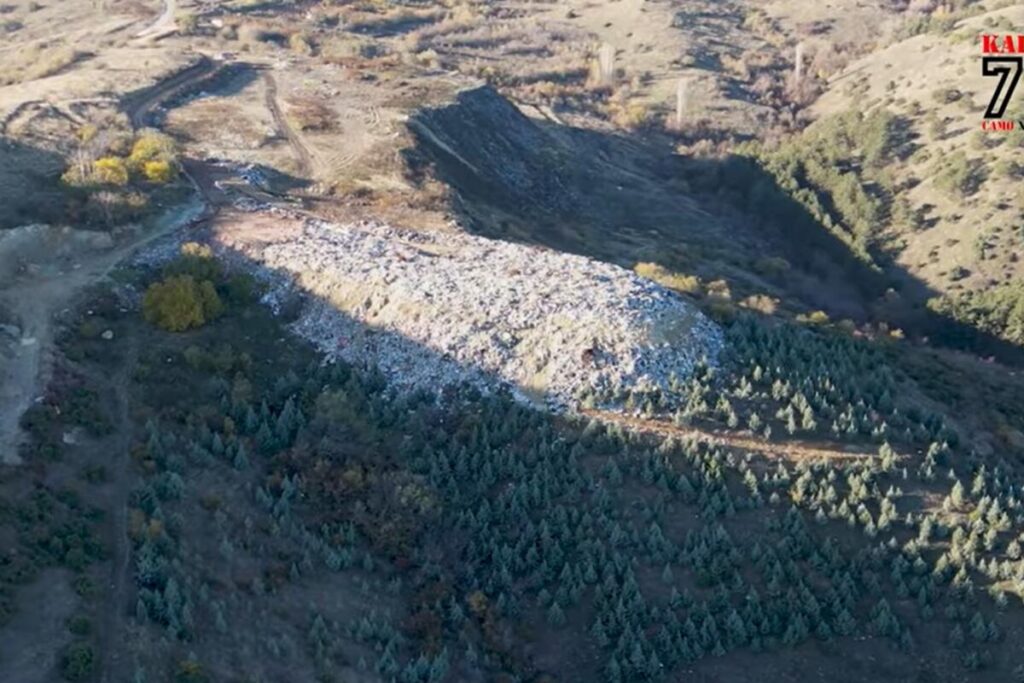
These days mark one year since the 18-day civil blockade of the city landfill above Kočani ended, when citizens gathered day and night to prevent trucks from unloading garbage. The blockade was an act of civil resistance after days, weeks and months of intense smoke from the landfill, which literally enveloped the entire Kočani Valley from the higher areas near the village of Beli, where it is located, from the borders of Vinica all the way to Štip.
The civic initiative committee gave the Kočani Municipality a chance to solve the problem, as it promised — that waste from neighboring municipalities would no longer be dumped and that a supervisory body would constantly monitor the landfill. Then and now, citizens have the same fear — the health consequences.
Citizens presented data on the constant increase in the number of lung cancer patients due to constant air pollution, as well as the frequent respiratory diseases in children as a result.
Preserved and closed landfill near Vinica
Insufficient information is not only a problem for citizens, but also for municipalities and public utilities involved in the construction of the landfill. Representatives of 17 municipalities and public utilities participate in regular meetings of the joint venture that will manage the landfill. Đorđe Pejovski, head of the Department for Local Economic Development in the Municipality of Berovo, says that the construction of the regional landfill has been waiting too long.
“Parts of this project are not fully defined. The illegal landfill in Berovo is being closed, a company has been hired for that, but on the other hand, we are not yet transferring the waste to another municipality, as planned. There is a huge backlog. Ten years is too long to wait; in those 10 years, someone was born and grew up,” says Pejovski.
Public resistance
The project’s lead agency, the Ministry of Environmental Protection and Spatial Planning, explains the delay. The head of the waste sector, Ana Karanfilova Maznevska, explains the delay and slowdown of the project by an extensive monitoring process from the European Union, which is funding the project.
“These are long and arduous procedures that are strictly supervised by the European Bank, because financing is realized through loans, and the procedures must be according to their rules. An additional obstacle is public resistance, not because it is completely unfounded, but because citizens are not sufficiently informed. That is why we will continue information and education activities, because this system is new for our country, but necessary for the future,” says Karanfilova Maznevska.
Waste is the third largest source of greenhouse gases in Macedonia
All of the aforementioned processes are long overdue. This is also stated in the latest European Commission progress report on Macedonia, which states without hesitation: “No tangible progress has been achieved in the northeastern and eastern regions, despite significant financial assistance. The process continues to be hampered by a lack of commitment from local authorities, as well as weak inter-institutional relations and decision-making.”
Even more severe are the remarks in the section on climate change: no more specific measures have been taken to align with the EU Environmental Liability Directive.
“North Macedonia has not initiated investigations into environmental crimes (e.g. illegal disposal of hazardous waste), even though the new Criminal Code has been in force for more than a year. Environmental monitoring does not meet EU standards,” the report states.
The Nikšić case – Montenegro
The waste disposal situation in Macedonia is not much different from that in the countries of the region. In Montenegro, in the Nikšić region, a serious communal crisis occurred due to a burning landfill, after which a decision was made to redirect waste to Podgorica and close the Nikšić landfill. The Nikšić Municipal Council made a decision on a system of separate collection of municipal waste for processing, for which the Ministry gave its consent. Fines of up to 10.000 euros are also provided for non-compliance. World Bank funds have been provided for the construction of a Waste Center in Nikšić.
Landfills will be closed, but methane can have serious consequences for our health, while no one analyzes what is left in the soil under the accumulated waste, believes Ivana Čogurić, one of the founders of the “Ecopatriotism” movement, which fights against the pollution of natural spaces in Montenegro. The presence of drinking water in the immediate vicinity is of particular concern. Čogurić believes that citizens should be provided with the conditions to show care for waste.
“When we reactivate local communities as cultural and educational units as they once were, until they became party cells; when we acknowledge the problems of citizens who complain to their local community, and begin to solve them at higher levels through innovative methods and positive examples from the region or beyond, perhaps the will will emerge among the citizens themselves to hit the trash can and the waste sorting container. Because while we throw all types of waste in the same bin, we are choosing a life full of inconvenience. We have a great chance that hospitals will become accommodation facilities in which there will be no room for us or the youngest, who will suffer what we, the elderly, have collectively sown,” said Čogurić.

Ivana Cogurićphoto: Private archive
The residents of the eastern region of Macedonia have a real chance to get a modern facility that will develop ecological habits in waste management, thereby reducing damage to nature and health. At the same time, they are looking for answers that do not exist yet — what kind of damage we have suffered in recent years due to burning waste in combination with pronounced climate change.
Macedonia has a formal obligation under the UNFCCC (United Nations Framework Convention on Climate Change). This convention requires regular updates on greenhouse gas emissions, which include, among other things, methane emissions from landfills, an assessment of vulnerability and adaptation to climate change, and an analysis of mitigation options. For now, citizens are only receiving general recommendations, but not the requested answers.
Vesna Kolovska Martin Karovski Photo, video and drone: Kire Andonov
Produced with the support of MEMO 98 and UNESCO within the project “Digital Tools and Artificial Intelligence for Climate and Disaster Reporting”, in cooperation with Kanal 77 and TV Vijesti

News