
Today’s edition is powered by Metal Packaging Europe
The proposed EU Steel Measure will harm circularity and raise consumer costs.
Europe must protect the entire steel value chain, including downstream users such as steel packaging, which provides essential goods to consumers and supports circularity across Europe.
——————————————————————————————————————————————————————————————
Europe likes to project that we live in an era of economic pragmatism. “De-risking” has become Brussels’ preferred mission; new economic security packages arrive on schedule; screening regimes are praised as if policy language alone could blunt geopolitical risk.
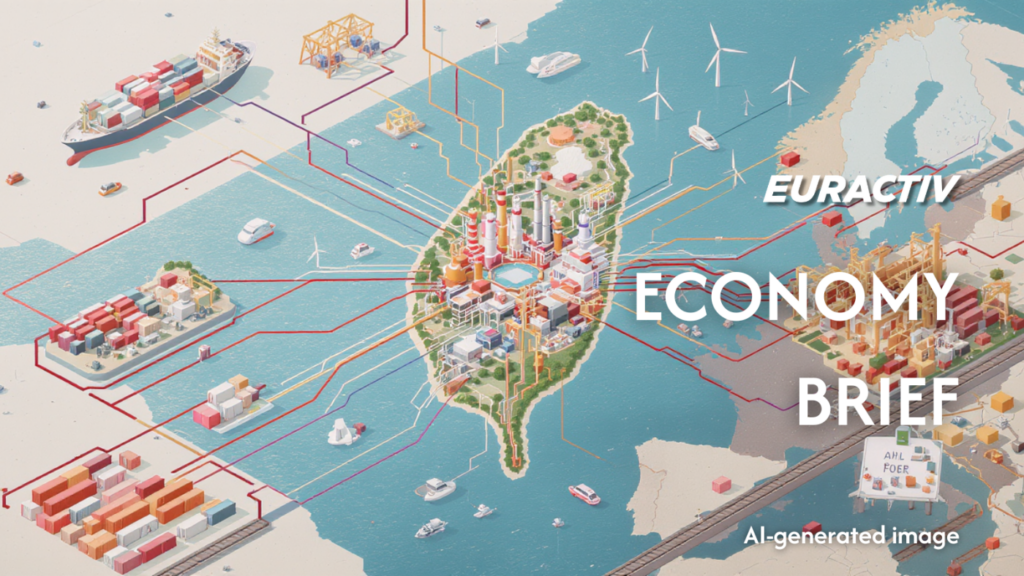
Nowhere, however, does Europe’s confidence collide with reality more than in the Taiwan Strait. Brussels and the capitals simply prefer not to face the trouble brewing in this crucial corridor of global trade.
For Beijing, a democratic, sovereign Taiwan is an island adrift in a political fiction that must eventually be rewritten. For the global economy, it is the high-tech hinge of modern industry. Europe’s reluctance to confront this contradiction only ensures that the shock, when it comes, will be harsher.
A senior Taiwanese delegation that visited Brussels last week made this point with unusual clarity. China’s pressure, Deputy Minister for China Affairs Shen You-zhong told me, is becoming “more advanced and aggressive”. Europe can no longer afford to treat the Strait as a remote concern.
Taipei is urging partners to help build what it calls “non-red supply chains” – strategic sectors such as semiconductors, critical raw materials, defence-adjacent technologies and trusted ICT components, which Beijing cannot weaponise.
“Compromising doesn’t guarantee true peace,” Shen said. A separate diplomatic source was more sober in their warning: Failure to play an active role in preserving the stability of the Taiwan Strait would be “suicide” for Europe.
But as Brussels maps out a new economic security plan, China is steadily reshaping the landscape. Europe is not alone in overlooking a certain narrow stretch of water, but the Taiwan Strait could easily become the globe’s own Triangle of Sadness.
Where Europe hesitates, reality rushes forward
Europe insists it is de-risking, but the region most central to its economic security barely features in public debate. “Has Europe realised that Taiwan is not a fairness issue? Yes and no,” said Michael Laha of the German Council on Foreign Relations.
Strategy papers mention the Strait and emphasise the need for ‘peace’, ‘dialogue’ and ‘free passage’ in the Indo-Pacific. But European companies continue business as usual, as if geography, technology and coercive economics existed in separate worlds.
China is moving fast, the West is losing momentum – and Europe, in Beijing’s view, should adjust accordingly. Inside Brussels, some fear the EU is a rag doll being pulled apart by the US and China.
It’s a framing that Europe’s industry chief Stéphane Séjourné rejects: “The reality is that we are targeted for what we are.” But if Europe is being punished for its liberal democracies and open markets, it has much in common with Taiwan.
In terms of democratic performance, Taiwan is ranked above major EU economies such as France, Italy, Poland, and Spain, according to Freedom House. But the island of 24 million is now in a perilous position, as China asserts control over both Taiwan and the Taiwan Strait, one of the world’s busiest economic arteries.
The Chinese military now conducts frequent drills and missile tests, overt intimidation tactics with profound implications for global supply chains. Nearly 90% of the world’s largest vessels by tonnage transit the Strait, and roughly one-fifth of global maritime trade passed through it in 2022.
Ironically, China itself would suffer the highest economic losses from instability there, with estimates reaching $1.39 trillion.
Taiwanese officials say that Beijing is stepping up its international lawfare, normalising military incursions, and cultivating proxies to weaken Taiwan’s democracy.
And while Taipei celebrates its liberal values, Beijing is flexing its “discourse power” (话语权) to frame global narratives in its favour and subvert the rules-based order to its advantage. But beyond the comms, the struggle is very real.
As the deputy minister put it, China’s lawfare and diplomatic messaging aims to make Taiwan “seem like part of China”, while geoeconomic realities – from semiconductor dominance to maritime chokepoints – pull global attention in the opposite direction.
Trouble in the neighbourhood
Europe is struggling to find its voice in the discussion. Japan, by contrast, has stopped speaking in code. Days into her mandate, Prime Minister Sanae Takaichi said a Chinese attack or blockade of Taiwan could constitute a “survival-threatening situation” for Japan, a legal threshold permitting self-defence.
Beijing responded with daily rebukes and selective trade pressure. The stakes are clear: 95% of Japan’s Middle Eastern energy imports, and a third of its total imports, depend on the waters off Taiwan.
South Korea’s exposure is similar. Seoul’s trade chief recently called to diversify supply chains. Stability in the Strait is not a hypothetical concern but an economic imperative.
Deputy Minister Shen summed up Beijing’s thinking with an old Chinese proverb: “To capture the bandits, seize the leader first” (擒贼先擒王). Japan, he said, is the northern anchor of the first island chain. If China can force Japan to compromise, it becomes much easier to pressure other countries in the region.
Anxieties extend beyond Beijing. With a deal-obsessed businessman back in the White House, Taipei and Tokyo fear Donald Trump might treat Taiwan as a bargaining chip.
And unlike governments, markets are not waiting. The shipping and insurance industries have already begun preparing for a world in which disruption in the Strait becomes a reality.
Lloyd’s underwriters are raising premiums. Some routes now require special war-risk insurance. Quietly, the Strait is being priced as a geopolitical fault line.
Taiwan’s TSMC alone produces over 90% of the world’s most advanced semiconductors, and has been dubbed the island’s “silicon shield”, making China more hesitant to intervene. Even a temporary disruption to production would trigger trillions in global GDP losses.
“If Taiwan ever became Chinese Taiwan, it would be catastrophic for the democratic world,” Shen said. Analysts estimate that a full-scale conflict over Taiwan could wipe out around 10% of EU GDP in the first year, roughly €1.5–1.8 trillion, making Europe one of the worst-hit regions outside Asia.
The Chinese military is projected to have the capability to invade Taiwan by 2027. But is an open conflict likely this decade? Laha believes it’s a “low-likelihood, high-impact event”, but one that governments should nonetheless prepare for.
De-risking, but make it kawaii
While Europe is thinking about de-risking, Taiwan and Japan have shown that targeted diversification is achievable when urgency exists.
In 2010, more than 80% of Taiwan’s outward investment went to China. By 2024, that figure had fallen to single digits, which officials expect to drop below 3% in 2025. The US has overtaken China as Taiwan’s largest export market.
Taiwan’s GDP per capita is on track to surpass $40,000, powered by high-tech industries. “Lowering our dependence on the Chinese market doesn’t mean that our economic growth slows down,” Shen said.
Taiwan, one of the Asian Tigers (the high-growth East Asian economies that industrialised at breakneck speed in the late 20th century), is projecting 7.37% GDP growth for 2025. The eurozone, by contrast, sits at around 1.2%. Few figures capture more clearly the dichotomies of de-risking between Taipei and Brussels.
Japan learned a similar lesson after the 2010 rare-earths crisis, cutting dependence on China from 90% to about 50%. Much of the EU’s playbook, dubbed ‘Resource EU’, is borrowed from Tokyo’s model.
Laha describes Brussels’ strategy as a “modest document” and says that true de-risking would require fully independent secondary supply chains, stricter cyber rules, and political criteria distinguishing trusted suppliers from those vulnerable to coercion – Europe’s version of Taiwan’s “non-red supply chains”. Waiting too long, Laha warns, is the greater danger.
The pain would not be evenly spread. Europe’s core export sectors – automotive, industrial machinery, chemicals, and green technologies – depend on components, chips, and inputs that transit through or originate in the broader Taiwan-China production ecosystem.
To minimise exposure, some European and Taiwanese firms are already partnering. TSMC’s €10bn joint venture with Bosch, Infineon and NXP in Dresden – its first plant in Europe – anchors Taiwanese chipmaking in the EU and strengthens Europe’s push for supply-chain sovereignty. Defence-adjacent technologies – drones, low-orbit satellites, AI – are emerging as shared priorities.
Taiwan, Poland, and Ukraine recently signed a drone MoU, while Israel inspired Taiwan’s T-Dome defence system. These sectors sit at the intersection of civilian and military technology, where Taiwan has a strong industrial base.
Critical raw materials offer another channel, with both sides seeking alternatives to Chinese supply and companies already demonstrating how recycling technology could scale. However, treating Taiwan’s defence as off-limits is no longer prudence but self-harm. By contrast, helping Taiwan raise the costs of aggression is one of the most effective investments Europe can make in its own security and economic resilience.
Europe’s mantra of “de-risking” means nothing if it doesn’t account for the imminent threat to Taiwan. Failure to recognise this could lead the bloc into very dire straits.
Economy News Roundup
Taking on Europe’s fashion industry: Has Shein stolen the show? The opening of the world’s first Shein store in Paris has caused alarm among public authorities, the textile sector, and consumer associations, all of whom fear the advent of China’s ultra-fast fashion in Europe. Read more.
Japanese lesson: Facing mineral squeeze, Europe looks to Tokyo’s secret stockpiles. As Europe races to bullet-proof its supply of the obscure minerals that keep its economy running and its jets in the air, it’s turning to an unlikely coach to de-risk from China: resource-poor, crisis-hardened Japan. Read more.
Japanese lesson: Facing mineral squeeze, Europe looks to Tokyo’s secret stockpiles
As Europe races to bullet-proof its supply of the obscure minerals that keep its economy…
6 minutes
Compromise on rice imports paves way for EU trade preferences overhaul. Negotiators from the European Parliament and Council reached a deal to overhaul the EU’s trade preferences scheme for developing countries, ending a two-year stalemate after breaking the deadlock over a contentious safeguard to limit rice imports into the bloc. Read more.
Eurozone inflation inches up to 2.2% in November. Eurozone inflation inched up in November, official data presented this week, moving slightly over the European Central Bank’s 2% target. Read more.
Parliament to call for 10% bigger EU budget. Parliament is set to call for a €169 billion increase in the EU’s next seven-year budget, according to the first draft of its interim report on the Commission’s 2028 to 2034 Multiannual Financial Framework (MFF) proposal. Read more.
EU rehashes economic doctrine and resources plans to counter China threat. The Commission’s Economic Security Package, published Wednesday, is largely a rebrand of existing trade and raw-materials tools – but the tone has hardened after the EU found itself twice targeted by sweeping Chinese export controls this year. Read more.
EU could force companies to diversify supply chains, Séjourné says. The EU could legally require companies to buy materials outside of China, should insufficient efforts at diversification be made, said industry and trade commissioners Stéphane Séjourné and Maroš Šefčovič when announcing a new resource action plan. Read more.
EU could force companies to diversify supply chains, Séjourné says
The EU could legally require companies to buy materials outside of China, should insufficient efforts…
2 minutes
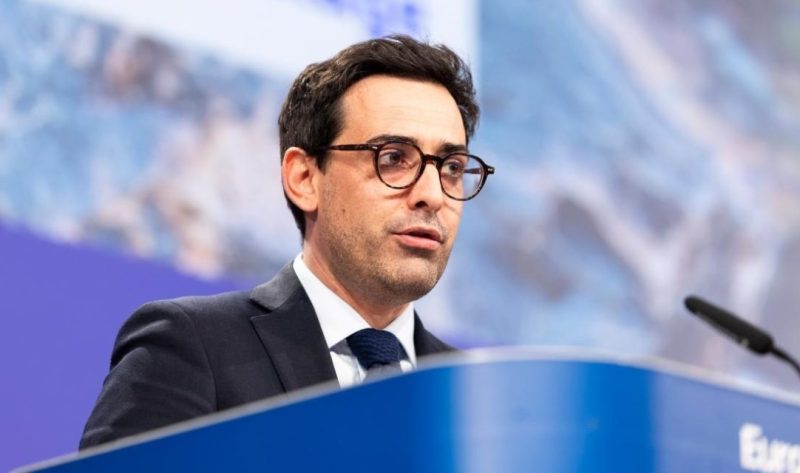
Interview: Korea’s trade chief says EU’s changing rules are ‘challenging’. South Korea’s Trade Minister Yeo Han-Koo recently visited Brussels and told Euractiv that the EU’s drive to “simplify” regulation is in fact creating a new hurdle – the constant churn of new EU rules. Read more.