
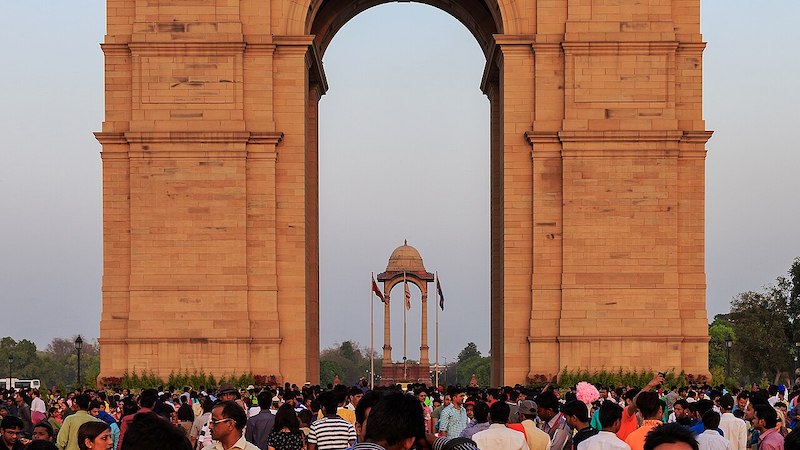
The events of November 24, 2025 at India Gate mark a troubling continuation of India’s increasingly punitive posture toward environmental activism. What began as a peaceful demonstration against Delhi’s suffocating air pollution ended in a violent crackdown, arbitrary arrests, and the death of an environmental activist. Far from being an isolated incident, the episode exemplifies a systemic pattern: the state’s growing tendency to treat environmental advocacy as a security threat rather than a democratic right.
The protest itself was modest in scale. A group of environmental activists, many of them students from Delhi University associated with Bhagat Singh Chhatra Ekta Manch and the Himkhand collective, gathered at the C-Hexagon near India Gate. Their demands were neither new nor radical—urgent action on Delhi’s record-breaking toxic air, stricter enforcement of pollution controls, and accountability for industrial and vehicular violations. For nearly an hour they occupied the road, an act of civil disobedience common in environmental justice movements worldwide. Police warnings to disperse were issued, but instead of negotiation or de-escalation, force quickly followed.
The Delhi Police justified their actions by accusing some demonstrators of breaking barricades and using chili or pepper spray—an allegation highly unusual for environmental protests. Authorities registered two FIRs for assaulting officers, obstruction, blocking public pathways, and conspiracy, describing the protest as “pre-planned.” Yet eyewitness accounts and the nature of the protest suggest otherwise. The police response was disproportionate, forceful, and ultimately deadly.
The death of a protester during this crackdown is tragic but not unprecedented in India. Since 2014, the country has become one of the world’s most dangerous environments for environmental defenders. At least fifty murders were documented between 2015 and 2021 alone, with dozens more in subsequent years. The list of victims is long and sobering: Poipynhun Majaw in Meghalaya killed after exposing illegal mining; Jagabar Ali in Tamil Nadu targeted for resisting mining operations; Rajeshwar Rao shot during a forest land protest in Madhya Pradesh; Ramesh Yadav found dead in Uttarakhand after opposing dam construction. Each case reflects a troubling pattern of collusion between political, corporate, and extractive interests.
What makes environmental defenders particularly vulnerable in India is the nature of the threats they challenge. Illegal mining mafias, land encroachment networks, real estate syndicates, and contractors wield tremendous influence, often operating with tacit or direct support from local authorities. Activists frequently report death threats that go ignored. Many face fabricated cases, constant surveillance, and a media ecosystem that too often labels them as troublemakers or “anti-national.” With weak regulation, powerful lobbying, and an overstretched judiciary, genuine accountability is rare.
The India Gate incident further illustrates how state institutions respond when environmental rights intersect with political narratives. Some protesters raised slogans venerating Madvi Hidma, the tribal Maoist commander killed in a controversial Andhra Pradesh encounter just days earlier. The symbolism placed Hidma alongside tribal-historical resistance icons like Birsa Munda, positioning him within a broader discourse of forest rights and anti-displacement struggles. Authorities seized on these slogans to delegitimize the entire protest, framing environmental concerns as Maoist-inspired dissent. The police narrative swiftly shifted from pollution and public health to national security and law-and-order. Media outlets aligned with the ruling party amplified this framing, branding the protest as anarchic and conspiratorial. In doing so, they overshadowed the core issue that brought the demonstrators to the streets: Delhi’s hazardous air, which routinely ranks among the world’s worst.
This reframing is not accidental. Across India, environmental activism is increasingly securitized. Movements defending forests, opposing mining, or demanding clean air are often portrayed as aligned with insurgency, even when no such link exists. This narrative gives the state license to deploy extraordinary powers, treat peaceful protesters as criminals, and use violence with impunity.
The November 24 incident thus reveals two parallel crises: an ecological emergency and a democratic one. India’s environmental defenders are caught in the crosshairs of both. As air becomes unbreathable, rivers polluted, and forests cleared, those who speak up face surveillance, intimidation, and violence. The convergence of extractive economic interests and national security rhetoric has created an atmosphere in which environmental justice is misconstrued as subversion.
India cannot address its environmental crises while crushing the voices of those who demand accountability. Civil liberties, minority rights, and the right to dissent are essential pillars of any functioning democracy—and essential tools for environmental protection. The death at India Gate underscores the urgent need for independent investigations, police accountability, and stronger legal safeguards for environmental defenders.
Unless India reverses its trajectory of criminalizing environmental activism, the cost will be borne not only by those who protest, but by millions who must breathe toxic air, drink polluted water, and watch their forests disappear with no one left brave enough to speak out.