
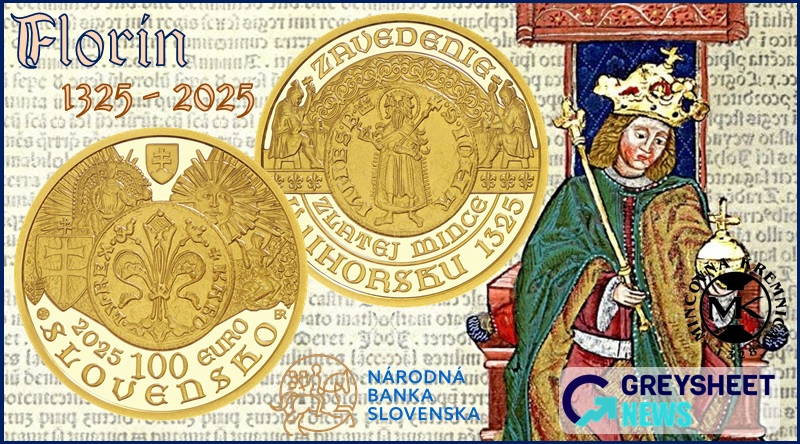
The minting of gold coins in the historical Kingdom of Hungary, which today encompasses present-day Slovakia began with the introduction of the florin in 1325, during the reign of King Charles Robert. The Hungarian florin was patterned after the Italian fiorino d’oro, which had been minted in Florence since 1252 and already known in Hungary by the end of the 13th century. The Hungarian coin was ichnographically identical to the Florentine florin. Its obverse featured the fleur-de-lis emblem of Florence and its reverse depicting Saint John the Baptist, Florence’s patron saint and encircled by the Latin abbreviation of his name, ‘S IOHANNES B’. The Hungarian florins were so similar to their Florentine counterparts that they could be regarded as imitations. The florin had a gold purity of 99% to 99.7% and nominally weighed 3.55 grams with a pure gold content of up to 3.52 grams.
The Kingdom of Hungary was not alone in producing florins on the model of the Florentine coin as many other sovereign states such as Spain, France, Belgium and the Netherlands did the same. King John of Bohemia – present-day Czech Republic, cooperated closely with Hungary when introducing the florin into his kingdom in 1325. The coins were minted at three locations, Buda in Hungary, Kremnica in Slovakia and Cluj Transylvania in present-day Romania. Since all the florins were struck without a mint mark, it is not possible to determine where a particular coin was produced. Owing to its high quality and Hungary’s extensive international trade, the florin was widely exported. It was minted throughout the reign of King Charles Robert and after his death in 1342, they were still produced for some time during the reign of his successor, King Louis the Great.
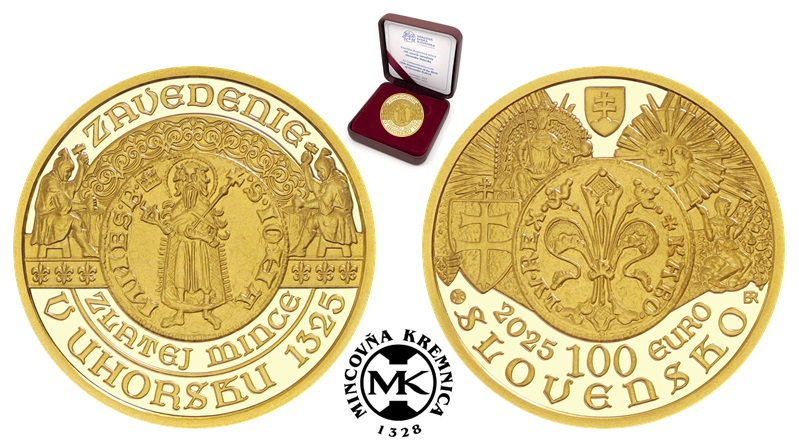
The coins are produced by the Kremnica Mint at their facilities in Central Slovakia on behalf of the National Bank of Slovakia and designed by Branislav Ronai. The obverse features a replicated image of the florin from the reign of King Charles Robert, showing St John the Baptist and the encircling inscription S IOHANNES B ending with a crown. To each side is a minter at work striking a coin and between them curving above the florin is a decorative pattern of intertwined Anjou lilies and beneath each minter is a band of fleur de lis. The inscription ZAVEDENIE is shown above the primary design and ZLATEJ MINCE V UHORSKU 1325 (Introduction of gold coinage in Hungary 1325) is placed below arranged in two rows along the curvature of the coin. The reverse side depicts the historical Hungarian florin introduced by King Charles Robert featuring the classic Florentine fleur-de-lis and the inscription KAROLV REX. To the left is a shield with a double cross together with a smaller shield, the Hungarian Angevin coat of arms shown to the left near the rim. Above the crest is a depiction of the king on his throne and at the top is the current Slovak coat of arms. To the right is an image of the sun and below is a miner extracting ore. Just below the primary design is the year 2025 and the denomination 100 EURO. Below the year and face value is the text SLOVENSKO along the lower rim. To the left of the text is the mint mark of the Kremnica Mint and to the right are the stylised initials BR of the coin’s designer.
Available from the 25th November, each proof quality coin is encapsulated and presented in a custom case accompanied with a certificate of authenticity. For additional information, please visit the e-webshop of the Kremnica Mint, official distributors.