
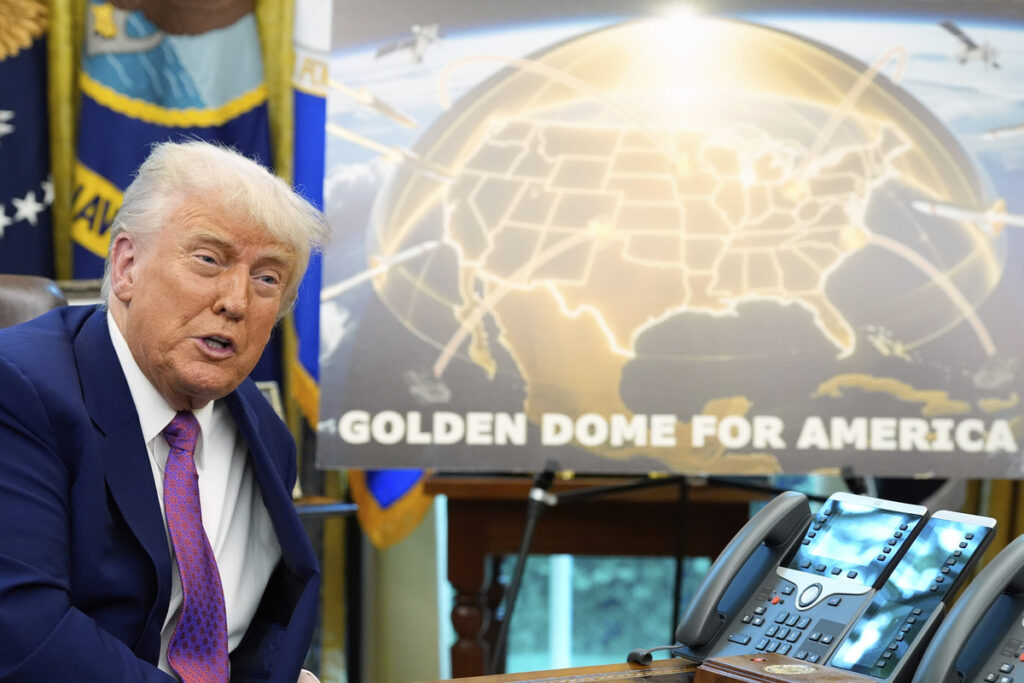
Defense Secretary Pete Hegseth said the U.S. is “accelerating” the development of its Golden Dome missile defense shield and indicated Washington is still forging ahead with planned nuclear testing.
Why It Matters
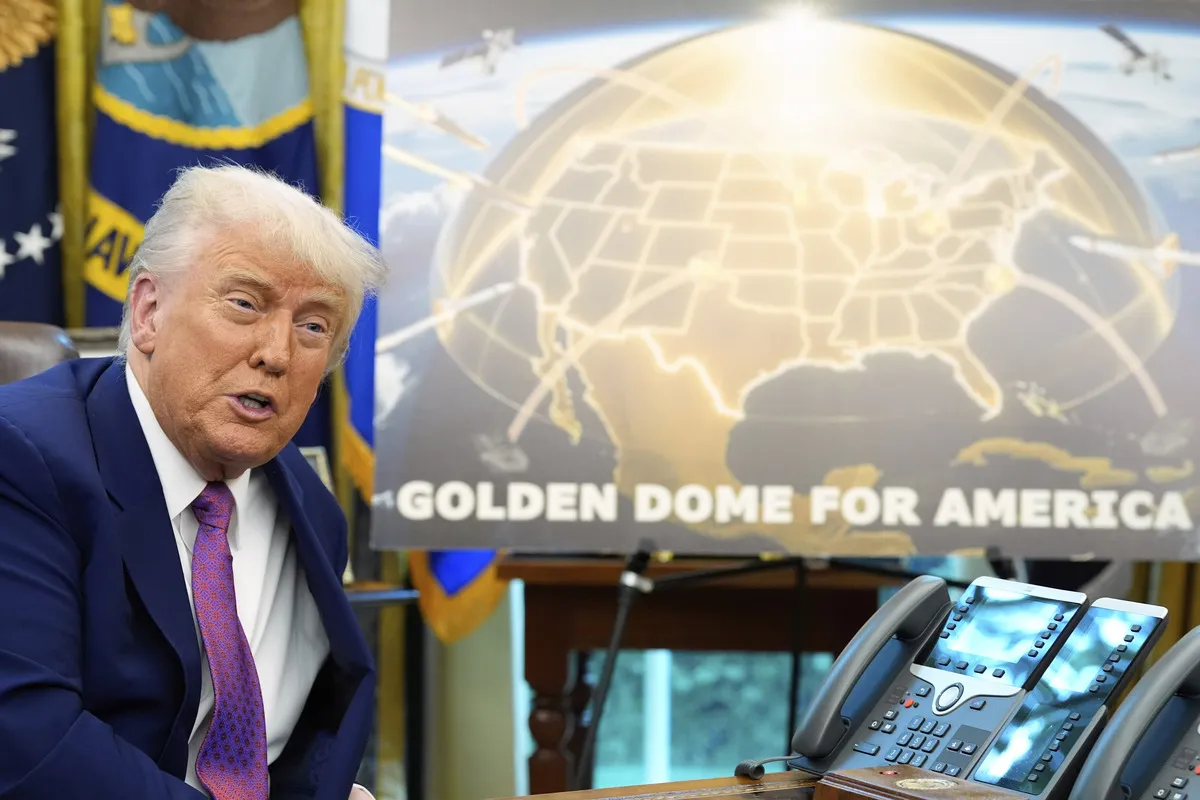
President Donald Trump unveiled initial plans for the “state-of-the-art” Golden Dome in May, which he said would be up and running by the end of his time in office to defend against “next-generation” threats like ballistic, cruise and hypersonic missiles.
An enormous military project criticized by Russia, China and North Korea, more than 1,000 companies could be involved in piecing together the Golden Dome. The name takes inspiration from Israel’s vaunted Iron Dome air defenses, although they are designed to intercept short-range threats, not long-range missiles.
What To Know
Speaking at the Reagan National Defense Forum in California, Hegseth said the Golden Dome will offer “tangible protection” for the U.S. before the end of the current administration.
“President [Ronald] Reagan promised SDI, Strategic Defense Initiative,” Hegseth said. “President Trump’s doing the same thing, now the tech has caught up and we can actually build the Golden Dome for America.”
Trump has framed the Golden Dome system as the end result of the SDI program kicked off by Reagan in the 1980s, popularly known as “Star Wars.”
The Golden Dome will use space-based sensors and interceptors to knock out missiles “even if they are launched from space,” the president said. Militaries across the world have increasingly turned to space in developing new weapons and capabilities.
But the project, already forecast to cost several hundred billions of dollars, is facing significant delays linked to the previous government shutdown and lack of clarity around the initial $25-billion investment, Reuters reported last month.
As it stands, the U.S. does not have a joined-up system for intercepting large-scale intercontinental ballistic missile (ICBM) strikes launched from Russia or China, although it would be able to take out the relatively small number of missiles that North Korea could fire at the U.S.
Western countries have trailed behind Russia and China in developing hypersonic weapons—expensive and difficult-to-produce systems able to travel upward of five times the speed of sound, or Mach 5.
The missiles, which can be launched from the ground, air or sea, are able to maneuver midflight, making them extremely hard to detect, track or intercept.
Hegseth also said the U.S will test nuclear weapons and delivery systems on an “equal basis” with other countries.
Trump said back in October that Washington would restore nuclear testing to match activities from unspecified nations. His remarks were opaque, leaving doubt over whether the president referred to tests of delivery systems or warheads, although Energy Secretary Chris Wright suggested shortly after the remarks that the U.S. was not planning on carrying out nuclear explosions.
The 1996 Comprehensive Nuclear Test-Ban Treaty prohibited all explosions. The U.S. signed the treaty, but has not ratified it, while Russia withdrew its ratification in 2023. But both sides would have to pull their signature if they no longer intend to observe the treaty.
The U.S., Russia and China—the three countries with the largest atomic arsenals—have not conducted full nuclear tests since the 1990s, although drills to make sure weapons still function correctly have continued in the decades since. North Korea is the only known exception, and the last test the Kremlin carried out was during the now-collapsed Soviet Union.
Several Democrat lawmakers reintroduced legislation earlier this week they said would help counter “reckless nuclear policy from the Trump administration.”
What People Are Saying
Defense Secretary Pete Hegseth called the Golden Dome a “gamechanger” in an address in California on Saturday, and said the U.S. would never be “vulnerable to nuclear blackmail.”