
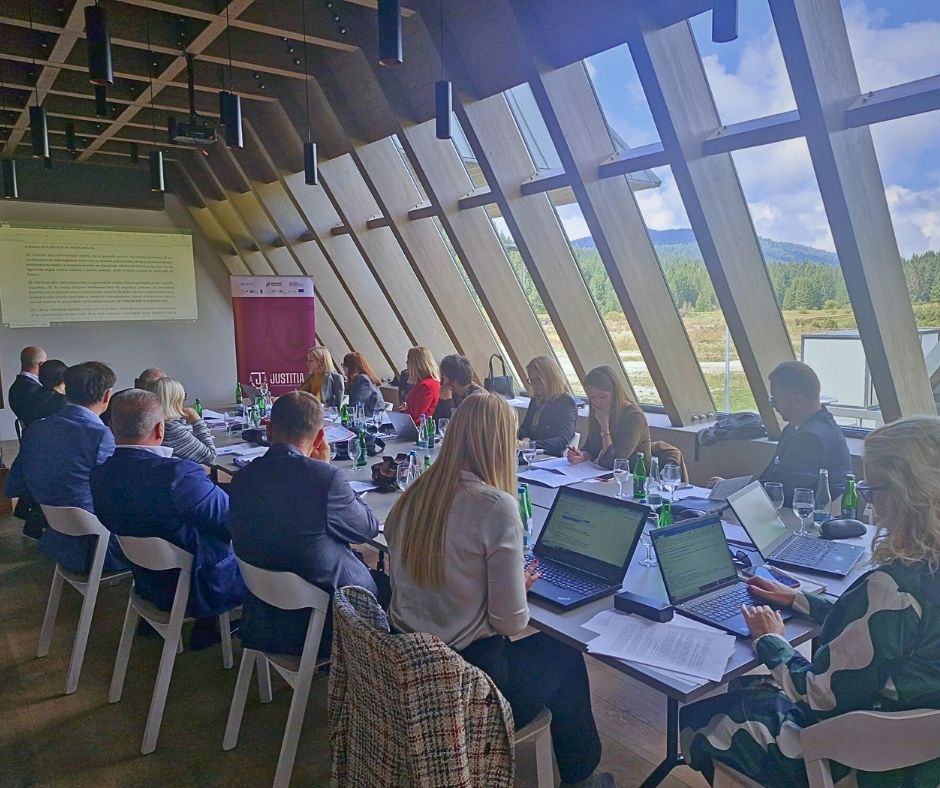
Hadžići, Bosnia and Herzegovina, 29–30 September 2025 — Under UNODC’s Project Justitia, the Ministry of Justice of Bosnia and Herzegovina (BiH) convened a two-day meeting of its Criminal Code Working Group to finalize amendments harmonizing national legislation with the UN Protocol against the Illicit Manufacturing of and Trafficking in Firearms, Their Parts and Components and Ammunition (UN Firearms Protocol).
The session, facilitated by the UNODC Global Firearms Programme, brought together representatives of the Ministry of Justice, the Court of Bosnia and Herzegovina, the Directorate for European Integration, the Supreme Courts, Prosecutor’s Offices and Judicial Commissions of the Federation of BiH and Republika Srpska, and international partners including UNODC, the EU and OSCE.
Building on recent Justitia activities with the Centres for the Education of Judges and Prosecutors in the Federation of BiH and in Republika Srpska, UNODC provided technical inputs focused on strengthening the criminal response to firearms trafficking. Participants discussed the international legal framework, national harmonization needs, and proposed refinements to sanctions addressing participation in organized groups that commit firearms offences.
Following the line-by-line review, the Ministry of Justice will consolidate the final draft amendments and submit them for confirmation as the next step in the adoption procedure. UNODC will continue to support national counterparts throughout the legislative process and subsequent implementation, including judicial practice harmonization and training under Project Justitia.
As a result of the event, the Working Group endorsed a minimum three-year sentence for organizing a group to commit firearms offences and confirmed that dual-use products remain covered under Article 193, while special-purpose goods continue to be regulated under the foreign-trade control law, enabling the Ministry of Justice to finalize the consolidated draft.
Project Justitia strengthens criminal-justice responses to firearms trafficking in the Western Balkans through legislative alignment, judicial practice harmonization, and specialized training for judges and prosecutors. The project has supported regional work on Special Investigative Measures, case-law collections, and courtroom-focused training across the Western Balkans, in cooperation with judicial institutions and partners.
This activity is implemented with financial support provided by Germany, the United Kingdom, Sweden, France, the Netherlands, and Norway through the Western Balkans SALW Control Roadmap Trust Fund, and supported by the European Union.