
The deterioration of Belarusian-Ukrainian relations after February 2022 did not mean the absence of Belarusians on the Ukrainian side. On the contrary, while Lukashenka aligned himself with Moscow and allowed Russian forces to use Belarusian territory for the assault on Kyiv, many of his opponents chose a different path.
December 7, 2025 –
Yevhen Magda
– 
AnalysisIssue 6 2025Magazine
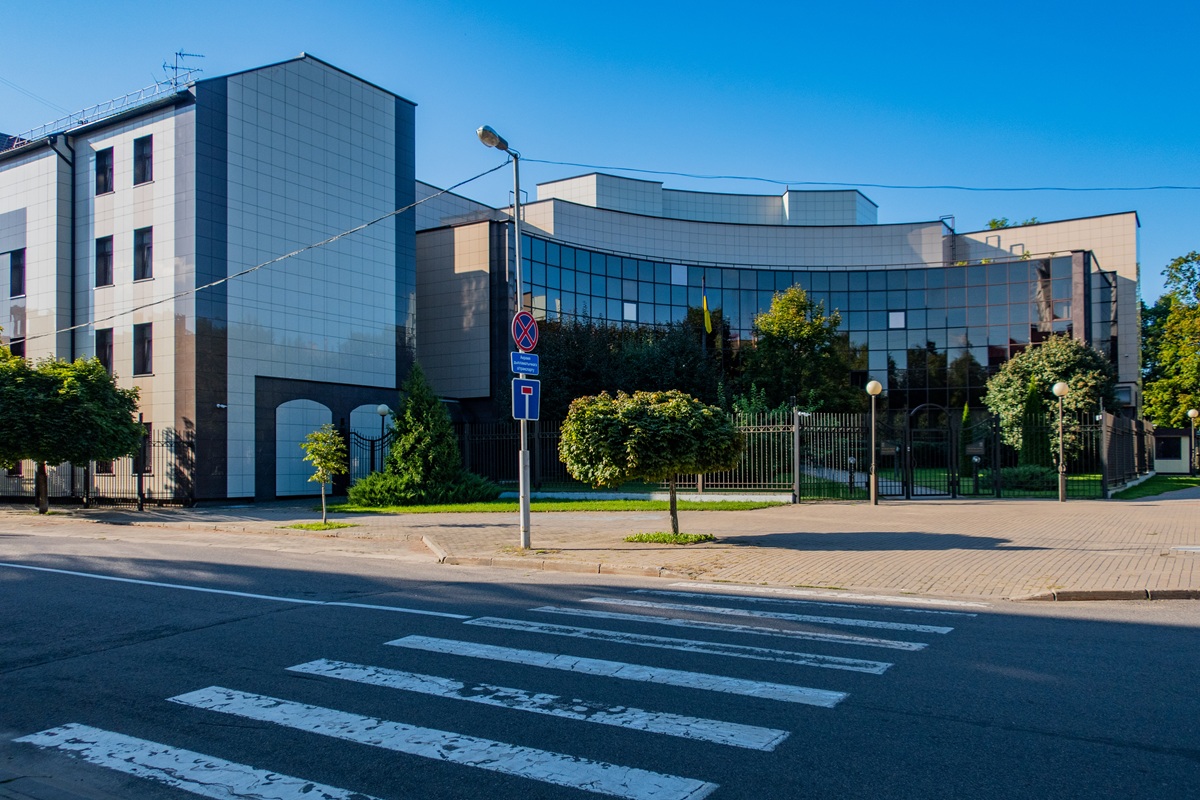
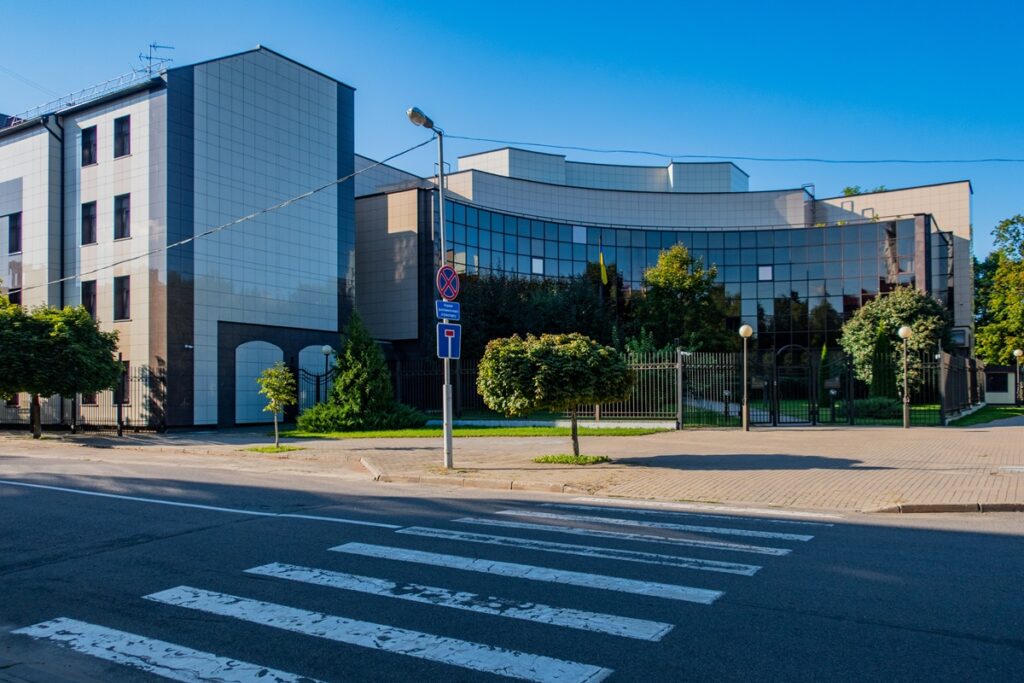
The embassy of Ukraine in Belarus. Minsk, Belarus.
Photo: Homoatrox (CC) commons.wikimedia.org
Between 2020 and 2025, relations between Belarus and Ukraine underwent a significant transformation, sliding into a deep crisis despite the formal maintenance of diplomatic ties. Political dialogue between Minsk and Kyiv has largely disappeared, trade has almost entirely collapsed, while the inter-state border now functions as a fortified barrier.
At present, Belarus-Ukraine relations can best be described as hybrid. Over these years, a fundamental shift has taken place: Belarus moved from being a mixed partner of Ukraine, at times providing strategically important materials, to serving as Russia’s principal collaborator in Europe. The 2020 protests were a decisive turning point for Alyaksandr Lukashenka. Since then, his legitimacy has not been restored, yet his geopolitical alignment has changed dramatically. Today, the Belarusian leader closely follows the Kremlin’s policy line, while his room for independent manoeuvre has been reduced to a minimum.
Illusionary hopes
The circumstances that forced Lukashenka to shift his position are evident. He is effectively repaying Russia for its willingness to support him during his crashing of the 2020 protests. Paradoxically, the term “special military operation” could just as easily have described a hypothetical deployment of Russian units to Belarus during the protests of August-September 2020. Such an intervention, however, has never taken place. The hopes that Belarus might strengthen its political agency and break free from the Kremlin’s influence quickly proved illusionary. Instead, the country remains trapped in ideological narratives about the “triune Slavic people”, that is the idea that Russians, Ukrainians and Belarusians belong to a single, united family of East Slavic people; the alleged destabilizing role of the West; and a deliberate exclusion of any anti-Russian elements from the official rhetoric. Lukashenka’s contacts with Vladimir Putin have only deepened since that moment, and his public statements now include references to Russia’s “new regions”, meaning the occupied territories of Ukraine.
The anti-Lukashenka protests in 2020 marked the starting point of a fundamental change in Belarus-Ukraine relations. Interpreted by the authorities as an attempt to overthrow the regime in Minsk, they not only entrenched domestic repressions but also triggered mass emigration. Hundreds of thousands of Belarusians fled their homeland to escape persecution. The existing visa-free regime made Ukraine the most accessible destination, and as a result a large Belarusian community settled there. Yet the Ukrainian leadership was slow to articulate a clear position on the dramatic events in Belarus. It also failed to channel the human potential of Belarusian migrants in ways that could have served Ukraine’s national interest.
A falsely pragmatic approach
The subsequent course of events unfolded in a paradoxical manner. In 2021, after the EU introduced sanctions against Belarus, Ukraine aligned itself with these measures, including by suspending air traffic with Minsk. The immediate trigger for sanctions was the forced landing of a Ryanair flight from Athens to Vilnius in May 2021 and the detention of Roman Protasevich, one of the leaders of the NEXTA media project, together with his partner. At the same time, however, the Ukrainian leadership pursued what could be described as a falsely pragmatic approach towards Lukashenka’s regime. While refraining from political recognition of Lukashenka, Zelenskyy’s government continued to import bitumen, fuel, lubricants, and electricity from Belarus. In 2021 alone, these trade operations brought Minsk around 2.9 billion US dollars, a figure that understandably provoked strong criticism from the Belarusian democratic forces.
It is worth stressing that Lukashenka’s opponents – largely drawn from NGOs and civil society – deliberately avoided calling themselves an “opposition”. The term they prefer to use is that of “Belarusian democratic forces”. This semantic choice gained little traction in Ukraine and significantly complicated dialogue between Sviatlana Tsikhanouskaya’s team and Ukrainian politicians. Compounding matters, many of Lukashenka’s most visible opponents, including Ales Bialiatski, Viktar Babaryka, and Maria Kalesnikava, were imprisoned, while Tsikhanouskaya and her entourage lacked the political weight and experience to break the ice with Kyiv. Although Tsikhanouskaya enjoyed a political “honeymoon” in relations with Lithuania and Poland, her team was in no hurry to build a comparable level of engagement with Ukraine.
Contrary to a common assumption, the final stage of preparations for Russia’s full-scale invasion of Ukraine from Belarusian territory was not the Zapad 2021 exercises held in autumn of that year. Instead, it was the joint Russian-Belarusian Allied Resolve drills which were conducted in early 2022. These manoeuvres were preceded by the migration crisis on Belarus’s borders with Lithuania and Poland, which effectively served as a distraction. Under the cover of exercises, the Kremlin deployed a strike group in Belarus, whose real mission was to advance on Kyiv. There are grounds to believe that Lukashenka was generally aware of Moscow’s strategic intentions – something suggested by his February 2022 interview with Russian propagandist Dmitry Kiselyov – although he likely did not know the exact date of the invasion.
Under the white-red-white flag
The invasion on February 24th 2022 permanently reshaped Ukrainian attitudes towards Lukashenka. Although his rating among Ukrainians rose somewhat after Russia’s hybrid aggression in 2014 and the end of the term of Lithuania’s President Dalia Grybauskaitė, this was only a temporary phenomenon. Since 2022, the Belarusian self-proclaimed president lost this ground and cannot expect to recover it. His own words – “Putin and I are co-aggressors” – combined with Russia’s use of Belarusian territory to launch missile strikes against Ukraine, brought about a serious deterioration in Belarusian-Ukrainian relations. What is more, Lukashenka’s opponents, particularly those ready to take up arms, have moved into the spotlight and gained new significance.
The deterioration of Belarusian-Ukrainian relations after February 24th 2022 did not mean the absence of Belarusians on the Ukrainian side. On the contrary, while Lukashenka aligned himself with Moscow and allowed Russian forces to use Belarusian territory for the assault on Kyiv, many of his opponents chose a different path. Belarusian volunteers had already been present in Ukraine’s defence forces since 2014, when the tactical group “Belarus” was created. The first Belarusian casualties date back to the Anti-Terrorist Operation and later the Joint Forces Operation.
After the outbreak of the full-scale war, Belarusians fighting under the white-red-white flag managed to stand out amid the wave of Ukrainian citizens who rushed to defend their homeland. A turning point came on Freedom Day, March 25th 2022, with the formation of the Kastuś Kalinoŭski Battalion, which later expanded into the Kastuś Kalinoŭski Regiment. Today this is the largest foreign contingent within Ukraine’s defence forces. All in all, over the past three and a half years, several hundred Belarusians have served in these volunteer ranks, more than 60 have been killed, and at least two – known by their call signs “Klishch” and “Trombli” – remain in Russian captivity. Among those who gave their lives in combat against Russia were such respected figures as Miroslav Lazovsky (“Mysh”) and Ivan Marchuk (“Brest”).
In autumn 2022, missile strikes from Belarusian territory against Ukraine ceased, most likely after Lukashenka had received a discreet warning from Kyiv about possible retaliatory strikes. Belarusian oil refineries, after all, lie within the reach of Ukrainian missile and artillery systems. Notably, in the first weeks of the full-scale invasion, Russian and Ukrainian delegations met in Belarus for ceasefire talks. These talks failed, and Lukashenka’s potential as a mediator has now proven exhausted. However, in December 2022, the first Ostroh Forum took place in Lviv, bringing together Ukrainian and Belarusian experts and politicians to discuss the future of bilateral relations.
Since autumn 2022, various representatives of the Belarusian democratic forces have visited Ukraine. Pavel Latushka and Zianon Pazniak, Franak Viačorka and Anatoly Lebedko, Vadim Kabanchuk and Anzhalika Melnikova, Valery Kovalevsky and Zmicier Shchygelski – all held meetings in Kyiv, often with Mykhailo Podolyak, advisor to the head of the Presidential Office and informal curator of relations with the Belarusian democratic forces. Yet, at the official level, expectations were modest. Occasional encounters between Zelenskyy and Tsikhanouskaya at international events were limited to greetings and handshakes. A full-fledged visit by Tsikhanouskaya to Kyiv still remains unlikely.
A paradoxical role
Although Belarusian diplomats withdrew from Ukraine on March 19th 2022, diplomatic relations between the two states did not collapse altogether. In April 2023, however, after Lukashenka hosted Denis Pushilin – the head of the so-called Donetsk People’s Republic and Russia’s collaborator – in Minsk, Kyiv recalled its ambassador, Ihor Kyzym. By the end of the year, Kyzym was formally dismissed, and his Belarusian counterpart in Kyiv, Ihor Sokol, also lost his post. Even so, a handful of Ukrainian diplomats remain in Minsk.
At the same time, Belarusian territory has assumed a paradoxical role in the war. In 2022 and 2023, Ukrainians who had been illegally deported by the Russian occupying forces were able to return home via Belarus. The country has also served as a transit point for occasional prisoner exchanges between Russia and Ukraine.
At the beginning of 2023, an unidentified drone strike damaged a Russian A-50 early warning and control aircraft stationed at the Machulishchy airbase in Belarus, forcing its relocation to Russia. This episode marked a turning point in military cooperation between Moscow and Minsk, and its various dimensions call for a closer examination.
On March 25th 2023, Vladimir Putin declared his readiness to deploy tactical nuclear weapons on Belarusian territory “at the request of Alyaksandr Lukashenka”. This move was not only an act of nuclear blackmail – a central instrument in the Kremlin’s strategy – but also an asymmetric response to the International Criminal Court’s arrest warrant issued for Putin. The subsequent developments – Lukashenka’s interviews with Russian propagandists, training exercises for nuclear-capable delivery systems, and the orchestrated hysteria surrounding the so-called “Oreshnik” system – only underscored the extent to which Minsk’s actions remain directed by the Kremlin.
Russia also maximized its use of Belarusian army stockpiles of military equipment and ammunition to replenish its own reserves. The next logical step was the cooperation of Belarusian enterprises with Russian companies, as well as the independent fulfilment of orders for the Russian military-industrial complex. The scale of this interaction continues to grow. Such cooperation reflects Lukashenka’s strategy of avoiding direct participation in combat operations while maintaining loyalty to Putin.
A striking demonstration of this loyalty came with the transfer of Wagner Group units to Belarus after Yevgeny Prigozhin’s failed mutiny in the summer of 2023. Seemingly, the Wagnerites vanished into Belarusian forests; some became instructors for the Belarusian Interior Ministry’s Internal Troops, while others left the country. Lukashenka effectively performed uncomfortable tasks on Putin’s behalf.
In recent months, Lukashenka has renewed his attempts to present himself as a mediator in efforts to end the Russia-Ukraine war. Several factors appear to have encouraged this initiative: the smooth reaffirmation of his presidency in January 2025; a series of successful operations by Belarusian and Russian security services against political opponents; and a tentative warming of relations with the United States. Yet, Kyiv continues to view Lukashenka with deep mistrust, and there is little prospect that such trust could be restored. At the same time, the internal situation within the Belarusian democratic forces – marked by the concentration of influence in the hands of Tsikhanouskaya and the organizational weakness of its structures – has likewise hindered the intensification of dialogue.
Current Belarus-Ukraine relations are thus summed up by the following developments. Kyiv is not prepared either to restore full diplomatic relations with Minsk or to deepen its engagement with the Belarusian democratic movement. The role of Belarusian volunteers in Ukraine’s defence forces is gradually diminishing for both objective and subjective reasons, though their presence remains visible. Ukrainian representatives continue to maintain political contacts with the democratic forces, while communication with Minsk takes place primarily through intelligence channels. Economic ties are negligible, despite Lukashenka’s repeated signals of interest in participating in Ukraine’s post-war reconstruction.
Looking ahead, a logical step would be the articulation of a joint position on Belarus within the framework of the Lublin Triangle. This could also provide an opportunity to transfer and promote Ukraine’s experience given the many shared features of Minsk and Kyiv’s post-Soviet trajectories.
Yevhen Mahda is a Ukrainian political scientist and analyst and the executive director of the Institute of World Policy, a think-tank based in Kyiv.
