
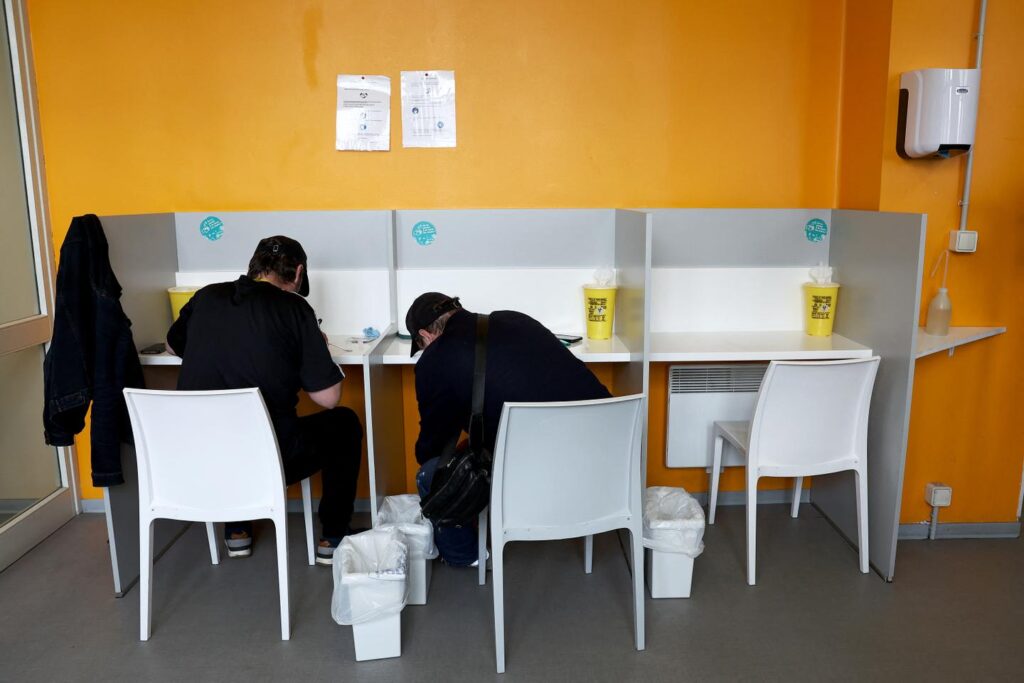
 Supervised injection site Argos in Strasbourg, France, June 4, 2025. FREDERICK FLORIN/AFP
To say that Dr. Elisabeth Avril is tired of the never-ending debate is an understatement: “What more do we need to secure the future of the room?” As she prepared to open Paris’s addiction treatment center, known as an HSA, on the morning of Thursday, November 6, the longtime advocate for the project did not hide her disappointment. In the French capital as in Strasbourg, the only two cities in France to host drug consumption rooms, these facilities, which have been operating on an experimental basis for nine years, could close on December 31 if nothing is provided for in the law by then.
Their fate depends on a government amendment to the proposed social security funding legislation, under debate in the Assemblée Nationale, which calls not for permanent status but for a further “extension” of the experiment until December 31, 2027. The amendment itself depends on the future of the bill, which is destined for a parliamentary journey as chaotic as that of the budget.
This is at the root of Avril’s fatigue: All the evidence has already demonstrated the effectiveness and usefulness of these HSAs. In an op-ed published in Le Monde on November 6, a group of healthcare workers argues that “these places are the most effective and humane response to street drug use. All evaluations confirm it: Scientifically, socially and practically, it works.”
You have 71.63% of this article left to read. The rest is for subscribers only.