
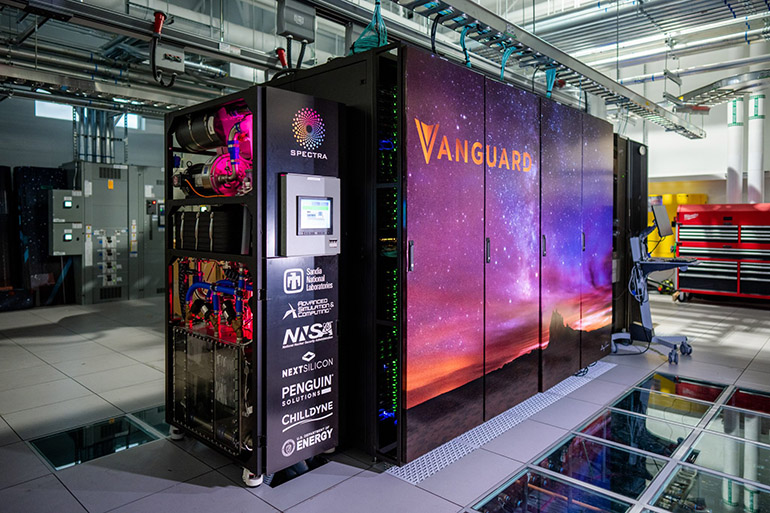
 Sandia National Laboratory and NextSilicon, a technology company, collaborated to create a supercomputer designed to prioritize tasks in real time, Sandia announced on Monday. The computer, called Spectra, could alter how the nation conducts high-stakes simulations for its nuclear deterrence mission. In other words, while it won’t top the TOP500 list of supercomputers, the prototype will test a novel architecture.
The power of the Maverick-2
Spectra features 128 of NextSilicon’s Maverick-2 dual-die accelerators, specialized chips that analyze code to prioritize tasks. Spectra’s prioritization ability could increase performance while reducing power consumption.
An advantage of the Maverick-2’s design is that it simplifies moving applications to the new system. Maverick-2’s algorithms can profile an entire application and identify hotspots and likely flows, allowing it to optimize the hardware autonomously. The Maverick-2 does not require code changes or software stack reinvestment. It supports a variety of popular programming languages, including C/C++, FORTRAN, OpenMP and Kokkos. Many applications can run on Maverick-2 without modification, meaning researchers do not need to rewrite code. This could save months to years of work that researchers normally spend optimizing their software to the latest hardware.
Enhancing national security
Sandia is now leading a consortium with Lawrence Livermore and Los Alamos National Laboratories under the National Nuclear Security Administration’s Advanced Simulation and Computing (ASC) program. The collaboration aims to understand how Spectra will handle national security-related tasks that help assess the safety of the nation’s nuclear deterrent without underground testing, which the U.S. ended in 1992.
Spectra is the second platform in Sandia’s Vanguard program, which explores the viability of emerging technologies for ASC mission applications. The first platform, called Astra, was introduced in 2018. Astra is a supercomputer run on Arm processors. Previously, Arm processors had been used for low-power mobile computers like phones.
“By deploying prototype systems, we will investigate whether new technologies can be integrated into our large production platforms in the coming years,” said Simon Hammond, director of the Office of Advanced Simulation and Computing and Institutional Research and Development Programs at the National Nuclear Security Administration.