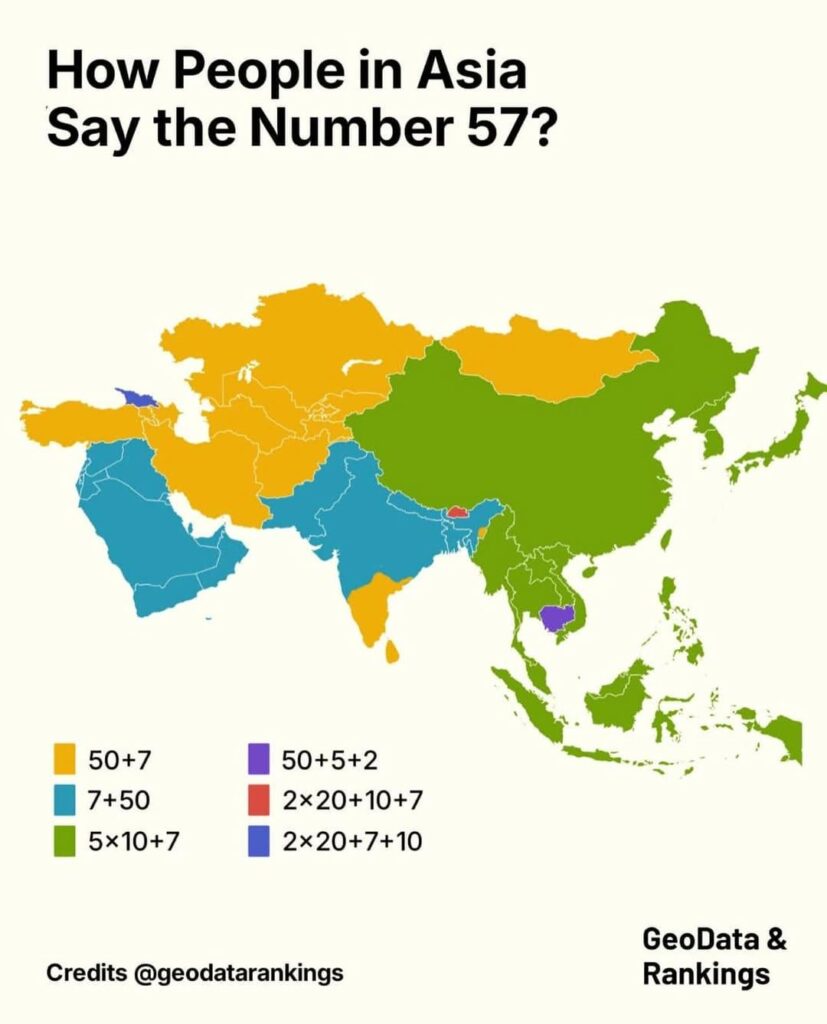
Cambodia and Bhutan, they don’t care about the outside world.
GuardHistorical910 on
Arabs say 7+50~~+100+3000 because they read from right to left~~. [edit: this part seams not to be fully correct, had a false memory] europeans learned “arabic” numerals from arabs, initially adopted that system but changed quite quickly. most languages changed order of the tens and ones over time and had times where both was acepted. even in english.
In medeival german it also used to be regionally eather 50+7 or 7+50. Martin Luther wrote 7+50 and that stuck.
In Check Republic and i *think* allso in some scandinavian countys still both is correct. while 7+50 tends to be more casual and 50+7 for more acurate context.
There is a german association, that advocates for 50+7 in school context and i think they have a point. [https://zwanzigeins.jetzt/](https://zwanzigeins.jetzt/)
OhNoMeIdentified on
is this map after ww3?
HippoPottyMouth-1 on
“Four Score and 7 years ago..” This is a famous example of the vigesimal system that has roots in many languages including older English. It literally means 4 x 20 + 7.
NMnine on
Those colours are cheeks
Dear_Specialist_6006 on
Being from Indo-Pak I can tell you, I don’t even know what this means
SOLISTER_ on
Korean has both 5*10+7 and 50+7
apocalypse-052917 on
Tamil isn’t 50+7, it’s 5*10+7
CantoSacro on
I’m curious how they differentiate between 5×10+7 and 50+7. In English, 50 has it’s own word, so you could say it is 50+7. But the root of the word fifty is literally “five tens”, so 5*10+7 works also.
limeralism on
This is not accurate. In Georgian its ორმოცდაჩვიდმეტი which literally means forty and seventeen.
M0rph0ne on
Korean and Japanese are both natively 50+7 like Turkish and Mongolian, and their new 5×10+7 systems are adopted from Chinese characters.
As for two digit numbers like 57, the native Japanese number system is obsolete and they now only use the Chinese system 5×10+7. However, in Korean, both systems are used.
OOOshafiqOOO003 on
Lima puluh tujuh
5*10 + 7
mizinamo on
For Hindi, every number from 1 to 99 has to be memorised separately; 57 is *not* made up out of the words for 7 and 50.
* सत्तावन = sattaavan = 57
* सात = saat = 7
* पचास = pacaas = 50
The number words make sense in Sanskrit, but the sound changes to Hindi made a huge mess out of it. You can still recognise *patterns*, but it’s not regular by any means.
You can see the similarity between *saat* and *sattaa-*, but they’re not the same vowel length nor the same consonant length, nor even the same number of syllables. And *-van* and *pacaas* bear no visible relationship at all.
If you go back to Sanskrit *saptapañcāśat* and take the individual portions *sapta* and *pañcāśat*, you can kind of see how *sapta* turned into *saat*, *pañcāśat* turned into *pacaas*, and *saptapañcāśat* turned into *sattaavan*.
But synchronically?
Different bits got eroded in each component.
It’s like trying to figure out how “could**a**” and “I’**ve**” are related.
—————-
“But wait!” you say. “Perhaps the combining forms *satta-* and *-van* are regular!”
So — usually -van but sometimes -pan, and -caas in the subtractive 49 (“one less than fifty”, which is how Hindi expresses its numbers ending in -9).
And of course 77 is sat-hat-ar instead of sat-sat-*something*.
Jumpy-Foundation-405 on
Here in Germany we also say the number backwards first 7 then 50.
Either-Technician594 on
In Israel, in Hebrew, it’s 50+7, not 7+50 like in Arabic.
Thy_Gap_Slayer on
I think 67 is trending a bit more
WhoAmIEven2 on
Still none as complex and weird as how Danes say 98. Nordics win again 😎
hinterstoisser on
What’s going on in Bhutan
sweetmangolover on
In Southern Indian languages, 50+7 and 5*10+7 are pronounced similarly. At least in Tamil, Ainbathu is both 50 and 5 x 10.
MaddingtonBear on
Hebrew is wrong. It’s 50+7.
De_Real_Snowy on
In Hebrew it’s 50+7… Not 7+50.
Strange-Ad147 on
Umm what? It’s 50 and 7 in Burmese. 50 kinda sounds like 5 and 10 but it’s different.
littypika on
This explains why East Asia and Southeast Asia on average is so good at mental math, they don’t have a unique term for a lot of numbers, so you have to use math which is baked in the language itself.
Also, Cambodia has a very silly method.
TheDomy on
Are I missing something or why have I seen like 4 maps recently in which India and only India is subdivided like that, I know the language differences but it’s surprising anyone cared to think about that only for India
boodyclap on
Can someone please explain this to me?
9and56 on
Bhuthan is French, confirmed.
Daddy2222991 on
You guys don’t know the Indian language.
iMangoTango on
We say 7 + 50
TokeruTaichou on
Why is there a difference between northern and southern India?
Slnixy on
But in Georgia it is 20×2 + 12
Rus101m on
Isreal should be yellow, it’s 50 and 7
ComputerAbuser on
I guess it would take a while to count to 100 when you have to say 4 words per compound number.


38 Comments
Oh no
In Hebrew it’s 50+7
Hamishim VeSheva
Cambodia and Bhutan, they don’t care about the outside world.
Arabs say 7+50~~+100+3000 because they read from right to left~~. [edit: this part seams not to be fully correct, had a false memory] europeans learned “arabic” numerals from arabs, initially adopted that system but changed quite quickly. most languages changed order of the tens and ones over time and had times where both was acepted. even in english.
In medeival german it also used to be regionally eather 50+7 or 7+50. Martin Luther wrote 7+50 and that stuck.
In Check Republic and i *think* allso in some scandinavian countys still both is correct. while 7+50 tends to be more casual and 50+7 for more acurate context.
There is a german association, that advocates for 50+7 in school context and i think they have a point. [https://zwanzigeins.jetzt/](https://zwanzigeins.jetzt/)
is this map after ww3?
“Four Score and 7 years ago..” This is a famous example of the vigesimal system that has roots in many languages including older English. It literally means 4 x 20 + 7.
Those colours are cheeks
Being from Indo-Pak I can tell you, I don’t even know what this means
Korean has both 5*10+7 and 50+7
Tamil isn’t 50+7, it’s 5*10+7
I’m curious how they differentiate between 5×10+7 and 50+7. In English, 50 has it’s own word, so you could say it is 50+7. But the root of the word fifty is literally “five tens”, so 5*10+7 works also.
This is not accurate. In Georgian its ორმოცდაჩვიდმეტი which literally means forty and seventeen.
Korean and Japanese are both natively 50+7 like Turkish and Mongolian, and their new 5×10+7 systems are adopted from Chinese characters.
As for two digit numbers like 57, the native Japanese number system is obsolete and they now only use the Chinese system 5×10+7. However, in Korean, both systems are used.
Lima puluh tujuh
5*10 + 7
For Hindi, every number from 1 to 99 has to be memorised separately; 57 is *not* made up out of the words for 7 and 50.
* सत्तावन = sattaavan = 57
* सात = saat = 7
* पचास = pacaas = 50
The number words make sense in Sanskrit, but the sound changes to Hindi made a huge mess out of it. You can still recognise *patterns*, but it’s not regular by any means.
You can see the similarity between *saat* and *sattaa-*, but they’re not the same vowel length nor the same consonant length, nor even the same number of syllables. And *-van* and *pacaas* bear no visible relationship at all.
If you go back to Sanskrit *saptapañcāśat* and take the individual portions *sapta* and *pañcāśat*, you can kind of see how *sapta* turned into *saat*, *pañcāśat* turned into *pacaas*, and *saptapañcāśat* turned into *sattaavan*.
But synchronically?
Different bits got eroded in each component.
It’s like trying to figure out how “could**a**” and “I’**ve**” are related.
—————-
“But wait!” you say. “Perhaps the combining forms *satta-* and *-van* are regular!”
Well, let’s have a look:
* 17 = **sat**rah
* 27 = **sattaa**iis
* 37 = **sãĩ**tiis
* 47 = **sãĩ**taliis
* 57 = **sattaa**van
* 67 = **saR**sath
* 77 = **sat**hattar
* 87 = **sattaa**sii
* 97 = **sattaa**nve
So, sometimes sattaa- but sometimes sãĩ- or sat- or or even saR-.
* 49 = un**caas**
* 50 = **pacaas**
* 51 = ikyaa**van**
* 52 = baa**van**
* 53 = tir**pan**
* 54 = cau**van**, cav**van**
* 55 = pac**pan**
* 56 = chap**pan**
* 57 = sattaa**van**
* 58 = attaa**van**
So — usually -van but sometimes -pan, and -caas in the subtractive 49 (“one less than fifty”, which is how Hindi expresses its numbers ending in -9).
And of course 77 is sat-hat-ar instead of sat-sat-*something*.
Here in Germany we also say the number backwards first 7 then 50.
In Israel, in Hebrew, it’s 50+7, not 7+50 like in Arabic.
I think 67 is trending a bit more
Still none as complex and weird as how Danes say 98. Nordics win again 😎
What’s going on in Bhutan
In Southern Indian languages, 50+7 and 5*10+7 are pronounced similarly. At least in Tamil, Ainbathu is both 50 and 5 x 10.
Hebrew is wrong. It’s 50+7.
In Hebrew it’s 50+7… Not 7+50.
Umm what? It’s 50 and 7 in Burmese. 50 kinda sounds like 5 and 10 but it’s different.
This explains why East Asia and Southeast Asia on average is so good at mental math, they don’t have a unique term for a lot of numbers, so you have to use math which is baked in the language itself.
Also, Cambodia has a very silly method.
Are I missing something or why have I seen like 4 maps recently in which India and only India is subdivided like that, I know the language differences but it’s surprising anyone cared to think about that only for India
Can someone please explain this to me?
Bhuthan is French, confirmed.
You guys don’t know the Indian language.
We say 7 + 50
Why is there a difference between northern and southern India?
But in Georgia it is 20×2 + 12
Isreal should be yellow, it’s 50 and 7
I guess it would take a while to count to 100 when you have to say 4 words per compound number.
israel is wrong. hebrew is hamishim vsheva.
Bhutan and Denmark are now allies
How do they say 67?
Good. Now do 67