
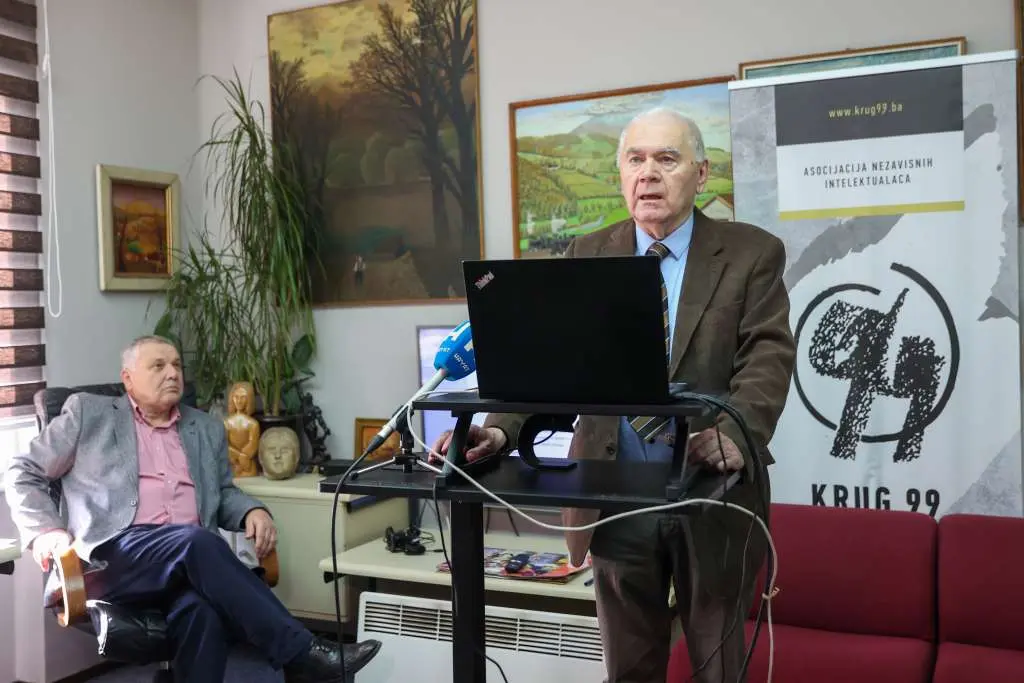
The president of the independent association of intellectuals “Circle 99” Adil Kulenović stated in Sarajevo that the language that keeps the Bosnian state in “uncivilized projections of a special case”, a captive discriminatory political system that prevents the progress of the state and society, must be rejected.
He said these words as the opening speaker at the “Circle 99” session entitled “Reject the hegemonic political vocabulary for the sake of the democratic transition of Bosnia and Herzegovina”, held on the occasion of the 30th anniversary of the Dayton Peace Agreement.
Study and Differential Dictionary
“Circle 99” has prepared a draft analytical study on the hegemonic vocabulary, the ethnopolitical system and European standards. As part of this work, a Differential Dictionary was also developed, which will become an official document after discussion by the members of the association. A glossary of political terms of Bosnia and Herzegovina is also being prepared, with a clear differential meaning between the terms used in Bosnia and Herzegovina and those according to European democratic standards.
The language of the last century and ethnic narratives
Kulenović points out that the language of the last century still dominates in BiH, in which the Bosnian nation is understood as an ethnic community, not a political community of citizens. According to him, such an understanding of the nation is not a theoretical difference, but a key tool of political control.
He emphasizes the importance of using the term international instead of international, because the former precisely describes relations between states as political subjects, while the latter in the region often suggests relations between “peoples”, which directly supports the ethno-national narratives of Serbia and Croatia.
The ethnically defined concept of nation and political control
In the hegemonic narrative of Serbia and Croatia, the nation is understood as a “people” – a historical-cultural and biological community. Such an understanding allows ethno-national elites to position themselves as the only legitimate interpreters of political rights in BiH, which suppresses the citizen as a political subject.
The most problematic concepts in the system, according to Kulenović, are: ‘constituent people’, ‘legitimate representation’ and ‘vital national interest’, which serve to block institutions, manipulate elections and maintain ethnic domination.
Sovereignty and civic subjectivity
Kulenović explains that the hegemonic narrative assigns sovereignty to ethnic communities, while European political theory assigns sovereignty to the state and is realized through citizens. For this reason, Belgrade and Zagreb often recognize the “territorial integrity of BiH”, but avoid recognizing the sovereignty of Bosnia and Herzegovina as a single state.
Instrumentalization of concepts and geographical terms
The study also exposes the manipulative use of concepts such as ‘Muslim’, ‘Christian’ and ‘Sarajevo Valley’, which are used in political discourse to mobilize, polarize and delegitimize the state.
Internal and external parallel power
Through these concepts, Serbia and Croatia maintain parallel power structures within BiH, through the church, education, culture, media, and external connections and lobbying in international institutions, promoting the narrative that BiH is a “community of constituent peoples” and not a sovereign state of its citizens.
A differentiated dictionary as a tool for democratizing vocabulary
The aim of the study and glossary is political and academic: to return concepts such as sovereignty, federalism, entity, citizen and public interest to their European and democratic meaning, so that BiH can be understood and organized as a political community of its citizens.
“Our choice is Western democratic integration, based on the values of a society of equal and sovereign citizens. Our political and theoretical vocabulary must be contextualized with this commitment,” concluded Kulenović at the “Circle 99” session.