
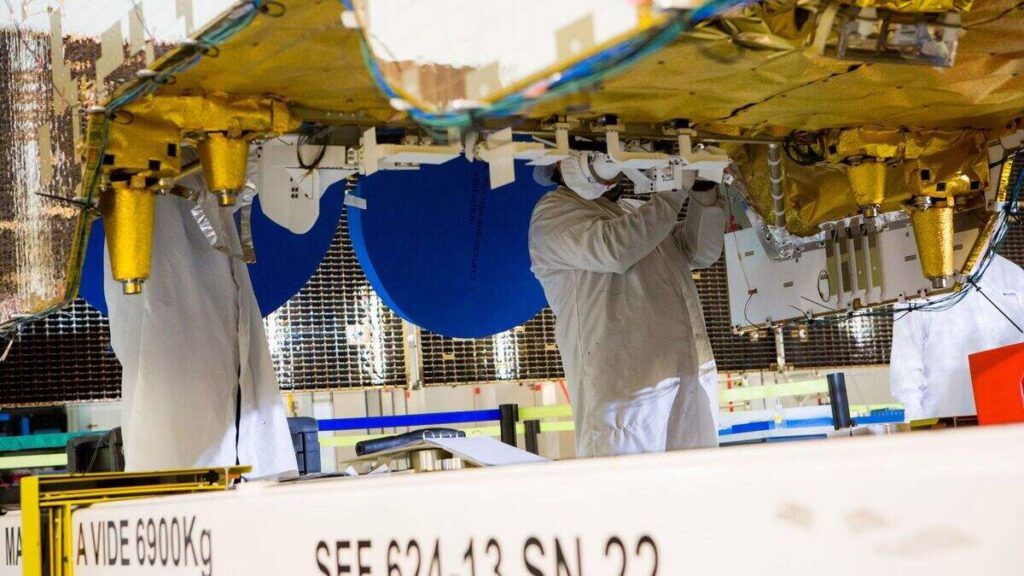
After 40 years of operating satellites built by others, SES is bringing to Luxembourg some of the production work needed to get its orbiting hardware into the heavens and generating profits.
“We will be creating an industrial space capability in Luxembourg,” said SES Chief Executive Officer Adel Al-Saleh during a speech last week marking the company’s state-backed birth in the 1980s and the people behind it.
“To accelerate schedules, reduce costs and guarantee quality, SES is internalising a critical segment of the supply chain: the final integration of partner satellite platforms with SES’s software-defined payload, all within a state-of-the-art manufacturing and test facility,” the company describes in several engineering jobs posted on its career website.
A satellite platform describes the spacecraft’s overall framework as well as internal power, propulsion, computer, communication, guidance and navigation systems. They can be produced in fairly standard options by Boeing, Airbus and a growing number of smaller companies.
Payload means the equipment needed to perform the task the satellite was launched to perform, for example by transferring types of data in different ways. Software-defined payloads can be reconfigured and reprogrammed while in orbit to change features like frequency bands, coverage areas and power allocation.
Details later
The company declined to describe to the Luxembourg Times where and when the manufacturing and testing operation would be built, or how many people it would employ.
The Economy Ministry declined to discuss a project that could represent a new chapter in Luxembourg’s decade of efforts to diversify its economy and increase employment in growing fields like the space sector.
Nor would the ministry say how many people were expected to be employed or how much money the government planned to invest to build the manufacturing facility. The government has been spending an undetermined amount on developing a space campus in Kockelscheuer to provide office capacity and equipment to companies focused on the sky’s farthest reaches.
Also read:From finance hub to space pioneer: Luxembourg’s €346-per-resident investment in the cosmos
The SES manufacturing centre is likely to add substance to the handful of companies making specialized components for the space sector, University of Luxembourg space systems engineering professor Andreas Hein said.
“For Luxembourg standards, I would say it’s going to be a relatively large production line compared to other companies who are focusing on smaller satellites,” said Hein, whose research team designed a tiny satellite about the size of a Rubik’s Cube launched into space early this year.
“We have to start building and being able to control more and more of our intellectual property (IP) versus being always dependent on third parties to build and design things for us,” CEO Al-Saleh told an audience during the 3 December event that included former Prime Minister Jacques Santer.
While SES will not tackle production of entire spacecrafts and will continue to outsource much of the work, “we have to take control over our IP and create industrial capability in Luxembourg,” Al-Saleh said. “Because with that, we can take developing talent to the next level. We can bring new capabilities into Luxembourg. Engineering capabilities that can design things, that can build things in space at scale.”
Also read:Hedge fund Davide Leone bets on satellite firm SES defense pivot
Do it yourself
The term manufacturing – which can evoke images of production lines churning out thousands of goods – may distort what SES brings to Luxembourg, said Andrew Cavalier, principal analyst at ABI Research in Singapore specialising in satellite communications.
But the company is making a significant shift away from its historical dependence on outside contractors delivering sophisticated equipment to instead buying the core platform and then bringing the high-value work in-house, he said.
“This allows them to iterate faster and reduce their exposure to the supply chain delays that have plagued the industry recently,” Cavalier said.
Telecom consulting and strategy firm Analysys Mason has been advising satellite operators “to strongly consider this strategy, to control more of the process and ensure compatibility and competitiveness of their offering [and] network capabilities,” Principal Analyst Dallas Kasaboski wrote in an email.
Technicians at satellite manufacturer Boeing build SES-9, a communications satellite launched in 2016 over Asia. © Photo credit: Boeing
The job of integrating the spacecraft with its mission payload involves careful installation and testing in a facility stacked with specialised equipment and designed with layers of safety measures.
While the size of SES’s project isn’t yet clear, Amazon this year opened a $120 million (€103 million) facility in Florida this year to build the thousands of small satellites needed for its Project Kuiper constellation.
Amazon founder Jeff Bezos’ Blue Origin company won a $78 million (€67 million) contract in October from the US Space Force to build a new satellite processing plant in Florida. The US military also awarded a $77.5 million (€67 million) contract to Astrotech Space Operations in April to increase satellite processing capacity in California.
Also read:Job cuts rippling through satellite champion SES
More satellites
SES’s Al-Saleh has said almost since starting his job early last year that the company is shifting to launching many more satellites into medium-Earth orbit – beyond 2,000km from our planet’s surface. The company is turning away from banking on infrequent, big launches and the expected revenue spike that follows toward “an iterative process that supports continuous innovation and responsiveness to market needs,” SES said in September when it announced it was working with US satellite manufacturing start-up K2 Space.
The Luxembourg company also has invested in US-based Lynk Global, which already built a $2 million (€1.7 million) manufacturing site near Washington, DC, and expects to complete its key merger with another US space company early next year. Lynk’s small satellites in medium-Earth orbit include about $300,000 of materials, not including labour costs, the company said in a public filing last year with the US securities regulator.
SES and Lynk Global will collaborate on satellite manufacturing in the US and Europe, the Luxembourg company said in March while disclosing its Lynk investment.
“SES’ investment in Lynk is likely the primary driver here, as the latter company has manufacturing capabilities and the former has IP to protect in its investment,” Kasaboski said.
Also read:Mobile phone signals from space: Luxembourg’s SES hustles for new revenues