
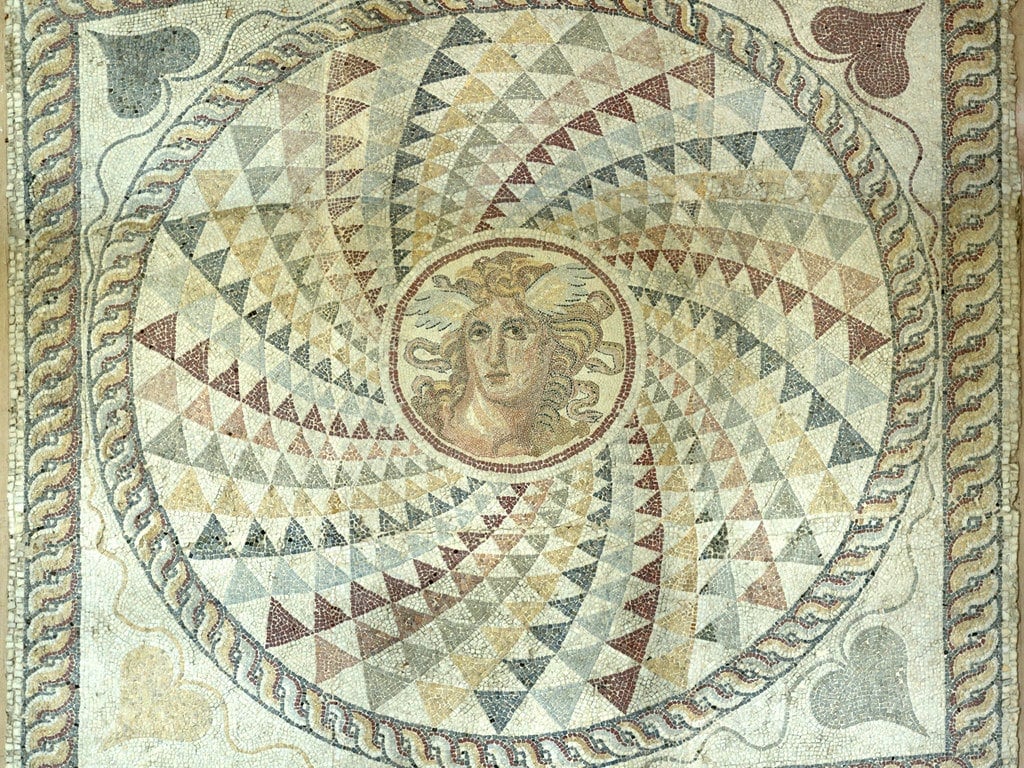
Ancient Greek Medusa, National Museum, Athens. Credit: Ross Berteig / Flickr / CC BY 2.0
Archaeologists in the ancient Hellenistic city of Amastris (Greek: Ἄμαστρις) have uncovered a rare carving of Medusa with a soft, almost childlike smile. The city, located in modern-day Amasra in Turkey’s Bartın province, has produced notable finds in recent years, but researchers say this depiction stands out for its unusually gentle expression.
The carving appeared during excavations in a monumental Roman stoa at the center of the ancient settlement. The structure belongs to the city founded by Queen Amastris, a powerful Hellenistic-era ruler with Persian royal roots and Greek education. Her city later flourished under Roman control, leaving behind grand public buildings now being unearthed.
Bartın’da Medusa’nın gülümseyen yüzlü figürü bulundu.
• Yunan mitolojisinde gözlerine bakanı taşa çevirdiğine inanılıyor. pic.twitter.com/AO6jeHkGUz
— Boşuna Tıklama (@bosunatiklama) December 10, 2025
A Medusa, unlike the traditional guardian
Medusa usually appears as a fierce apotropaic figure designed to repel danger with her snake-filled hair and frightening gaze. Her image often decorated shields, armor, pediments, and building facades.
The Medusa found in Amastris breaks sharply from that pattern. Instead of menace, the figure shows calm and serenity. Researchers say the face resembles that of a child or an Eros figure, a symbol linked to harmony and well-being in classical art. They believe the softer expression may reflect a period of peace and prosperity in the city during the Roman era.
Monumental stoa reveals its grandeur
The excavation is led by Bartın University under the direction of Prof. Dr. Fatma Bağdatlı Çam. Teams are working across a 2,850-square-meter (30,660-square-foot) area where they have uncovered the massive stoa, which once stood on marble Corinthian columns rising about 9 meters (29.5 feet) in height.
Archaeologists say the building likely served as a central gathering space for trade and social life, much like other stoas that lined agoras and forums in Roman cities.
Restoration brings the ancient structure back to life
Restoration is progressing through a detailed anastylosis project that rebuilds the stoa using its original architectural pieces. Three columns have already been re-erected, and four more are expected to rise by the end of the year. The work is approved by Turkey’s Ministry of Culture and Tourism and supported by the Turkish Petroleum Corporation. Specialists and students from several universities are contributing to the effort.
Prof. Çam says the stoa is likely the most monumental marble structure in the entire Black Sea region. She believes the smiling Medusa adds an important artistic layer to the site, showing how Amastris blended Persian, Hellenistic, and Roman influences into a unique cultural identity.
A growing list of major discoveries
The smiling Medusa joins earlier finds from Amastris, including a finely carved head of Alexander the Great, sculptures of Nymphs and Lares, and a collection of amulets, coins, and inscribed fragments. Researchers say these discoveries confirm the city’s strong mythological, political, and commercial links across the ancient world.
A future cultural landmark for the Black Sea region
Officials plan to open part of the restored site to visitors by late 2026 or early 2027. With its towering columns, rare artworks, and layered historical background, the Amastris stoa is expected to become a major cultural attraction. Prof. Çam says its revival offers visitors a rare chance to watch an ancient Roman metropolis rise again—under the gentle gaze of a smiling Medusa.