
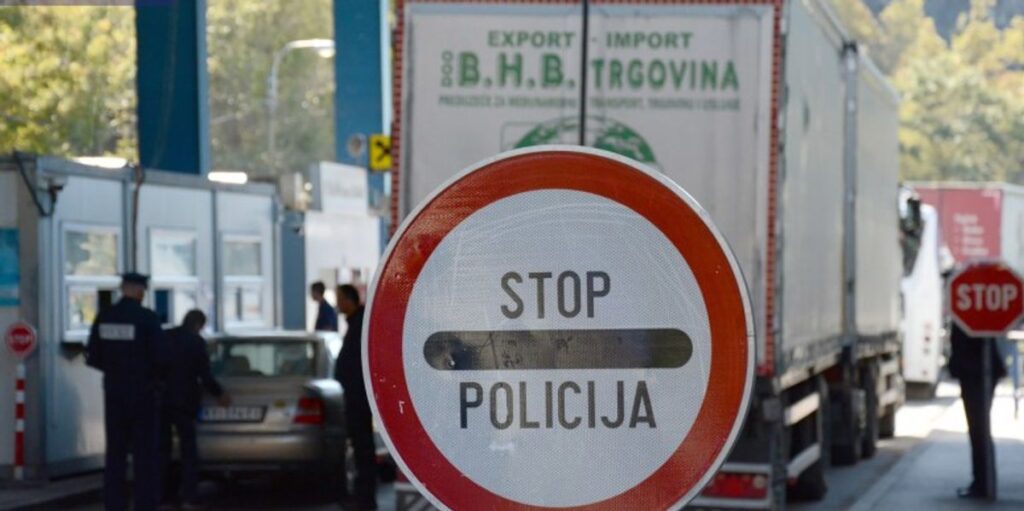
When Tefik Mustafa returned to Kosovo after more than a year in Serbian prisons, his family found him physically and emotionally broken.
Today he is in Switzerland, dealing with vision problems and a nervous breakdown – direct consequences of the harsh conditions in the prison where he was held, according to his family.
His story is just one of many similar cases in recent years, when Kosovo citizens have been arrested by Serbian authorities during transit trips.
From transit trip to 13 months of detention
His son, Qamili, recounts that Tefik Mustafa – a citizen of Kosovo and Italy – set off on June 1, 2024 towards Slovenia, through Serbia – a route he had used dozens of times before.
At the Merdare border crossing, between Kosovo and Serbia, he was stopped by Serbian police.
“They forced him to make his last phone call with his family in Serbian. Then, for 79 days, they didn’t allow us any contact,” Qamili told Radio Free Europe.
After a month of detention in Prokuplje, Tefik was transferred to a high-security prison in Belgrade.
According to his son, he was accused of organizing the kidnapping of three Serbian police officers in June 1999, on the Pristina-Gjilan highway.
For the family, the accusation was absurd, because, as Qamili says, Tefik was not even in Kosovo at the time.
From 1997, he lived and worked in Germany until 2004, when he returned to Kosovo for the first time, after the end of the war, says Qamili.
The prosecution requested 27 years in prison, but the Court sentenced him to one year. In the end, according to Qamili, Tefik was “acquitted” and released after 13 months in detention.
“They found no facts. Plus, when they released the father, they declared him innocent,” he says.
Qamili claims that during his time in prison, Tefik’s eyesight was severely damaged due to the dark environment in which he was held.
“The father is currently in Switzerland. He went for a visit and for medical treatment, related to his eye problem, but also for a kind of ‘blockage’… it’s a kind of nervous breakdown,” he explains.
According to him, the family sold properties and went into debt “to pay hundreds of thousands of euros” that Serbian lawyers were seeking to free him.
Six arrested and one missing in 2025
The Kosovo Ministry of Foreign Affairs and Diaspora (MFAD) did not respond to Radio Free Europe’s questions regarding Kosovo citizens arrested in Serbia this year.
However, REL sources within the MFA confirm that so far this year, six cases of arrests and one case of kidnapping by Serbian authorities have been recorded.
The arrested, according to them, are suspected of “war crimes” or “acts against the constitutional order of Serbia.”
Cases of those arrested in Serbia, according to sources in the MFA
Arbnor Spahiu – arrested in June on suspicion of “aggravated murder” in Banjska; released on November 21.
Lulzim Halili – arrested in July, accused of “war crimes”; remains in custody.
Sasha Djorgjevic – arrested in July, on suspicion of “collaboration with the Albanian State Intelligence Service (SHISH), through the Kosovo Intelligence Agency (KIA)”; remains in custody.
Behar Preniqi – arrested in August as a “suspected member of the KLA”; remains in detention.
Hazir Haziri – arrested in September on suspicion of “war crimes”; remains in custody.
Avni Qenaj – arrested in November for “war crimes”; court in Belgrade gave him one month in detention.
Milan Vukashinović is suspected of being abducted by Serbian gendarmerie in Leposavic – northern Kosovo – on November 1.
On August 14, Serbian authorities announced that they had detained two more individuals with the initials XE and BE (Xhemajl and Bashkim Emini) at the Serbian-Hungarian border crossing point of Horgoš, on suspicion that as members of the KLA, they had “committed war crimes against the civilian population.” Five days later, they were released.
The numbers that no one knows
Lawyers from Kosovo cannot defend citizens detained in Serbia without Serbian licenses, but they cooperate with local lawyers.
Arianit Koci, involved in some of the cases, says that the official figures are “relatively inaccurate.”
“There are cases when certain businessmen have been detained – with allegations of having committed war crimes – and then released. But they have insisted that this information not be made public, because, according to them, they must continue to pass through Serbia,” Koci tells Radio Free Europe.
He also mentions the case of a former police officer who was detained for several hours and released without anyone knowing.
“There are many such cases,” he says, adding that Serbia “deliberately drags out the procedures.”
“In the case of Hazir Hazir, the witnesses have exonerated him. But the prosecution now wants to check his phone from 2025 for an event from 1999. How is this possible?” he asks.
According to him, Haziri has crossed the territory of Serbia dozens of times before and was not stopped until September of this year.
“Citizens are collateral [damage]. The individual always suffers when two states have problems. Serbia, it seems, is exploiting this mechanism in a brutal way,” adds Koci.
Arrests as a political instrument
Experts also estimate that these bans usually occur when tensions between Kosovo and Serbia increase.
In the last two years, they have been high, due to several actions by the Kosovo Government to extend its authority to the northern part of the country, where the majority Serb population continues to be influenced by the government in Belgrade.
Behxhet Shala, from the Council for the Protection of Human Rights and Freedoms in Kosovo, says that citizens have become “political collateral.”
“It’s a ‘ping-pong’ game. It’s a collateral that the citizens of Kosovo pay because of tense relations with Serbia, as well as because Kosovo and Serbia have remained in the shadow of international interest, as a result of the fighting in Ukraine and developments in the Middle East,” Shala tells Radio Free Europe.
According to him, Serbia is simulating “reciprocity”, claiming that it is arresting Kosovars in retaliation for the procedures in Kosovo against Serbs.
“… but, any unlawful detention is a violation of human rights. Arrest and then release acquits them on paper, but the damage to the person is irreparable,” he says.
Shala criticizes the political class in both countries for using these cases only for rhetoric, without making any effort to build real cooperation mechanisms, with international or inter-institutional mediation.
During this year, the Kosovo MFA has repeatedly called on Kosovo citizens to avoid traveling through the territory of Serbia, assessing that “Serbia is no longer a territory that offers minimal security for the physical and legal integrity of citizens of the Republic of Kosovo, especially Albanians.”
The territory of this country is used especially by citizens who want to cross into EU territory, initially entering from Serbia into Hungary, as well as vice versa by the diaspora visiting Kosovo.
Pristina and Belgrade have abolished entry-exit documents from the summer of 2022.
Among other things, they also have an Agreement on Mutual Legal Assistance, reached in 2013 with the mediation of the European Union, but cooperation in practice is almost non-existent.
Arrests as a result of lack of dialogue
Belgrade-based political scientist Ognjen Gogić sees the wave of arrests of Kosovo citizens in Serbia, as well as Kosovo Serbs, as a direct consequence of the interruption of political dialogue between the two countries.
According to him, since the last high-level meeting in September 2023, communication between the parties has been “practically destroyed.”
“All this shows that the dialogue is not working. Arrests without any coordination are proof that all communication channels have collapsed,” Gogić tells Radio Free Europe.
According to Gogić, the arrests of Kosovo citizens in Serbia are also a result of internal political pressure.
Criminal proceedings initiated in Kosovo against several Serbian officials – including leaders of the Serbian List for alleged violations of laws in Kosovo – have created expectations among the public in Serbia that Belgrade will “respond”.
To calm this opinion, says Gogić, Serbian authorities often arrest Kosovars during transit.
But these movements, according to him, are also a political message for Pristina: “It is symptomatic that the arrests are happening almost in parallel, on both sides.”
Gogić adds that internal tensions in Serbia – the numerous protests against the government since last November – also fuel this dynamic.
Part of the public accuses Serbian President Aleksandar Vučić of being “soft” on Kosovo, and the arrests serve as a political response to this criticism, according to him.
Gogić warns that without cooperation between the two justice systems – even through the EU mission in Kosovo, EULEX – citizens of Kosovo and Serbia will continue to face legal uncertainty, not knowing “what awaits them” when they enter the territory of the other side.