
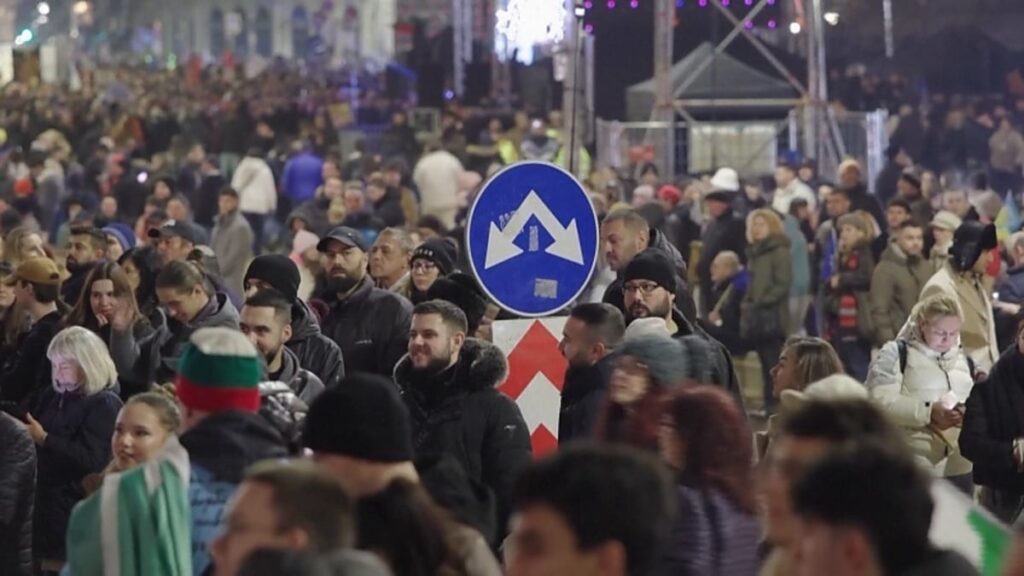
A wave of street protests against ruling class graft is destabilizing Bulgaria just weeks before the Balkan nation is set to join the euro.
What should be a moment for celebration has exposed a growing sense of resentment, especially among younger Bulgarians, after years of European Union membership failed to deliver on a promise of improved rule of law.
The trigger for the latest unrest was a government plan to increase spending in next year’s budget that many protesters believe would only help corrupt politicians strengthen their grip over the country’s institutions.
Bringing the EU’s poorest nation into the single currency area before it has delivered on basics like the rule of law is a move opponents of enlargement will be ready to exploit.
This drone aerial photograph shows the crowd as tens of thosands of protesters gather in central Sofia to demonstrate against the Buglarian government, in Sofia on December 10, 2025. © Photo credit: AFP
That’s a credibility issue which, in turn, could hurt the bloc’s entire geopolitical strategy since eventual membership for Ukraine is fundamental to restoring stability on its eastern borders.
Bulgaria’s turbulence “does carry a reputational risk for Europe — a country just entering the euro zone is shaken up by events that reflect on its fiscal policy,” said Mario Bikarski, senior geopolitical analyst at Verisk Maplecroft.
The country’s biggest protests in more than a decade have pitted demonstrators against the former media mogul Delyan Peevski, a powerful lawmaker who’s widely seen as the face of state capture in the Balkan nation.
Although Peevski is sanctioned by both the EU and the US, his support has been crucial to holding together the shaky pro-European government of Rosen Zhelyazkov. Peevski has denied any wrongdoing.
As protests continue, the premier faces a vote of confidence on Thursday, for which he’ll need Peevski’s support to survive.
When tens of thousands of people took to the streets of the capital Sofia and other cities on Dec. 1, some said they’d been brought by their parents to rallies in 2013 when Peevski was controversially appointed head of National Security Agency.
Twelve years later, the same cast of characters continues to hold sway over the country that ranks among the EU’s most corrupt members.
US President Donald Trump recently castigated the continent as “decaying” and a failure, while his Russian counterpart Vladimir Putin pushes for a deal to end his war on Ukraine which would redraw the entire western security architecture over Europeans’ heads.
Elsewhere on the eastern flank, disillusionment with pro-EU elites has fueled the rise of populist leaders who are staunch critics of Brussels, such as Polish President Karol Nawrocki and the Czech Prime Minister Andrej Babis.
A protester waves the Bulgarian flag during an anti-government protest in Sofia on December 10, 2025. © Photo credit: AFP
In Bulgaria, the thirst for a political alternative is very real. The country has held seven elections in the past four years, none of which has led to a stable governing majority.
The growing discontent has created an opening for President Rumen Radev, the country’s most popular politician. The former air force general has echoed the Kremlin’s talking points by opposing military aid to Ukraine, which he said would empower “warmongers.”
Radev has voiced skepticism of the euro and pushed for a referendum on adopting the single currency.
After last week’s protests Radev urged the government to resign and called for early elections, praising Bulgarians for protesting against the “hijacked state, corruption and lawlessness.” The president recently suggested that he may start his own political party and enter the race, but didn’t elaborate further.
That move would be a major change for the electoral dynamic.
Radev has sought to tap into public anger at Peevski, mocking rallies organized by the mogul’s party as “a new genre: a protest in support of those in power.”
Years of political instability have undermined Bulgaria’s fiscal discipline as politicians push for more spending to win over voters.
The revoked budget envisaged increasing the spending in the security sector to 3.6%, more than twice the EU average, according to calculations by the Institute for Market Economics in Sofia.
Bulgaria’s fiscal discipline — with one of the bloc’s lowest debt to GDP ratios — won the country the support of member states to join the shared currency despite concerns about corruption. That bid was also helped by Russia’s full-scale invasion of Ukraine, which forced the bloc to deepen internal integration with a new urgency.
Zhelyazkov has touted euro adoption as one of his government’s major achievements, though a July poll showed that almost half of Bulgarians oppose the move. The premier also mentioned it while vowing to hold onto power, saying the country needs stability through the transition to the new currency.
His withdrawal of the earlier, unpopular budget bill failed to assuage public anger.
Bikarski predicted a high risk that Zhelyazkov’s government won’t survive to complete its term. That would undo some of the advantages to businesses of euro adoption — a flagship achievement of any pro-European government, he said.
However to Dimitar Bechev, a senior fellow at Carnegie Europe, Bulgaria’s crisis could also be a moment of hope for an uncertain continent.
“It’s good for the EU,” he said. “It means there’s a pro-democracy impulse from within, not because of EU pressure. Europe should be happy that citizens are demanding clean government.”