
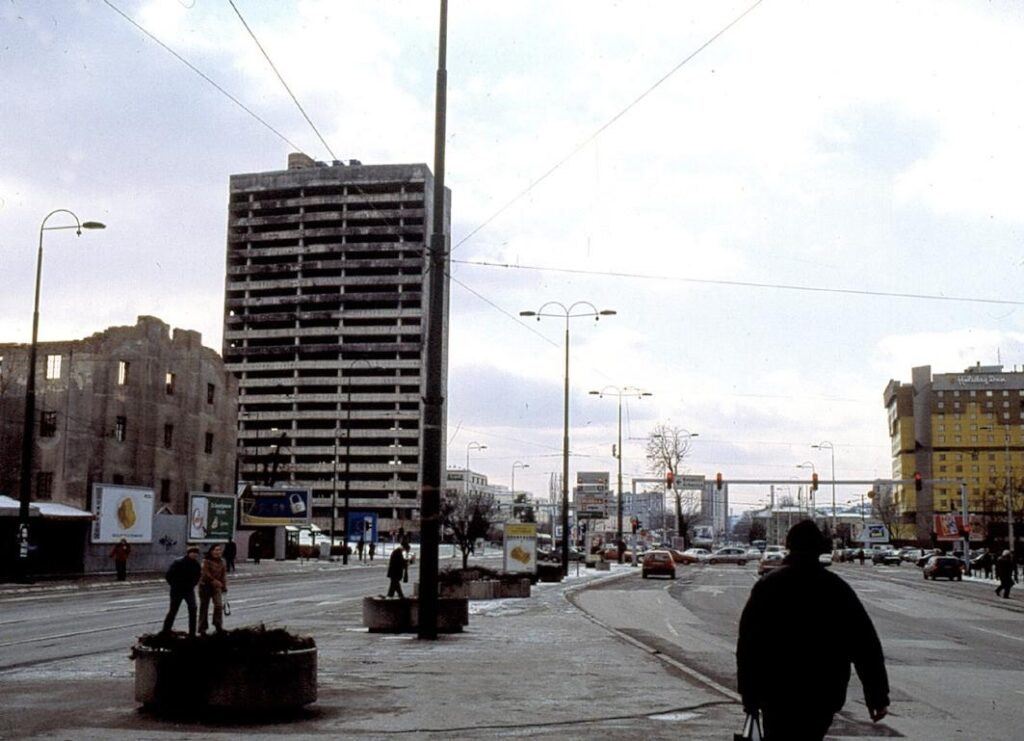
One must concede to the peoples of the Balkans a singular talent: They are past masters of borders, adept at marking them and generally living with them.
This refers, of course, to political borders – the kind that require a passport stamp to cross. But it also goes for those invisible frontiers that the uninitiated fail to notice but which are everywhere: the cornices of buildings, the layout of gardens, the subtle signposts – at a bend in the road or the mouth of a valley – that quietly announce entry into another community.
Thirty years ago, on 14 December 1995, the signing in Paris of the Dayton Peace Agreement brought an end to the Bosnian war, in which 100,000 had been killed and two million displaced.
For three years, fierce fighting had raged between the Bosnian Serb army (VRS), supported by Belgrade, the militias of the Croatian Defence Council (HVO) and the Sarajevo government’s Armija, which mainly consisted of Bosniaks.
The accords, to their credit, stopped the bloodshed. Yet by using what had been the front lines as the blueprint for Bosnia and Herzegovina’s administrative map, they formalised population expulsions and conjured into being a state that is, quite simply, unworkable.
Take but one example: There is a minister of education at the central state level, one in each of the country’s two entities – the Republika Srpska and the Federation of Bosnia and Herzegovina — and one in each of the Federation’s ten cantons, some dominated by Bosniaks, others by Croats.
That makes 13 ministers, each enforcing a school curriculum telling, naturally, a different version of history – in a country of fewer than 3.5 million inhabitants.
This delicate tapestry has now been under construction for three decades. Yet at a time when negotiations about Ukraine’s future are underway, the Bosnian experience offers a sobering reminder. It is not enough to halt the fighting to make peace. And maintaining a state’s borders is not enough to rebuild a society, or a functioning state.
But how can the situation be improved? Join the European Union? It was promised long ago to Bosnia and Herzegovina, and more recently to Ukraine. But it remains a distant dream.
Perhaps we might instead learn from the philosophical resignation of Sarajevo’s old-timers.
Once, while I was searching for the exact spot where Archduke Franz Ferdinand was shot by the Serbian anarchist Gavrilo Princip on 28 June 1914, one of them said to me: “He shouldn’t have pulled the trigger. Today, we might have been rich — and Austrian.”
Had the Habsburg dynasty still been in power, Bosnia and Herzegovina would have belonged to the same empire as much of western Ukraine. But that’s another story.
Roundup
Brussels steps back from Ukraine borders debate – As Washington pushes Kyiv to consider ceding land to secure a peace deal with Moscow, Brussels is now beginning to distance itself from the ongoing debate over territorial concessions to Russia, the biggest sticking point in the negotiations. It’s a significant shift for the EU: after almost three years of insisting that borders cannot change by force, officials are stepping back from the most explosive part of any peace deal.
White smoke for pharma rules – EU legislators struck a deal at around 5 am on Thursday to overhaul the bloc’s 20-year-old pharmaceutical rules, concluding more than two years of negotiations after a final trilogue that ran for over 10 hours. The breakthrough came after negotiators settled the most contentious elements of the package.
Trump’s ideological war – European leaders convinced themselves that by flattering and indulging him, they could persuade Trump to drop his most cherished goals. That delusion can no longer be sustained, argues Euractiv columnist Simon Nixon.
Across Europe
Bart won’t budge – Belgian Prime Minister Bart De Wever has poured cold water on the EU’s push to indefinitely immobilise Russian sovereign assets, dealing a blow to the bloc’s efforts to fund a €210 billion loan to Ukraine. He argued that an emergency mechanism to use the assets should not apply: “Where is the emergency? There is an emergency in Ukraine. But Ukraine is not in the European Union.”
Renewing German–Israeli defence ties – German Minister for Economic Affairs is set to travel to Israel next week and will bring a coterie of defence executives with her, a sign that German-Israeli military ties are strengthening following a brief period of tension. An unusually high number of those accompanying the minister are representatives of the defence industry.
Headscarfs banned in Austrian schools – Austrian lawmakers on Thursday voted by a large majority in favour of a law banning headscarves in schools for girls under 14, a move rights groups and experts say is discriminatory and could deepen societal division. Austria’s conservative-led government – under pressure with anti-immigration sentiment is running high – proposed the ban earlier this year, arguing it is aimed at protecting girls “from oppression”.