
Norway’s state auditor general released a highly critical report on Thursday in which it claimed that Norway’s domestic intelligence agency PST and the country’s overall preparedness measures are weak and do not meet current threat levels. PST’s leader and her boss, Norway’s justice minister, quickly went on the defensive, stirring up more criticism in Parliament.
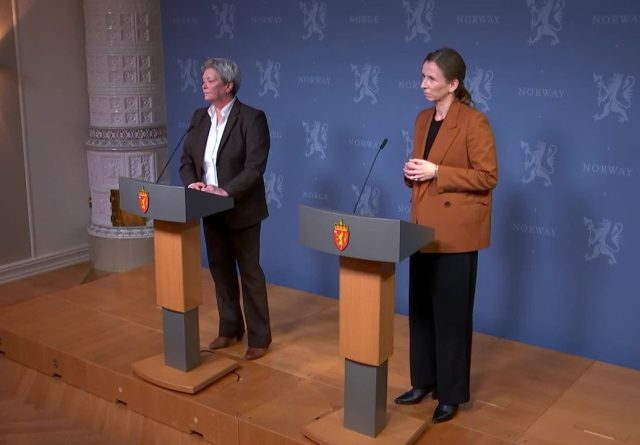 PST chief Beate Gangås (left) and Justice Minister Astri Aas-Hansen responding to criticism from the State Auditor General’s office on Thursday. PHOTO: Justisdepartementet
“We take the criticism seriously,” Justice Minister Astri Aas-Hansen of the Labour Party stressed at a press conference on Thursday afternoon. She claimed the entire government has also taken threat levels against Norway seriously, and agrees with the state auditor’s office (Riksrevisjonen) that PST faced “great challenges” during the period under examination, 2019-2024.
That was before Aas-Hansen’s time, when the Center Party was in charge of the government ministry responsible for both the state police and preparedness. Center left the government in January and Aas-Hansen took over justice minister in February.
Aas-Hansen also seemed to agree with the state auditor’s that the ministry didn’t give PST “the necessary resources and means” during that five-year period, when “its case load increased considerably” and both “the threat picture and the security policy situation became more serious.” She claimed she and her team have been fully aware of the situation and view the report as “an instrument we can use to work better, prioritize better and strengthen national security as a result.
“But let me be completely clear,” Aas-Hansen continued. “The government has taken the threat picture and the security policy situation very seriously. We have provided for big budget increases, better management, more efficient regulation and closer cooperation among the various branches (of service).” She went into detail on budget hikes for PST (the biggest of which came after Russia’s full-scale invasion of Ukraine in 2022), law changes aimed at making it easier for PST to carry out its duties, and steps taken to strengthen its management.
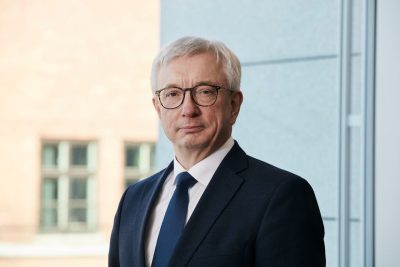 State Auditor General Karl Eirik Schjøtt-Pedersen remains unhappy over how the Justice Ministry has responded to PST’s needs. PHOTO: Mathias Fossum/Riksrevisjonen
State Auditor General Karl Eirik Schjøtt-Pedersen nonetheless seemed unimpressed when he took the stage earlier in the day and claimed that PST’s resources are not adequate given the “much worsened” threat picture and “radically increased” case load at PST. He was “strongly critical” of how the ministry “has not taken measures” to address the situation earlier, while Aas-Hansen insists it has.
Schjøtt-Pedersen pointed to how PST has been caught “for many years” in a “challenging situation” as it faced an ever-growing amount of information, new assignments, several serious incidents and high pressure from its core work. As a result, according to his department’s audit, “PST’s capacity to fulfill its obligations as a security and intelligence agency is limited” and earlier warnings to the ministry allegedly went unheeded.
The sheer language in the auditor’s report is the strongest criticism it can deliver and seldom used, Schjøtt-Pedersen noted. He cited an ongoing “gap” between the threats PST must handle and its capacity, suggesting that despite Aas-Hansen’s claims of bigger budgets and more resources, the agency still can’t do its job.
 Those working here at PST in Oslo need more help, according to state auditors. PHOTO: PST
PST is described in the auditor’s report as both an intelligence agency, a security service and a police service. Its job is to prevent and reveal threats against Norway’s national interests, and investigate and prosecute those that are carried out (in the form of violent crime and terrorist acts).
The auditors’ investigations of PST are classified, but up for discussion with the ministry and uncovered what the auditors call “unpredictable and large workloads, weaknesses and lack of clarity in the ministry’s management of PST.” They cite “challenges” around high-tech resources that “reduce PST efficiency and limit its ability to fulfill its mandate.”
Security around high-ranking officials including the royal family has “eaten up resources” since PST was made responsible for providing bodyguards, secure vehicles, royal escorts and other security services. “When PST has to pay the entire bill for all of this (including overseas trips) it affects other assignments,” Schjøtt-Pedersen said.
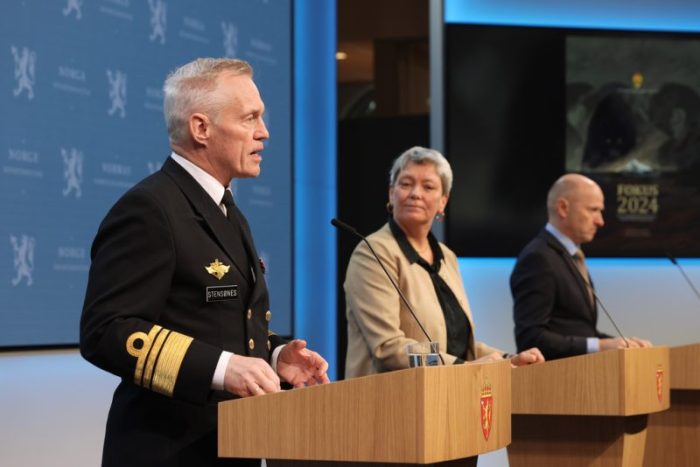 The auditors had no complaints about how PST is working with the military intelligence agency E-tjenesten, the leaders of which are shown here last year. Their cooperation is said to have improved greatly. PHOTO: Forsvaret/Torbjørn Kjosvold
Only PST’s cooperation with Norway’s military intelligence agency (E-tjenesten) has become “considerably improved,” according to the otherwise highly critical audit. Auditors found a large and important increase in the two agencies’ exchange of information, and that the two agencies are working much more closely together.
“That’s positive,” Schjøtt-Pedersen said. “The Parliament has repeatedly stressed how important it is to have good cooperation between E-tjenesten and PST.”
That’s likely to become even more important after news this week that some EU officials now see a need to form its own intelligence service, given all the trouble from Russia and other security issues. Denmark’s own intelligence agency also reported “uncertainty” this week around the US’ traditional role as a guarantor for European security.
Most of the threats to Norway, Denmark and the rest of Europe are tied to Europe and China, but Denmark’s intelligence service now raises concerns around the US as well. President Donald Trump is not mentioned by name, but his keen interest in taking over Greenland (which has historically long ties to Denmark) struck a nerve. The Danish military intelligence agency (FE) writes that the US is now using its economic and technical strength as a means of exerting its power “also towards allies and partners.” The US is “not even ruling out use of military power any longer against its allies” either, wrote DE.
Oslo newspaper Aftenposten asked E-tjenesten to comment on the Danish concerns, but a spokesman merely responded that the agency “doesn’t comment in general on Norway’s allies apart from confirming cooperation.”
The Norwegian auditor’s report, meanwhile, is viewed as important, not least in Parliament. Aas-Hansen’s initial response to the report, along with her defense of PST and current preparedness, sparked more criticism, with an MP from the Conservative Party calling it “a scandal” that auditors don’t think Norway’s preparedness and intelligence is good enough.
“It’s tragic if the government hasn’t followed up PST better,” MP Ove Trellevik told state broadcaster NRK. Calls were also going out for better information from the justice ministry, while the leader of the Parliament’s disciplinary committee, Per-Willy Amundsen of the conservative Progress Party, told NRK that he expected to call for a hearing on the auditor’s report.
NewsinEnglish.no/Nina Berglund