
When President Prabowo Subianto of Indonesia stood before the United Nations General Assembly in September and declared that “the two descendants of Abraham must live in reconciliation, peace and harmony,” ending his remarks with “shalom,” he astonished observers on both sides of the Israeli-Palestinian divide. The word hung in the air—a salutation in Hebrew from the leader of the world’s most populous Muslim nation, a country that has never recognized Israel’s right to exist.
Three months later, as the U.S.-brokered ceasefire between Israel and Hamas is tested daily, Indonesia has emerged as a key player in Gaza’s postwar future. For Washington, this would be something new: a Southeast Asian Muslim-majority partner stepping into Middle East security. The U.S. won’t deploy its own troops; Jordan, Saudi Arabia and the UAE declined to join the International Stabilization Force (ISF) authorized by the UN Security Council to and secure the Gaza Strip; and Turkey is unacceptable to Israel.
So why Indonesia? Part of the answer may lie in what Israel actually wants longer term. Meanwhile, the question of which Muslim nations Palestinians might accept in the form of the stabilizing force doesn’t come up.
Initiating a Thaw
Greg Barton, chair of global Islamic politics at Deakin University in Australia and co-author of “Indonesia and Israel: A Relationship in Waiting” (Jewish Political Studies Review, 2005), traces the change in the Israeli-Indonesian dynamic to Abdurrahman Wahid—known colloquially as Gus Dur—who served as Indonesia’s president from 1999 to 2001. Barton says Wahid tried to normalize relations with Israel. “His argument was: We have relations with China and Russia. We don’t agree with them on a lot of fronts, but it hasn’t stopped us talking to each other…issues should be dealt with through dialogue and diplomacy.”
It didn’t work. “That was always one of those third-rail issues—if you touch it, you’re unlikely to make any meaningful progress, but you’re likely to be punished,” Barton says. Dinna Prapto Raharja, a political economist who advises Indonesia’s Foreign Ministry, puts it even more plainly: “The moment President Wahid said Indonesia should open diplomatic relations with Israel in 2001, opposition was so fierce that at the end of the day, he was kicked out of office.”
Wahid did not disappear. He returned to the role that had always given him the cultural and religious authority to maneuver—leading Nahdlatul Ulama (NU), the world’s largest Muslim organization. In 2003, Wahid went to Israel, invited by Shimon Peres to the Peres Center for Peace. “He came back to public criticism, but because of his social capital, he could get away with it, Barton says.”
Wahid wasn’t just making diplomatic gestures. As the leader of Nahdlatul Ulama, he represented a scholarly approach to Islam. “NU works on jurisprudence and interpretation and argues for a progressive approach to scriptural interpretation,” says Barton, “but is very much connected with that scholarly tradition. In a rough sense, it’s sort of like the rabbinical tradition—where you study learned writers from previous centuries. You may agree, you might disagree, but you connect with the tradition.”
That intellectual framework positioned NU against Indonesia’s rising fundamentalist organizations—making interfaith engagement not just comfortable but necessary.
But Are They Ready?
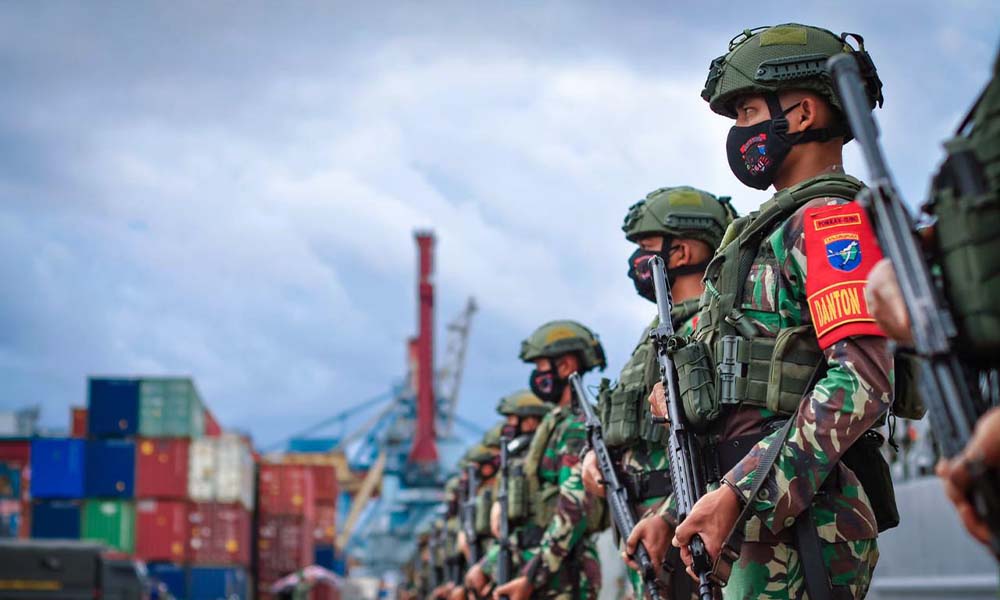
In November, Indonesian Defense Minister Sjafrie Sjamsoeddin announced that 20,000 personnel stood ready to go to Gaza—medical teams, engineers, logistical units.
One detail went unmentioned: Indonesian soldiers have never trained for urban disarmament operations. They’ve built field hospitals after earthquakes, cleared rubble after tsunamis, guarded refugee camps in Central Africa. Neutralizing armed militias in bombed-out cities while coordinating with an occupying military of a country that doesn’t have diplomatic ties with their government? That’s new.
Raharja, the political economist, was candid when I asked about military readiness. She had just returned from Turkey, where she’d met with military officials. “I noticed such a big contrast between the military there and the military in Indonesia,” she said. “The way they speak, the way they see the world—it’s just totally different.” Turkish officers spoke casually about enforcement, control, red lines. “Our military doesn’t have that vocabulary yet.”
Her assessment got sharper: “Even though Indonesia may speak so firmly about ‘we are ready, we are ready,’ I don’t think they know what’s coming if it’s beyond a peaceful approach.” She paused. “There’s no peaceful sitting-down scenario yet because no one on the Israeli side or the Palestinian side has agreed to sit together.”
Reports suggest the troop number of committed Indonesian troops has already been quietly reduced from 20,000 to 1,200. The mission brief emphasizes medical and reconstruction support but avoids any mention of disarmament or combat operations.
The Geography of Acceptable Muslims
Hay Eytan Cohen Yanarocak is a Turkey expert at the Jerusalem Institute for Strategy and Security. He explains why Israel would accept Indonesian forces but reject Turkey’s: “Although Jakarta has no direct relations with Jerusalem, we are talking about a country whose leader takes a warm approach toward Israel, speaks at the UN podium about the need to ensure Israel’s security, and even ends his remarks with ‘shalom.’ Indonesia’s geographical distance from Israel and the fact that it does not pose a conventional threat is another reason.”
“As for Turkey,” he adds, “it is essentially the reverse.”
Atlantic Council Ankara analyst Ömer Özkizilcik is equally blunt: “Among all Middle Eastern and Muslim-majority countries, Turkey has the best military and the most experience in post-conflict peacekeeping. When it comes to technical capacity, Turkey is the obvious choice.”
More critically, Turkey is seen as the only actor that could compel Hamas to give up its weapons and dismantle its tunnels. “If Turkey is inside the stabilization force, Hamas will very likely disarm,” Özkizilcik tells me.
“The same Turkish presence would also mean that five or ten years from now, if a new Israeli government wants to occupy or annex Gaza, Turkey’s presence would prevent that,” Özkizilcik explains. “So from an Israeli perspective, accepting Turkey in Gaza means blocking future Israeli ambitions to reoccupy the Strip.” Regarding Indonesia, Barton notes: “The last thing they would ever want to do would be to engage in any sustained firefights with Hamas. They certainly wouldn’t want to be taking on the IDF.” And with Turkey, he says, it’s all about President Recep Tayyip Erdoğan, whose support for the Muslim Brotherhood and past backing of al-Qaeda affiliates in Syria makes him unacceptable to Israel. “You can see Erdoğan coming to Gaza carrying a lot of baggage and a lot of tension and a bellicose attitude. Indonesia has none of that.”


Palestinian voices are conspicuously absent from stabilization discussions. In a November 11 interview with Le Figaro, President Mahmoud Abbas said Gaza must become “a zone of peace and security under full Palestinian sovereignty,” a formulation that pointedly avoids endorsing any foreign security presence. But no Palestinians have been formally consulted on whether they want an international force, who should lead it, or what it should do. Neither the Palestinian Authority in Ramallah nor the Hamas negotiators have been asked to shape the framework now taking form around them.
Meanwhile, Indonesia’s stance toward Israel is complicated. In 2023, it lost the right to host the FIFA U-20 World Cup after refusing Israeli athletes. In October, Indonesian officials denied visas to Israeli athletes for the 2025 World Artistic Gymnastics Championships in Jakarta, even after appeals to international sports arbitration. And recent economic protests have made the Indonesian government more cautious about any gesture that could be seen as abandoning the Palestinian cause.
A History of Secret Cooperation
Long before anyone in Jakarta talked about stabilizing Gaza, the Israeli and Indonesian governments were connected in a way neither could acknowledge: surveillance technology.
Throughout the early 2020s, Indonesian agencies secretly purchased spyware from at least four Israeli firms—NSO Group’s Pegasus, Candiru, Wintego, and Intellexa—according to joint investigations by Amnesty International and Haaretz. When Indonesia’s neighbor Singapore discovered the sales in 2020 and summoned a senior Israeli official in protest, Indonesia denied everything. The following year, more than a dozen senior Indonesian officials were targeted by one of NSO’s most sophisticated hacking tools, a reminder that these systems circulate far beyond the control of any single buyer. It created no visible diplomatic friction, largely because both sides denied the relationship existed.
Is a similar dynamic at play with the ISF? Along the lines of Cohen Yanarocak’s assessment of Indonesia as a non-threatening partner, some experts suggest it’s less about its capacity to send medical teams and engineers or whether a multinational force can meet the ISF’s goals—to secure Gaza, prevent Hamas from rebuilding its military capacity, and support a transition to a non-Hamas governing structure. Rather the plan is to simply provide international cover for an outcome Netanyahu’s security cabinet has already decided, whereby Israeli forces retain the option to return whenever they judge the threat renewed.
Commenting on Indonesian President Prabowo’s approach, Dinna Prapto Raharja notes: “He tries to build trust by saying something out loud, and then he will correct as time goes, to measure impact from his statements.” It’s an approach that works for domestic politics. Whether it works for stabilizing Gaza—where the gap between public rhetoric and private cooperation has been a defining feature of Middle East politics for decades—remains to be seen.
Top image: Indonesian Army soldiers. Credit: Penerangan Kodiklatad via Wikimedia Commons