
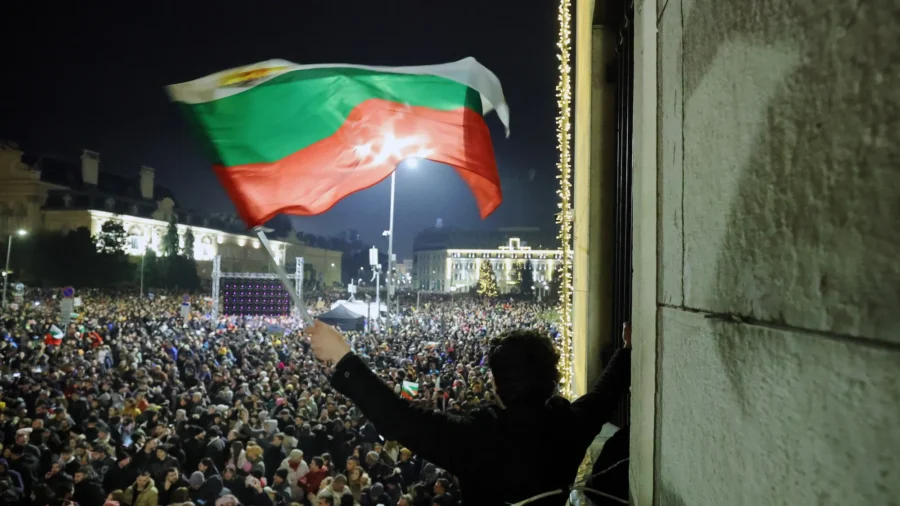
Bulgaria’s government announced on Dec. 11 that it is resigning after weeks of mass street protests over economic policy and entrenched corruption, just weeks before the Balkan country is due to adopt the euro as its official currency.
Bulgarian Prime Minister Rosen Zhelyazkov announced the resignation to reporters in Parliament in the country’s capital, Sofia, and in a televised address just minutes before Parliament was set to vote on a no-confidence motion tied to economic mismanagement. The motion, brought forward by the opposition, had gained momentum amid some of the largest demonstrations Bulgaria has seen in years.
In a televised address, Zhelyazkov said that members of the ruling coalition had met to review the challenges they face and the “decisions” they must “responsibly make.”
He said that the coalition realized “the protest was against arrogance and conceit” and that the protest was “not a social protest, but a protest for values.”
“Ahead of today’s vote of no confidence, the government is resigning,” Zhelyazkov told reporters.Protests Swell as Anger Over Corruption Boils OverThe resignation caps weeks of unrest. Initially sparked by the government’s draft 2026 euro-denominated budget that was later withdrawn under public pressure, the protests quickly broadened into mass demonstrations driven by long-standing public anger over corruption and the perceived sway over government policy of sanctioned politician and oligarch Delyan Peevski. Opponents have accused Peevski of using his influence to shape government policy in line with oligarchic interests.
Students from Sofia’s universities joined the rallies, which organizers said swelled far beyond last week’s protests that drew more than 50,000 people. Local media estimated that the crowds surpassed 100,000, making the demonstrations some of the biggest since Bulgaria joined the European Union in 2007.
Zhelyazkov said his coalition would have probably survived the no-confidence vote but said the sheer scale of the mass protests made remaining in office untenable.
“We have no doubt that the government will receive support in the upcoming vote of no confidence,” he said. “Regardless, the decisions of the National Assembly are important when they reflect the will of the sovereign.”
Opposition parties hailed the collapse of the government. Asen Vassilev, coleader of the We Continue the Change–Democratic Bulgaria coalition, called the resignation “the first step in making Bulgaria a normal European state.” The next step, he said, is ensuring that new elections are “fair and free,” unlike the previous elections that he alleged had been marred by vote manipulation.
Bulgarian President Rumen Radev, who earlier this week urged the government to quit, echoed the sentiment in a post to lawmakers on Facebook, saying, “Between the voice of the people and the fear of the mafia—listen to the public squares!”
Under Bulgaria’s constitution, Radev must now offer the largest party in Parliament the first opportunity to form a government. If that effort fails, the mandate passes to the second-largest bloc before the president is empowered to appoint a caretaker Cabinet and call new elections. With deep political fragmentation and seven inconclusive national votes since 2021, analysts say an eighth election in the near future appears all but inevitable.
Zhelyazkov’s Cabinet will stay on in a caretaker capacity until a successor is chosen. The political uncertainty comes at a sensitive moment for the nation of 6.4 million, which is set to join the eurozone on Jan. 1 and adopt the euro as its official currency after years of preparation.Public Reaction to ResignationOn the streets of Sofia, residents said the resignation was widely expected after weeks of escalating unrest.
“I hope for something positive,” said Milka Peneva, a doctor. “But since I’m from the older generation, I have quite a few reservations about being overly optimistic. Still, I support the young people, and I genuinely hope things will turn out well for them.”
Others said the government’s fall was long overdue.
“It’s normal—this is how it should have been,” said IT specialist Hristiyan Marinov. “Now we hope that smarter people will come out of those 240 who were in Parliament … and put an end to the abuses we’ve seen.”
Entrepreneur Chocho Enchev called the upheaval “a positive shake-up,” while some voiced caution as the country prepares to adopt the euro.
“With us entering the eurozone, perhaps there will be less money being stolen from the country,” said fitness instructor Daniela Lepoeva. “But many people are afraid that prices for everything will rise—rent, goods, everything—so I don’t know what to expect. There will probably be both positives and negatives.”
By joining the euro currency union—a key European Union project aimed at deepening ties among member countries and bolstering financial stability within the bloc—Bulgaria is poised to become the 21st member of the eurozone.
Reuters and The Associated Press contributed to this report.