
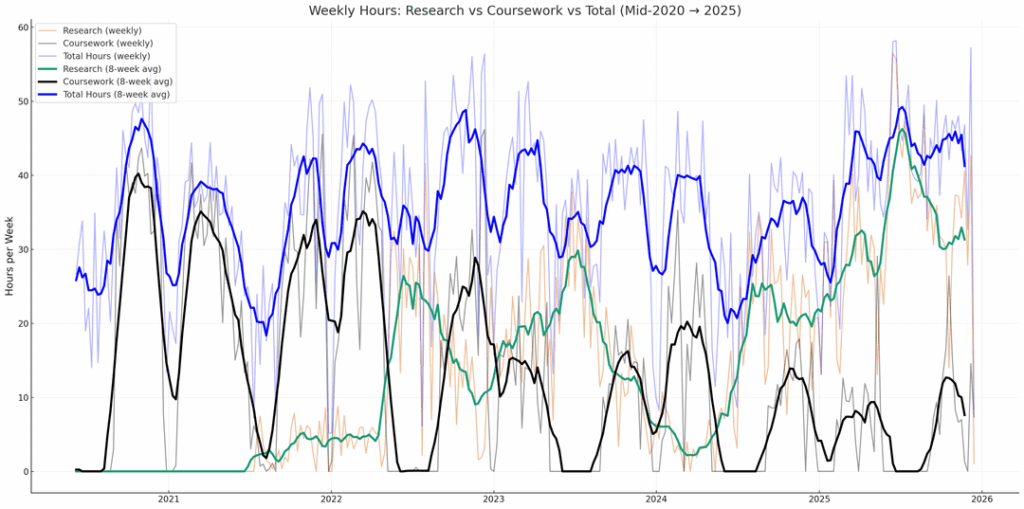
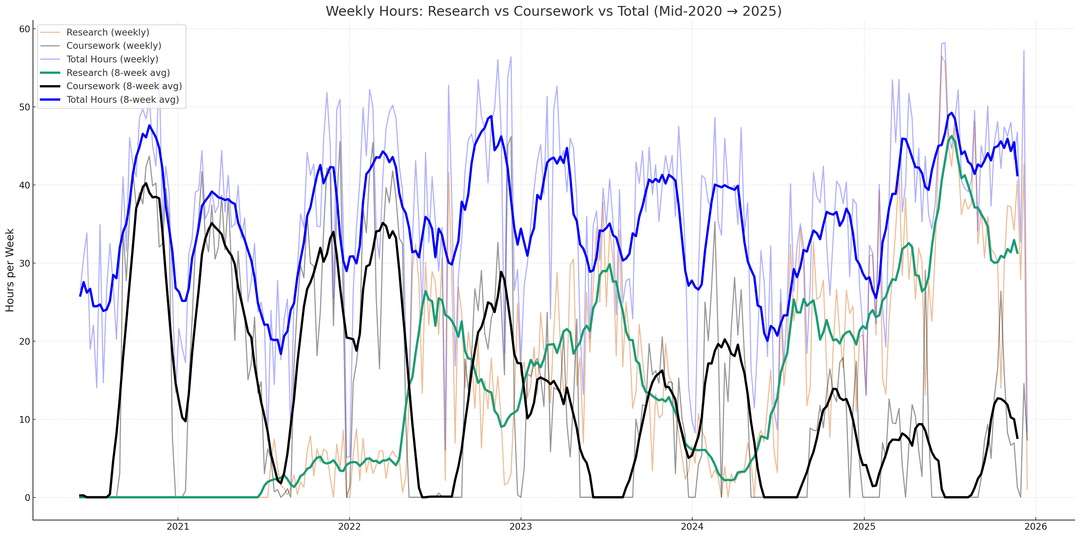
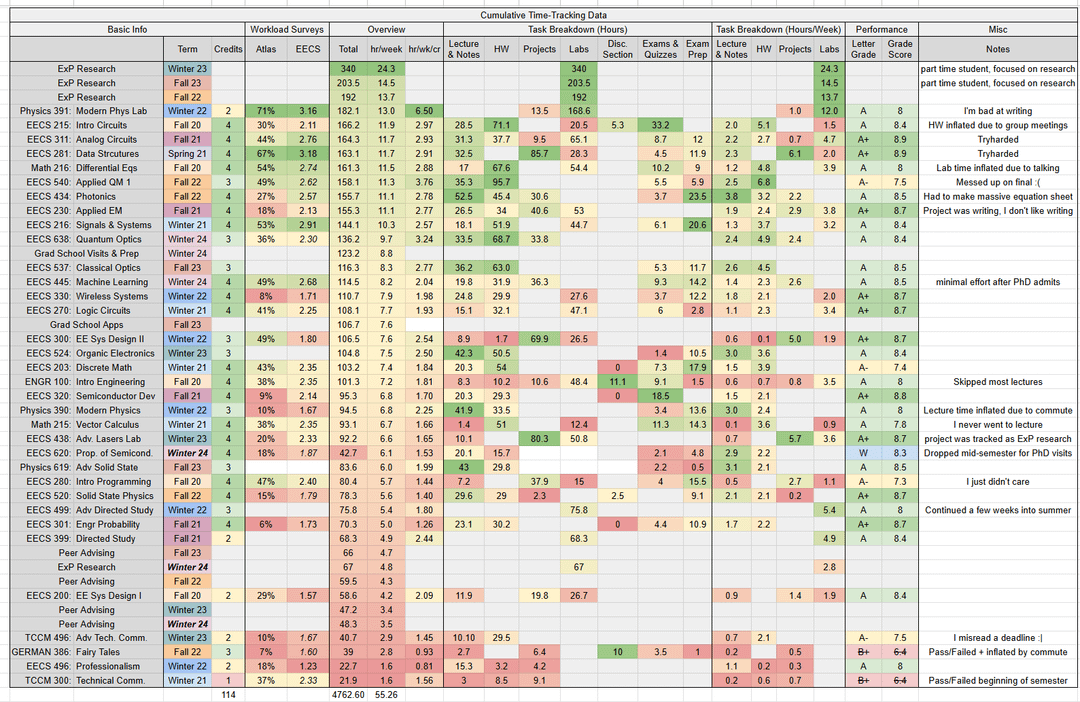
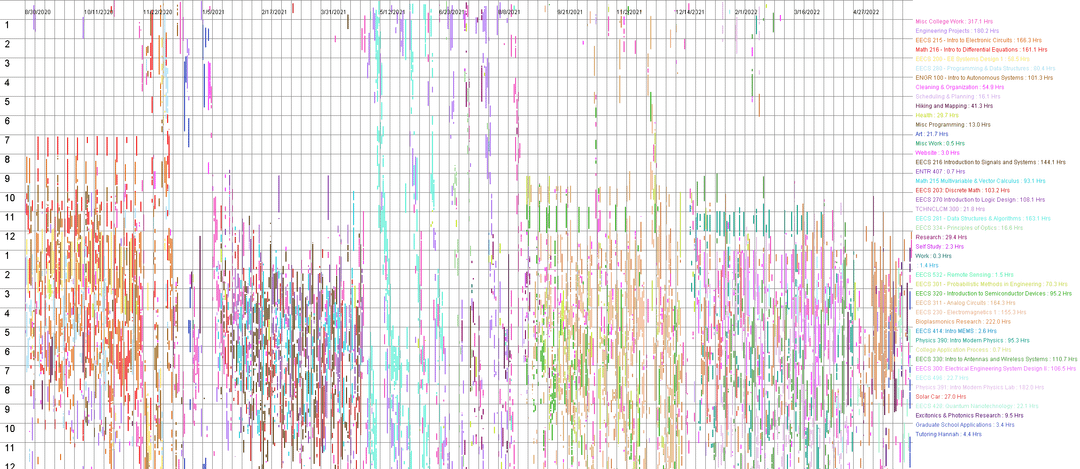
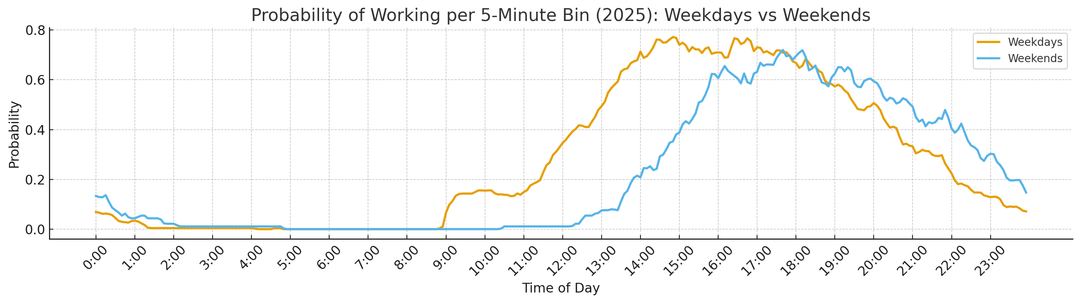
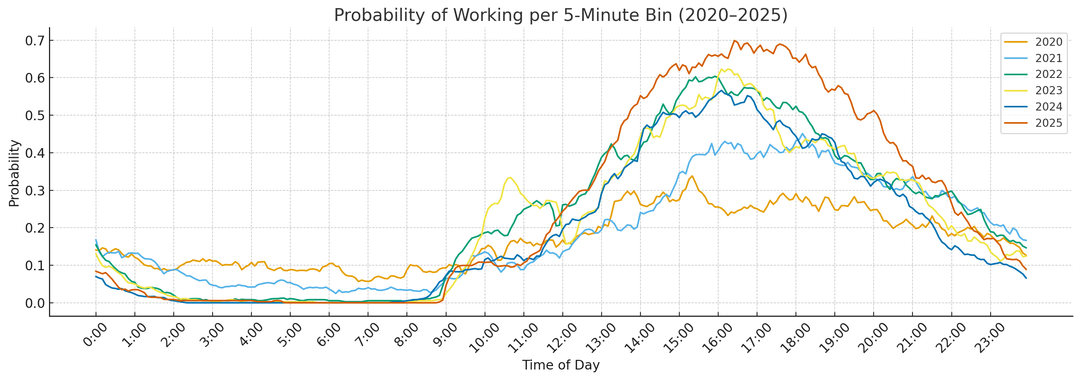
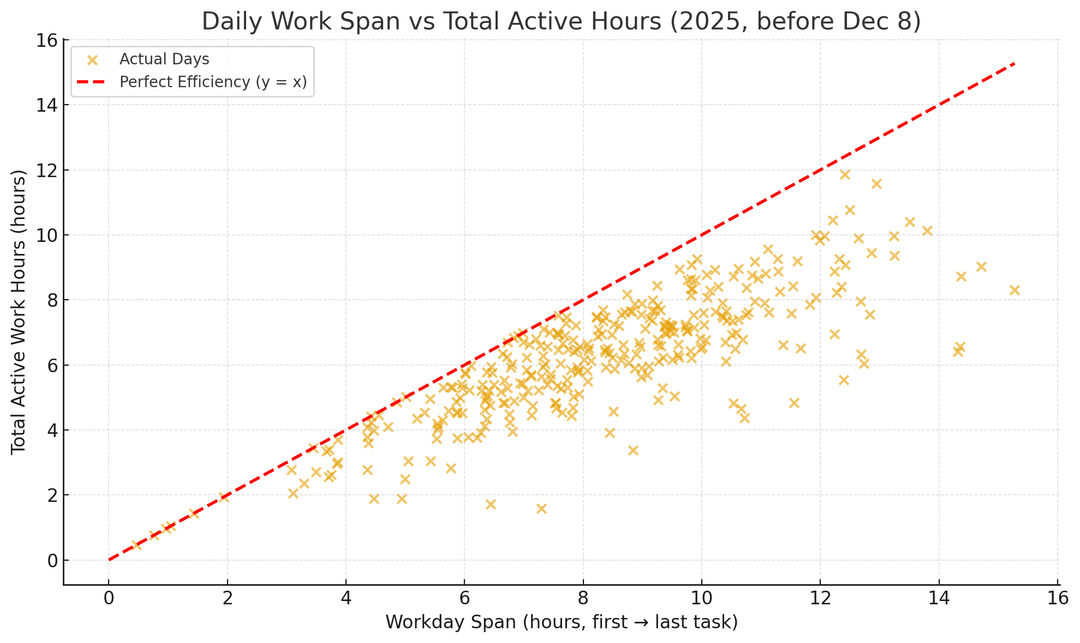
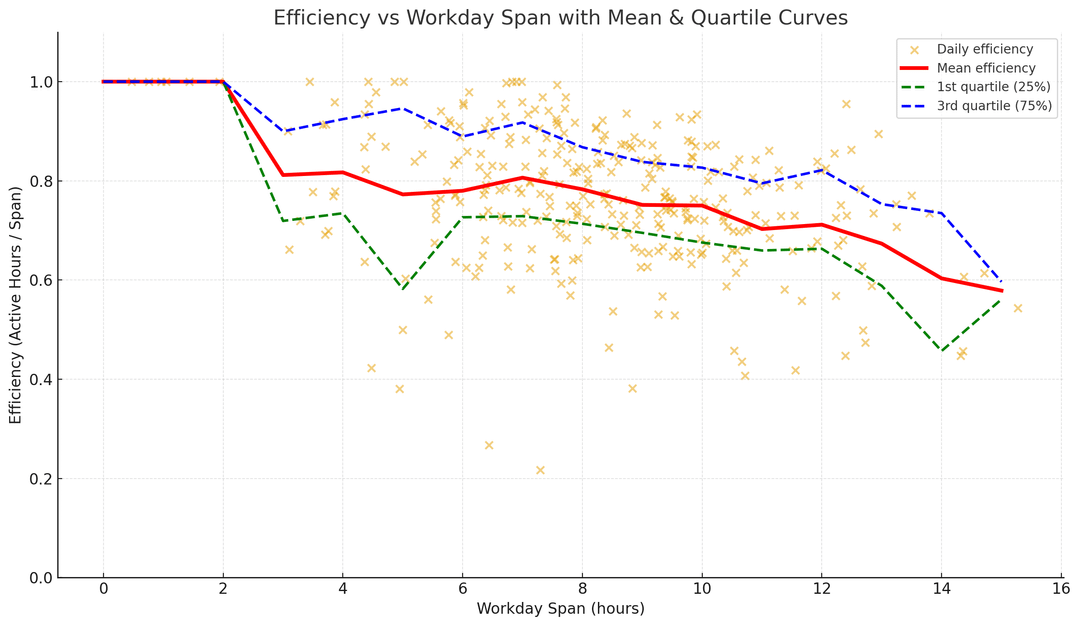
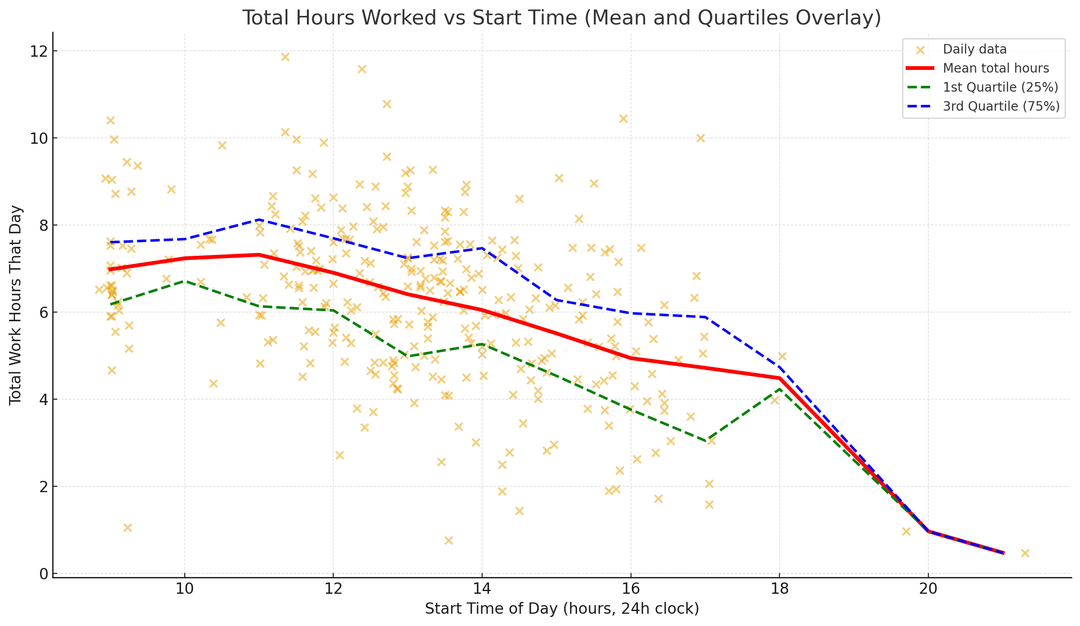
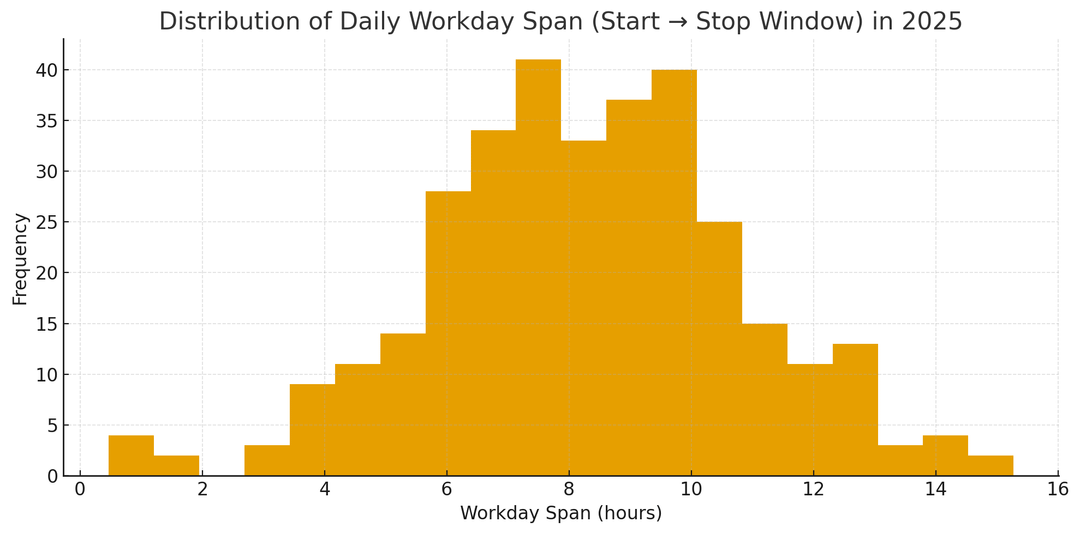
I started using Toggl to track my activity in 2019, but didn't start using it for everything until 2020, the year I graduated high school. The second image is a spreadsheet I made of the time spent in each of my undergraduate classes at UMich and how I did in them. The third image is an example of what the data itself looks like–I only track things if I am actively working on them, i.e. actively sitting at my computer reading something, writing code, taking notes, etc.
2025 has been my most productive year so far, averaging 6.22 hours of active work per day. I have a really terrible sleep schedule (as should be obvious by image 4), but I work every day to make up for it (I've only taken 2 days off in the past 8 months, including weekends). You'll also notice I only wake up at 9 AM less then 20% of weekdays, which is just because I have a 9AM research subgroup meeting every Tuesday.
Also, you can see that my sleep schedule completely devolved in 2020 due to COVID, where I am only about 2x more likely to be working at 4 PM as I am likely to be working anytime from 2 AM to 6 AM. Image 3 shows an example of what this looked like in pracitice. Essentially, if I don't have any regular meetings at normal times, I default to a ~28 hour sleep schedule that slowly rotates through the day over the course of a few weeks.
I didn't want to spend a ton of time on this post, so a lot of the plots are bad, but I wanted to share this because I thought it was interesting. If anyone has any specific questions about the data or is curious to see other data representations, let me know 🙂
Posted by CuseCoseII
13 Comments
Thinking stuff like this was going to make a better version of myself led to me attempting suicide. This is mental illness, this is not beautiful.
How much time did you spend actually recording/validating/correcting this data?
Quantum mechanics and German fairy tales aren’t that dissimilar to be quite honest.
Good for you but tracking your work hours this diligently does not sound healthy
There should be a category for the time spent tracking
my favorite part is the probability of working bin and seeing the tail end at 12am/1am/2am lol
Cool charts.
I would have personally tracked time sleeping, fucking off, drinking, and getting laid, but that would have taken discipline. Then again, my PhD is in a bro science.
Kidding aside, I hope you go easy on yourself and have time for rest and rejuvenation.
Bro doesn’t even get a full 8 hours of sleep every night. What the fuck are you even doing? Hahahaha
Wow, this is very cool!
What was your undergrad major and what’s your PhD in?
Consider adding at least one day off per week, and setting strict bedtime and waking time for EVERY DAY. This amount of work, and the diligence with which you track it, cannot be good for your mental or physical health.
You only graduated high school in 2020 which means you’ve gotten a bachelors and started your PhD within 5 years. You clearly work over summer and winter break too. Were you raised to believe that your work ethic was the only way to prove that you are worthwhile, capable, and lovable?
An irregular and too-short sleep schedule damages your brain and that damage can be _permanent._ Poor sleep habits are also highly correlated with early onset Alzheimer’s. Never taking a break or resting is going to burn you out and harm you.
My career in mathematics is OVER because I led a lifestyle like this. I never took a break from when I could legally start working at 15 years old until I was 27. During that time I was hospitalized twice for suicidality. I narrowly missed a third hospitalization at 27 when my “onset episode” of bipolar disorder had me manic, psychotic, and actively ruining my life. It can happen to you.
You are worth MORE than the work you do. If you want a long and productive career, stop running this like it’s a sprinting race. It is an ultramarathon. Pace yourself accordingly.
Was this post considered productive?
I tracked my sleep for a few years and the only conclusion I came to was that:
1. I do sleep at night
Feel this data has a similar conclusion:
1. You work on things.
I know it’s fun to track your actions/activities but is this data really telling you anything you don’t already know?
How much time did you account for name dropping MIT?