
The first year of the Trump’s 2nd term economy has been nothing short of tumultuous. Foggy unemployment rates, a DOGE’d federal branch, Liberation Day, immigrant workers getting kidnapped out of the country—it’s hard to keep track of where the economy actually stands.
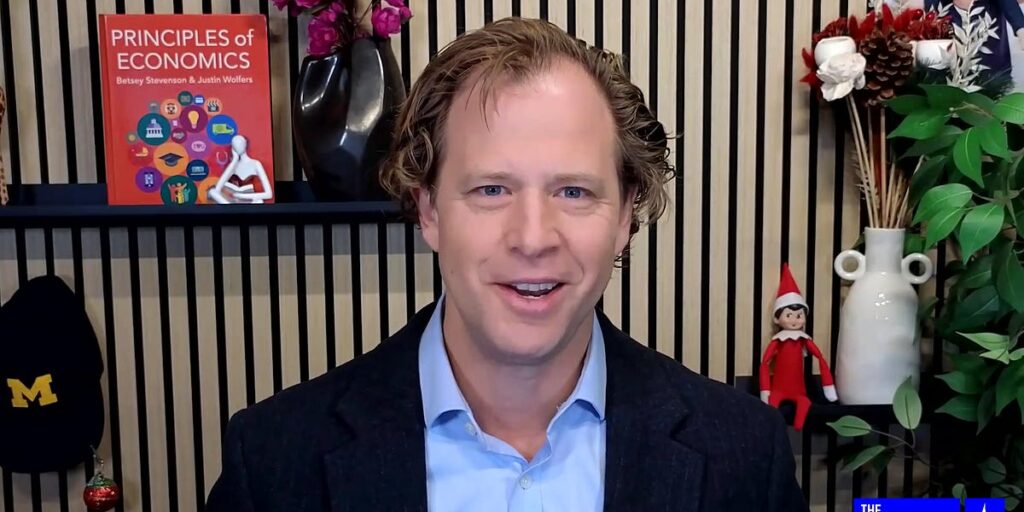
Luckily for us, Economist and Public Policy Scholar Justin Wolfers joins Jen to help us clear the waters. As Wolfers explains, “the single best thing an economist can ever hope for is boring,” and that is not what we have been getting. The pair discuss the economic implications of the chaos, the incompetency of the people calling the shots in the White House, and how the Fed can maintain independence despite it all.
Justin Wolfers is a professor of public policy and economics at the University of Michigan and a Senior Fellow at the Brookings Institution and the Peterson Institute for International Economics. Justin is also a contributing columnist for the New York Times and the host of the popular podcast Think Like an Economist. You can watch more from Justin on Youtube.
The following transcript has been edited for formatting.
Jen Rubin
Hi, this is Jen Rubin, Editor-in-Chief of the Contrarian. We are so happy to have back our friend Justin Wolfers, who is an economics professor at the University of Michigan. Welcome, Justin!
Justin Wolfers
Hey Jen, how are you?
Jen Rubin
You know, the year is almost at an end, and what a wild year it has been. Give us a picture of where we started economically at the beginning of the year, and where you think we are now.
Justin Wolfers
Right. I think it’s a great question, because too often we get caught up in news cycles of whether Wednesday is worse than Monday. Yes. Or whether the president did something crazy on Tuesday in between. So let’s go all the way back. Yesterday was my birthday, Jen.
Jen Rubin
Oh, happy birthday!
Justin Wolfers
Thank you. I was fishing for that a little, but I’m gonna go back to my last birthday, which was December 11. 2024. So we know the president had been elected, there were nerves about that, but the state of the economy was overall pretty good. Unemployment was close to 4%. Inflation, if you remember back a couple of years ago, during the pandemic, the post-pandemic inflation had gotten as high as 9%. And it was most of the way back to normal. It was down to 3%, and it looked on course to be around about 2%, you know, by now.
And to be honest, the single best thing an economist can ever hope for is boring. And if it weren’t for the interesting stuff in our politics, we were set for a remarkably, and I would even say beautifully. boring year ahead. There were probably some hangover problems left from the Biden administration, who did not by any means get everything right. But the President certainly inherited a very, very healthy economy, low unemployment, inflation most of the way back down, a little bit of repair happening on the budget, not enough.
And the rest of the world, this is the other thing that’s worth thinking about. Look, if everything’s calm. the US is just a yacht that just sails nicely, growing at 2% a year, and everything’s fine, and it’s when there’s storms that we need to look out. Well, it turns out there were no storms on the horizon either. There were no major world wars, there were no commodity price shocks, there were, of course, serious issues. There’s Ukraine. There’s the geopolitics of China, I… you know, I don’t want to minimize those, but that’s sort of the regular background noise. There was not a global pandemic, so I was certainly optimistic one birthday ago.
Jen Rubin
And you’re not so optimistic on this birthday, or you’re unsettled on this birthday?
Justin Wolfers
I’m unsettled. I have to tell you a secret, Jen, but you can’t tell anyone else. I had to get Botox. I had to get Botox because these wiry lines were starting to get a little bit pronounced. So, where are we right now? It was actually interesting, the Fed just released its latest set of forecasts, which includes its forecast for how 2025 was. We won’t actually know how 2025 was until the end of 26, But that had GDP growth for the year at 1.7%. it’s important to say that out loud, because Bascent keeps saying we had a quarter of three, or a quarter of 4, and things are good, and blah blah blah blah blah. But 1.7 is positively mediocre. Robustly moderate. It’s not a failing grade, but it’s not something you race home to tell your mum you just achieved. I might be telling you too much about my personal life there. It’s below the economy’s potential.
And when we grow slower than potential, what tends to happen is that gap between what we could be and what we are widens. The most obvious place you see that is the unemployment rate. The unemployment rate was as low as 3-point-something percent a couple of years ago. It’s been drifting up. And it’s one of those stories that hasn’t gotten told because it’s relentlessly boring, which is every month or two, the unemployment rate has gone up by 1 tenth of one percentage point. Not enough for anyone to comment on in any monthly news cycle. But added up, and it’s gone up a half a percentage point. And that is families doing without, people’s dreams dashed, self-esteem on the rocks, and real pain.
We’ve also seen tariffs come in, the cost of living continues to be a problem. I want to say that for folks who are experts…I’ve had a number of people say, well, you said tariffs are terrible and things aren’t terrible, and I agree they’re not terrible. But, what was the year that was? Well, in January, we went all DOGE. In February and March, people were saying, you ran on tariffs, but you haven’t given us any details. We can’t do business until you give us details. We got to April, which was Liberation Day. It took all of 7 days for the President to walk that back when the bond market decided to vomit. the Liberation Day tariffs. The President gave himself 90 days just to have a bit of a break, and to actually think about his signature policy before implementing it, a mere 10 years after walking Down the golden escalator. At the end of that 90 days, he realized he still hadn’t done any of the 90 deals he promised, and he still didn’t have a tariff regime.
It’s funny, probably could have told him that a week in advance. So he gave himself a 24-day extension. At the end of that 24-day extension, he says, I now have to impose a tariff regime. And he basically announces a new set of tariffs that look just like the Liberation Day tariffs, but they’re all plus or minus a couple of percentage points, so you can’t say that nothing happened during that 90 days. But in terms of implications for the American economy, basically nothing happened. A board of people then told him, you can’t just announce a tariff today and expect it to be on tomorrow, so it’ll take a little bit of time to implement. Which means that for most of the year, in fact, we haven’t had the Trump tariff regime.
And it’s really only quite recent that it’s become clear that there is going to be a persistent tariff regime. There were questions many of us had, would the bond market, big business, the big end of town, bully the president out of this? And at various times, it looked like they were going to. And so, the reason I think you haven’t seen the economy react horribly is that we actually haven’t had a horrible tariff regime. You have to implement the bad policy before you get the bad consequences. It’s now been implemented, but of course, then we had a government shutdown, which means it’s hard to tell what the hell’s going on, at one level, because we don’t have data.
At another level, because that’s its own shock. And so everything bad that’s happened in the second half of the year, the administration has said, is because of the Schumer shutdown. Rather than the fact that they caused economic uncertainty to rise to an all-time high, rather than having century-high tariffs, rather than incoherence, incompetence. autocracy, a walking away from the rule of law, a destruction of our institutions, an attempt to undermine state capacity. Rather than thinking any of those might be the problem, it’s all about the federal government shutdown, which of course, again, has got nothing to do with Trump, and it’s got everything to do with Chuck Schumer, again.
Look, I’m less interested in the politics, I just want to point out the economics of it are. He actually didn’t get his work done. Because he didn’t get his work done, the economy didn’t get quite that harmed. So when you asked me, do I feel bad or uneasy, it’s uneasy. I feel uneasy because we’re going to start to see these things play out. And I feel uneasy for a second reason, which is much of what obsesses us in the day-to-day of the news cycle is what’s going to affect next quarter’s GDP. And Jen, because I know you, I know that you’re going to come back and look beyond next quarter, and so much of the unease in my stomach. Is because of what’s gonna happen beyond next quarter or next year.
Jen Rubin
Now, Because we’ve had this tariff uncertainty, to understate the problem, by orders of magnitude. Is that related, in your mind, to the low GDP? Meaning, it kind of froze action. People didn’t know what to do. They didn’t know whether to hire or not, whether to build or not. The other specific question I have is that the Fed Chairman, and we’ll get to the Fed in a moment, said something to the effect that the jobs numbers may be overstated. Talk to us about those two things.
Justin Wolfers
Okay, so, look, let me start. You asked about economic uncertainty and the way that it shaped GDP. I’m just going to tell you about the Wolfers household instead. I’m a dad, I live in the Midwest, I have a very, very sexy blue minivan, and everyone knows that dads in minivans are the hottest thing alive. But, I also have a partner, and sometimes we might need a second car. So, we literally, around about November, decided, well, we should probably buy a second car. In the Midwest, this is just how you get around. But then tariffs were coming, and I was worried that prices were high because of tariffs.
And the only thing I hate more than not having a car is being taken advantage of or being a sucker. And so I watched the tariffs come in, and I’m like, well, I don’t want to buy my car now, so I didn’t. And then there was the 90-day pause, and I thought, well, we’ll see where this ends up, because I don’t want to buy while the tariffs are in, if he’s about to rule… we’ll, you know, walk him back. So I didn’t buy a car during the 90-day pause either, and no one was offering great deals during that 90-day pause, because they were all worried we’re coming back to high tariffs.
And then we came back, and it turns out we’re back to high tariffs, and he also added on steel tariffs, and now I feel like a real fool, I wish I already had my car. I’m riding my bike to school, which is fine, except it’s now the middle of winter, and so that’s starting to hurt a little bit. So it feels like it’s time to buy a car, but now the tariffs are in, and there’s a Supreme Court case coming. And if the Supreme Court rules the way I expect them to rule, the tariffs are going to go away. In which case, why would I buy a car today if—and the Supreme Court ruling could literally come down any day now. If the tariffs are going to be ruled unconstitutional, we don’t know if the illegal tariffs are going to be refunded, so I’m going to hold off on buying my car till the Supreme Court rules. Jen, I just told you the story of one household, but it’s one household that failed to spend $30,000 or $40,000 buying a new car.
Jen Rubin
Yes.
Justin Wolfers
And it’s not just my family. And the ups and downs of the business cycle actually are not much driven by the consumer. A lot of them are driven by investment. What do companies do? And the reason for that is I can bring my boss plans for a great new expansion, a new factory, a new outlet, whatever it is, a new line of business. My boss always can say, I think this is a great idea, Justin, but why don’t we wait a few months and see what shakes out? Delaying is very cheap compared to making a bad investment. And if the business environment could change enormously, delaying becomes incredibly valuable.
And so I think, actually, the story of my new car, which still doesn’t exist. Might actually be the story of many businesses and their expansions. And just as an anecdote, when you talk to CEOs or board members around the country. The amount of time they talk about the present is very high. It’s the number one thing. Whether it’s a CEO trying to decide on their company’s bathroom policy, which is not normally a CEO thing, except the CEO is now worried that if they happen to have gender-neutral bathrooms, they’ll get a call from the White House. And so that makes it a CEO policy.
The board is worried that renewable energy credits will get, you know, struck down, or that tariffs are about to change, or that occupational health and safety laws are about to be transformed, or the Department of Education will get abolished or reconstructed, and this just makes it incredibly difficult to do business. And provides a strong incentive on waiting. And so I think that’s sort of… and I want to be clear then, Jen, you asked me about tariff uncertainty. But what I just described was not just tariffs.
Jen Rubin
Trump uncertainty.
Justin Wolfers
Yeah. Because this is not a conservative government, it’s the least conservative administration of my lifetime. So the uncertainty is about the Department of Education, it’s about getting workers across the border, it’s about getting goods across the border, it’s about getting immigrant labor, it’s, about government ownership of organizations, it’s about, you know, whether the government will nationalize, as it did 10% of Intel. So just tremendous policy, broader policy uncertainty, which has frozen people in place.
And I want to add another word to this sentence, if I may. It’s not just uncertainty, I think there’s a genuine concern about competence. Usually, Republicans and Democrats have… Experienced politicians running as their president, and those experienced politicians appoint Partisan experts. both words are true, partisan, left-wingers appoint lefties, right-wingers appoint righties, but they’re experts. And so what they’re trying to do is shift things at the margin within the structures of existing functional institutions.
Jen Rubin
Yes.
Justin Wolfers
That’s not how this Trump White House works. And it is, in many cases, literally incompetent. My favorite example is the president recently got rid of tariffs on bananas. It took him 10 months to realize that America doesn’t grow bananas. And that tariffs on bananas are not going to bring banana factories to the United States. My 13-year-old eats a banana for breakfast every morning. He knows where bananas are grown. He understands the economic folly of tariffing bananas. That’s just one story, but there are thousands of stories like that.
Normally, businesses think, I can invest, and taxes will either be a little higher or a little lower if it’s a Republican or a Democrat, but at least the folks in charge will be competent. That confidence has gone away, and so the idea that government might undermine productive economic behavior is something that executives are actually having to think about right now.
Jen Rubin
Interesting, your comment about being most concerned about the president, because in my lifetime, Republicans used to think that anything that the political structure did to weight economic decisions one way or the other was a bad thing. So now we have not just weighing, but controlling, dominating, economic decisions. Talk to us about my second question, which was the Fed and this comment about, perhaps employment is over-reported?
Justin Wolfers
Okay, so, There’s two conversations to have here. Sorry, life is so complicated at the moment, I need to keep slowing us down. Let me answer the question you care about, which is, what’s going on with the state of the economy? Answer number one, we don’t know, we’re just coming out of a data blackout. Because there was a government shutdown, important data wasn’t collected, some of the data was collected and wasn’t released, it hasn’t all been released yet, we don’t really know what’s been happening in the last few months. Some people believe private sector data is an adequate. replacement. It’s not. There’s no statistical question about this. It’s not. So, therefore, we don’t really know what’s going on out there.
Our best guess is that payroll’s growth is running around about 40,000. That’s a wonky number, you know what it means, but for everyone else, I’ll just sort of say it’s kind of like B-minus territory. It’s okay, it’s positive, but again, your mum’s not proud of you for that. But, it’s very difficult to measure employment in any economy, any time ever. Very technically demanding thing to do. I know how to interview 10 firms and ask those 10 firms how many people they employ. That’s easy to do. But to make them representative of the United States, I need to know they were 10 firms out of 1,000, out of 100, out of a million. And knowing what that is, that’s the unknown. Because the number of firms being born and dying changes every month.
The nerds, wonks, economists at the Federal Reserve border are the nerdiest, wonkiest, and most trustworthy in the world. Their best estimate, according to Jay Powell, is if we think employment’s growing at 40,000 a week, their estimate is that’s being overstated by 60,000. for the complicated reasons I was just describing, which is it’s hard to know how many firms have been born and died. And they have… we do have good data on that, and they’ve seen some early estimates. You can actually… you and I could see them as well, you have to be quite sophisticated to make sense of them. And that’s their best guess at what the Bureau of Labor Statistics is eventually going to go back and say, hey, guess what? We think we overstated, so that then says that it’s quite possible right now employment is shrinking.
Jen Rubin
Yes.
Justin Wolfers
Can I just take a moment for a second conversation?
Jen Rubin
Absolutely.
Justin Wolfers
A second conversation here is, I just said the Bureau of Labor Statistics is going to admit that it’s overstating employment. Folks who’ve spent too much time in partisan halls, or have been a little bit damaged by the current moment might say, oh, you mean the White House has forced the Bureau of Labor Statistics to overstate the numbers, or Trump is lying about the numbers, and so on. There’s been a deliberate attempt to try and make us feel distrustful of the information environment that we’re in. So here, I want to draw a distinction. Some people look you in the eye and lie. Right now, that’s the White House.
When Trump says drug prices fell 1,200%, The laws of mathematics are enough to tell me that’s a lie. Others are engaged in business as usual. And business as usual is, statistics, we never actually fully know the truth. What we have is measurements that give us a sense of what’s going on. All measurement is provisional, and as we get more measurements, we should update our sense of what truth is. That’s what’s going on here.
So it’s actually profoundly boring. It’s not political, it’s not biased. It’s the simple difficulty of measuring what an economy is doing at any point in time. So there’s no political bias here. There’s no claim that the Bureau of Labor Statistics is a poor statistical agency. In fact, it’s a world-leading agency, but even the world’s best statistical agencies have to adjust their sense of what’s going on as new numbers come in. To do otherwise would be foolish. And the Fed can sort of guess what it’s going to do next, because the Fed has already seen the inputs that the BLS is getting.
Jen Rubin
Got it. And frankly, if they did revise downward, that should give us some confidence that they’re not controlled by the White House, because the White House wouldn’t like to hear that they’re in Arrears, as it were, 20,000 jobs a month.
Speaking of the Fed, we have had a very tumultuous year at the Fed, and as I say that, I understand that that’s a bad thing to be saying, because the last thing you want to be tumultuous, the last place you want a dysfunctional workplace is at the Federal Reserve. Trump tried to fire a governor, we’ve had some personnel changes. He’s tried to strong-arm Jerome Powell. He’s picked, we think, a replacement, who is Not going to be criticized for being unenthusiastic about this president. Where are we with the Fed, and how worried should we be about what has been, really. Pardon the expression, the gold standard in central banking and reliability, around the world.
Justin Wolfers
Wow, gold standard. Good joke there, Jen. Why don’t we just spend a moment, you and I, in a moment of appreciation for an institution that is held? The Fed is doing the right thing by the American people.
Jen Rubin
Yes.
Justin Wolfers
I’m not saying they’re above reproach. You could argue rates are too high, you could argue they’re too low. That vigorous debate’s part of the whole process, and there’s something beautiful and profound about it. But they’re serving the American people. They’re not allowing themselves to be bullied, and… again, you can argue with the policy outcomes, but you can’t argue with the process and the determination to focus on the best interests of the American people. And so, to my friends at the Federal Reserve, I love you. I’m grateful. Keep at it, you’re doing important work. You’re maintaining the economic and financial stability that is an important part of the quality of life of everyone who’s watching this podcast.
So, now let’s go back to where are we. I, today, am much more optimistic than I had been. So, We’ve been at the point where the President has threatened to fire Jerome Powell without cause many times. Powell has legal advice that says that he can’t. So Powell stood up, and rather than just sort of wimping out, he stood up, and he said, no, I have legal advice to the contrary. That, and fears that the bond market would vomit, has been enough that the president has just hurled bombs without actually doing anything. when someone stands up to a bully, sometimes you learn the bully isn’t as courageous as they make themselves out to be, and so to Jay Powell, I want to say thank you. So, he hasn’t bullied Powell into resigning, or into changing his mind on anything.
There are 12 members who vote. Powell’s one of them. And one of them, Lisa Cook, came under direct attack. The White House threw everything they could at Lisa. And Lisa stood up and said, you can’t do this. You can’t fire me for cause because there’s no cause. The whole thing’s a political… looks like the whole thing’s just a political beat-up. That Lisa is a black woman seems of some relevance, but more to the point, I think she was also getting between Trump and his preferred outcome. Which was a takeover of the Fed. He wants the Fed to do what the President wants, work in his best interests, rather than the best interests of the American people. So Lisa helped. Congratulations, Lisa. I’m grateful. The law so far is held, the courts have said that Lisa will continue to serve. Which has basically led Trump to have few ways forward for his planned hostile takeover of the Fed. And actually, yesterday at 4th… I think it was 4PM, something very interesting happened, which got almost no notice. One of the strange things about the way the Fed works, now we’re going deep in the weeds, if that’s where you want to go.
Jen Rubin
We love the weeds here.
Justin Wolfers
Okay, so there are 12 people who vote on monetary policy, 7 of them are what’s called members of the Board of Governors. They’re governors of the Fed. They work out of DC. Then there are Federal Reserve Banks all around the country. Federal Reserve Bank of San Francisco, of Kansas, of, my local one’s Chicago, Boston, and so on. The president of each of those banks is appointed by a local committee, but they have to be signed off on by the Federal Reserve. The president of those banks serves a 5-year term. They do not all serve as monetary policy makers deciding interest rates, but they rotate through a series of jobs. So, they make up an important part of who sets interest rates.
And there’s a weird flaw in the way the law was written, which is their jobs get, they get reappointed on a 5-year cycle, and all of them get reappointed at once. Which meant if Trump had managed to get a majority on the Fed, before that happened, the Fed could then have refused the appointments of anyone except a Loyalist, and therefore every Federal Reserve Bank around the country would have been run by a Loyalist. And those loyalists would then get to vote on monetary policy, that would have then meant you had a majority of Trump loyalists.
The institution effectively would have been taken over by loyalists. They were due for reappointment by February, and there were questions as to whether Trump could get enough loyalists to upset the apple cart before February. They went and did something very clever during December. They quietly just reappointed everyone. In order to do that, they had to get each of the regional Federal Reserve Banks to reappoint their presence, and then they sent those appointments up to the Federal Reserve in Washington, and yesterday at 4pm, they released a note saying that they’d all been reappointed. So now, every Federal Reserve bank president around the country, per N, except for, I think it’s Atlanta has someone in place for the next 5 years?
That means those seats that get to vote on monetary policy will have not Democrats, not Republicans, but serious institutional economists who care about the future of the Economy in them, and that means the whole institution is much less subject to being taken over. So now let’s come back. There’s a long technical circle to get to where we are.
Jen Rubin
And by the way, kudos to whoever came up with that Trump-proofing scheme. It turns out that institutions and institutional knowledge really do come in handy now and then.
Justin Wolfers
Yeah, and I’m sure there may be legal cases ahead on all of this, and I’m not a lawyer. Now, I am breathing so much easier, because the worst of the possible outcomes is now off the table. So, what’s happened in between? Okay, so Lisa Cook kept her job, no more Trump appointment there. Adriana Kugler resigned, and so there was one opening. Trump did something that’s never been done before, took an active member of the executive, Stephen Moran—the chair of his Council of Economic Advisors, who did not resign for the job, simply took leave from the White House to go to the Federal Reserve. So, you couldn’t imagine a more dramatic undermining of the idea of independence. I’m on leave from the White House, but don’t worry, I’m independent of it. It doesn’t pass any test.
And Moran has simply parroted White House talking points. He may have done so sincerely. But, because I think when you spend enough time inside the White House, you start to believe what the White House thinks. But it’s been widely derided as having a clowned himself. That the arguments that he’s making are not intellectually serious, they’re evidence that he’s putting together is not defensible. The models he’s using are not coherent. So he’s gone out and he said, here’s what we should do, it’s totally different than the rest of you guys, and so according to Moran, Moran and Moran alone understands how the economy works, and the consensus of all other forecasts, of all other economists is wrong.
So, Moran’s there, but has had no influence, because there are 12 people vote, and if one bloke’s been a clown, the other 11, go about their work So, the next step is, we get a new Fed Chair coming up in the next few months. Widely rumored to be Kevin Hassett, who is the President’s Chief Economic Advisor. Hassett has shown a relentless Trumpian disrespect for the truth over recent months. And therefore lost my respect, because I have a deep and abiding respect for the truth, if nothing else.
And I think is not seen as a serious character by anyone in the economics establishment, because we are truth-driven. If you can’t describe the reality of an economy, we cannot trust you to fix it. So, the truth is the most important value to us. He has no commitment to it. The thing is, you can appoint a guy Fed chair. Fed chairs have historically been very influential… very influential. They’re influential because they’re the boss of the staff, but they’re influential, I think, most importantly because they use the staff to show intellectual leadership.
Now, if you’re a Fed appointee who’s intellectually not up to the job, who’s not married to the facts, you’re not gonna win any arguments. So my guess is you can appoint a guy Fed Chair, but you can’t make anyone follow. And I’m pretty sure—and this is an appointment so far at odds with the history of the institution. Remember, George W. Bush appointed Ben Bernanke, and Bernanke, I think, was reappointed by Obama. So this is the deep sense in which what matters is expertise. Bernanke went on to win the Nobel Prize. That’s how serious this job is.
Kevin Hassett is no Ben Bernanke. Kevin Hassett is not Ben Bernanke’s cousin’s left foot. And so Kevin Hassett can pound his gavel at the head of the table. But no one has to listen. And I know the people there, and they’re smart. And they’re gonna keep making honest arguments, and honest arguments are gonna win 10 out of 12 people over. And I feel like the institution’s going to be okay. Until we get to the Vance Presidency.
Jen Rubin
That is the most cogent, explanation for optimism about the Fed that I have heard, and I would just analogize to an institution I’m a bit more familiar with, and that is the Supreme Court. You may be the Chief Justice, but no one has to really pay attention to you. You are the Chief Justice, and you’re influential because at least 4 other people in the court are gonna follow you wherever you go, and you would therefore have a majority. So, very similar kind of institutions are influential because people put influential people in those chief spots, and if you don’t, it’s just, you know, Joe the Barber from down the street who needs to listen to him.
So, as we come around, you’ve had a nice birthday, hope it was pleasant, hope you enjoyed yourself. Obviously, the only thing predictable about this president is he’s completely unpredictable, completely untethered to facts. I suppose my meta question is, is the America economy and the institutions that you have seen strong enough to withstand another Trump year of chaos and incompetence. From what you’ve seen between the courts and the Fed, and kind of good business sense, Is it enough to kind of get us through another year?
Justin Wolfers
The thing I like about you, Jen, is you truly deeply understand the issues, and you get right at the heart of them. Look, no one knows, and I claim some small level of expertise, but not a grand level of expertise. But I think I can reframe your question in a way that really doesn’t answer it, but leaves open why the stakes are so big. So, we’ve just had one of the most tumultuous years in our economy, in memory. Of course, the pandemic was huge, and the global financial crisis. Each of those, by the way, were considered once-in-a-century shocks. seem to be having too many of them. So it was immensely, immense tumult over the past year, and real questions about the damage that’s been done.
And you point out that’s one quarter of the way there. It would take a lot. It takes some optimism, but a believable level of optimism to say the US economy, society, democracy can recover from what happened in the first year. takes some optimism, but I can get there. I can imagine a serious person being able to make that case. Not sure I would make it, but I can imagine it being a serious case, and one that one should consider. You quadruple that, becomes a lot harder. Now, maybe we don’t quadruple it.
So, first of all, all administrations do most of their work in the first year. You can only destroy the federal government once. That’s not quite true. But, you might only decide you want to destroy it once. The midterms are coming up, obviously, and often, Congress has been a constraint on the White House, although this is a White House that so far has literally done nothing through Congress except one budget.
Jen Rubin
Yes.
Justin Wolfers
So, normally you’d say, well, they’re going to have to stop doing stuff because they’re not going to have Congress on their side anymore. They haven’t used Congress. It’s actually been the greatest waste of holding the House and Senate of any… political leader ever, because nothing you put… if you don’t put stuff through Congress, the next president can undo it on the first day.
So Trump gets all these headlines today, and the moment this is over. Whether it’s a sane Republican or a sane Democrat, they can just cross it all out and it’s done. Now, some of the lasting damage that you’ve fired a generation of our leading public servants, they’re not coming back to work. Some of the damage persists, but if you’d created anything, whatever you’ve created is gone. So it’s a very temporary win for the president. So, you know, in any case, maybe it’s not going to be four times greater, because maybe the first year’s the most important, maybe the house will play an important role. You know, and often the role the house plays is, you know, they investigate stuff. But they’re gonna investigate stuff and find it’s corrupt. Guess what? I read the newspaper. I already knew that.
And there are deeper questions what the courts are going to do, because the further the courts walk down the road of empowering the White House over Congress, then actually the greater the scope. For the administration to both do damage, or if they wanted to change their minds, Too helpful stuff, too. So, look, I think it’s just… I just wanted to reframe your question. I don’t know the answer, but it worries me enough that I’m glad there are people like you, Jen, doing what you’re doing, and I’m glad that there are people like your audience thinking hard about these problems.
Jen Rubin
Oh, thank you. And I would hate to make your statement of complete uncertainty even more uncertain, but we haven’t yet had a major war under this president. And that might not necessarily hold. We certainly hope it does, but that too is up in the air. Justin, it has been quite a year. We have enjoyed every moment with you. We’ll look forward to seeing you in the next year. And let’s give 3 cheers for the Fed, and, three cheers, in particular for Jerome Powell, who I really do think is one of the unsung heroes, in this hard, hard year. So, happy holidays, enjoy yourself. I hope you get your second car that will bode well for your family and for our economy. So, we will see you next year and find out. Take care.
Justin Wolfers
Thanks, Jen.