
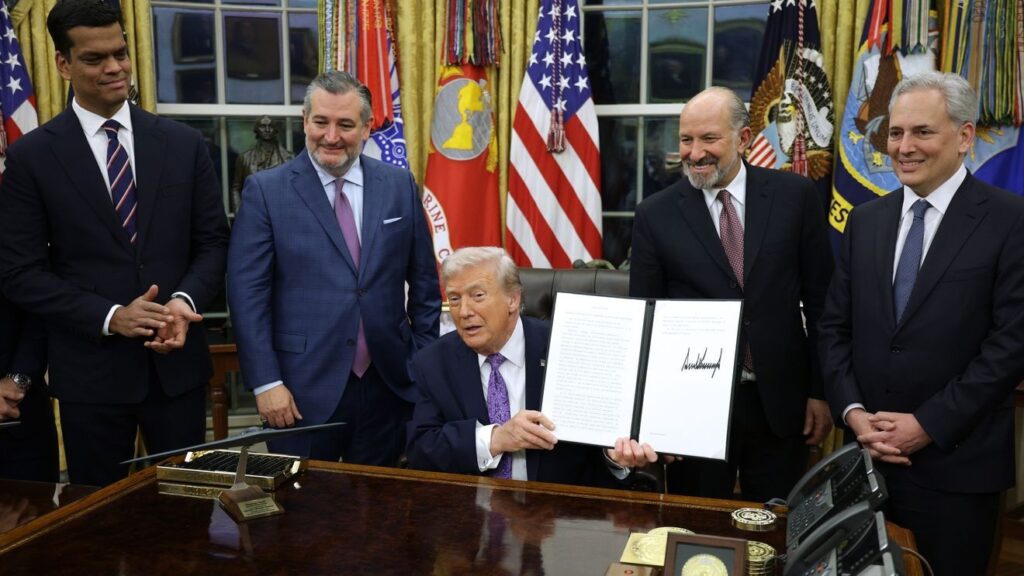
(TNND) — President Donald Trump framed his new executive order on artificial intelligence as a necessary step to rein in sprawling and burdensome state rules that could cause the U.S. to lose the AI arms race to China.
But experts questioned the federal government’s appetite for regulating the transformative technology, for all its good and bad.
And the CEO of an organization that advocates for online protections for children and teens took the president to task for what he called “an outrageous betrayal of the states that, as Congress has stalled, have worked tirelessly to protect their residents from the very real risks of AI.”
“AI is a rapidly evolving technology, and families need every cop on the beat,” Common Sense Media CEO James Steyer said in a statement. “With this order, the White House has attempted to hobble and silence our champions in the states just to curry favor with industry.”
Thursday’s signing wasn’t the first attempt from Trump to support AI developers, remove restraints or align AI with his policies.
He’s signed orders pushing back against “woke” AI, to fast-track the construction of data centers, and to promote the export of American AI technology.
The new order seeks to tamp down state rules on AI in favor of a “minimally burdensome” national policy.
The White House said it wants to ensure that children are protected, censorship is prevented and copyrights are respected.
But it doesn’t want roadblocks to AI innovation and the economic activity that it generates, calling out what it said was a growing patchwork of state rules governing what AI firms could and couldn’t do.
Without comprehensive guardrails passed at the federal level by Congress, all 50 states have introduced legislation on AI this year.
Thirty-eight states have adopted or enacted around 100 new measures this year, according to the National Conference of State Legislatures.
“There’s only going to be one winner here, and that’s probably going to be the U.S. or China,” Trump said at the signing ceremony. “And right now, we’re winning by a lot. China has a central source of approval. I don’t think they have any approval, they just go and build. But people want to be in the United States, and they want to do it here. And we have the big investment coming. But if they had to get 50 different approvals from 50 different states, you could forget it, because it’s not possible to do, especially if you have some hostile (states).”
Daniel Schiff, a policy scientist and the co-director of the Governance and Responsible AI Lab at Purdue University, said there are legitimate concerns both for and against state AI laws.
The patchwork can make it harder for AI companies to comply with all the rules. It can create coordination problems.
But he said there’s a lot of value in state laws, too.
“Yes, while a patchwork is problematic, I don’t see that we are in a robust, thoughtful or proactive space in our thinking, certainly federally in the U.S., where we can say, ‘Look, the states are doing a bad job, it’s a mess. And we in the federal government are doing a great job, and we’re on top of this, and what we come up with is going to be better,’” Schiff said.
Trump’s new order feels more like a shot for innovation and against regulation than it does a thoughtful way to balance the challenges of AI, Schiff said.
Local control comes with its trade-offs, Schiff said.
But he also doubted that a single federal AI bill could cover all the bases.
AI is too sweeping, complex and evolving, he said.
What Americans need is more coordination between the states and federal government, not the elimination of state laws that might be tailored to a population’s unique needs and sensibilities, Schiff said.
Schiff said he doesn’t see any real appetite either from the administration or from Congress to develop robust guardrails around AI.
That’s a similar thought that another AI expert shared with The National News Desk over the summer.
“Until the federal government undergoes a sea change in the way they think about AI and its impact, positive and negative on all people, I’m thankful for the patchwork of state regulations,” said Anton Dahbura, the co-director of the Johns Hopkins Institute for Assured Autonomy.
Trump’s order establishes an AI Litigation Task Force to challenge state laws inconsistent with the administration’s policy.
And administration officials were instructed to come up with a list of “onerous” state laws.
It also threatens to withhold federal broadband funding from any state with such AI laws.
Common Sense Media fought against a provision in Trump’s “One Big Beautiful Bill” that would have stopped states from enforcing AI laws and regulations for a decade in the spirit of fostering innovation.
Ultimately, the provision was stripped from the massive bill.
And now Common Sense Media is pushing back on the executive order.
“States have always served as laboratories of democracy, and many of our strongest federal consumer protections, including smoking bans and seatbelt requirements, began as state laws. AI should be no different,” Steyer said. “Stripping states of their constitutional rights to protect their residents from unsafe AI — while holding critical broadband funding hostage, no less — erases the progress they are making and puts lives in danger.”
Common Sense Media has sounded the alarm over the dangers of AI chatbots for teenagers in need of emotional or mental health support.
And a youth-focused mental health organization, The Jed Foundation (JED), has urged AI companies to slow down and weigh safety risks for teens before releasing their systems to the public.
JED released an open letter to technology companies in mid-September, a day after three parents who experienced unimaginable tragedies opened up in a Senate hearing about the alleged dangers of AI chatbots.
The parents shared heartbreaking accounts of how they believed using AI chatbots grew into an unhealthy obsession for their children, ultimately driving them to take, or attempt to take, their own lives.
Earlier this year, Congress passed the “Take It Down Act,” a bill championed by First lady Melania Trump to criminalize the publication of nonconsensual sexual imagery, including AI-generated deepfake revenge pornography.
But Schiff isn’t optimistic Congress will get many more protections passed.
“There are some things that could get through, but with all the other priorities, with the level of political division, it’s hard to imagine the executive branch and both parties of the legislature agreeing on something,” Schiff said. “We haven’t even gotten to pass federal privacy regulation, for instance.”
Schiff said it’s “very risky” to keep pushing AI development without regulation.
And he contended that regulations can actually help AI companies by giving them clarity in development and more public trust in their products.
Schiff said the task force, set forth in the executive order to sue states over their AI laws, might not find success on legal grounds. But he said that could still cause a chilling effect on new state laws.
State officials just might want to avoid the trouble, Schiff said.
The order also signals to state-level Republicans to shift away from a regulatory approach, he said.
And the threat of losing out on federal money could have a real impact on states, suppressing their willingness to impose rules on AI, Schiff said.