
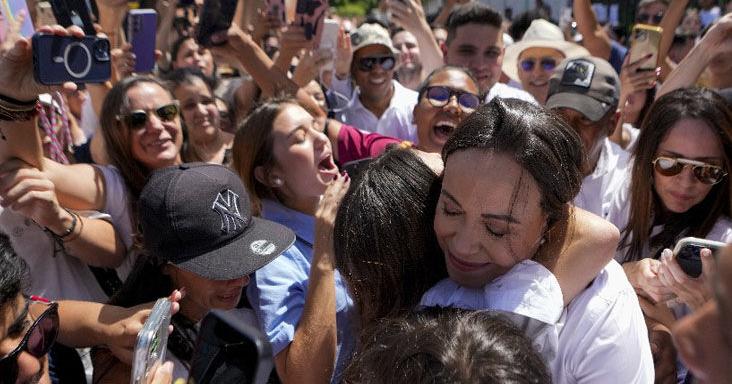
VENEZUELA’S opposition leader María Corina Machado wore a wig and disguise to pass ten military checkpoints during her daring escape from the country as she attempted to travel to Norway to collect the Nobel Peace Prize.
She did not make it in time. Machado arrived in Oslo just hours after the ceremony on December 10, at which her daughter accepted the award on her behalf.
However, her journey out of Venezuela allowed her to reunite with her family after being in hiding since 2024.
Machado won the prize for “her struggle to achieve a just and peaceful transition from dictatorship to democracy.”
She has accused President Nicolás Maduro of stealing Venezuela’s July 2024 election, from which she was banned— a claim backed by much of the international community.
Her decision to leave Venezuela and join the Nobel festivities carried both personal and political risk.
Machado began her escape on Monday afternoon.
According to a report in the Wall Street Journal, she was smuggled out of her safe house shortly before dawn, then placed in a vehicle headed for the coast. The 75-mile trip to a small fishing village—where a boat had been arranged — took nearly ten hours.
The vehicle passed through ten military checkpoints, each posing a life-threatening risk of arrest. With two helpers beside her, Machado slipped through every control undetected, arriving at the coast just before midnight.
The report said that once she reached the coast, the next leg of her journey began: a perilous crossing of the open Caribbean Sea to Curaçao. She and two companions set out on a wooden fishing skiff at 5 a.m., battling strong winds and choppy seas.
Machado had last appeared in public on January 9 in Caracas, protesting Maduro’s inauguration for his third term.
Complex operation
CBS reported on Wednesday that it took an American private rescue team 15 to 16 hours to get Machado out of Venezuela.
Most of that time was spent in rough seas, and the man who led the operation—Bryan Stern, a US special forces veteran who heads the Grey Bull Rescue Foundation—described the crossing.
He said, “It was dangerous. It was scary. The sea conditions were ideal for us, but certainly not water that you would want to be on…the higher the waves, the harder it is for radar to see. That’s how it works.”
In an interview with CBS News, Stern offered insight into the complex operation his organisation undertook to extract Machado and get her on a plane to Norway, where she reunited with her children for the first time in about two years. “She has a very large target on her back,” he said.
“This is not a random shopkeeper who doesn’t wanna be in Venezuela anymore. This is moving around a rock star.”
The report noted that once Machado was taken off Venezuelan soil and transferred to a boat, Stern was there to welcome her aboard for a 13–14 hour trip to an undisclosed location, where she caught her flight to Oslo.
About two dozen members of his team were directly involved, with many more assisting through intelligence, translation, and logistics.
Stern said the rough seas and dark skies on Tuesday night were ideal for covert work but made for a miserable passage.
“The maritime domain is the most unforgiving domain. This was in the middle of the night—very little moon, a little bit of cloud cover, very hard to see, boats have no lights.” By the time Machado climbed aboard, “all of us were pretty wet. My team and I were soaked to the gills. She was pretty cold and wet, too. She had a very arduous journey.”
‘I’ll be back’
Upon arriving in Norway, Machado was greeted by cheering supporters as she waved from the balcony of Oslo’s Grand Hotel. She later said she had met many Venezuelans hopeful of one day returning to a liberated country.
At a Thursday news conference, Machado said the US assisted in her escape from Venezuela.
She also spoke about a Venezuela without Maduro and plans for transition within 100 days.
Asked about the Trump administration’s seizure of an oil tanker off the coast, she backed global efforts to cut off oil revenue that supports Maduro’s government, though she did not reference the US directly.
“The regime is using the resources—the cash flows that come from illegal activities, including the black market of oil —not to give food for hungry children, not for teachers who earn $1 a day, not to hospitals in Venezuela that do not have medicine or water, not for security. They use those resources to repress and persecute our people,” she said.
“So yes, these criminal groups have to be stopped, and cutting the sources of illegal activities is a very necessary step to take,” she added.
“I believe that President Trump’s actions have been decisive to reach the point where we are right now, in which the regime is weaker than ever,” Machado said. “The regime previously thought that they could do anything…Now, they start to understand that this is serious, and the world is really watching.”
Asked whether she would support US military intervention, Machado said Venezuela had already been “invaded” by Russian and Iranian agents, terrorist groups, and Colombian drug cartels that operate with impunity and fund Maduro’s regime. Maduro’s government has warned that Machado would be considered a “fugitive” if she left the country.
“I’ll be back in Venezuela, I have no doubt,” she said.
The opposition leader vowed that Venezuela would soon be “bright, democratic and free,” adding that courage grows when what one loves is in danger. “Peace, ultimately, is an act of love,” she said.
“I am very hopeful Venezuela will be free, and we will turn the country into a beacon of hope and opportunity, of democracy.”