
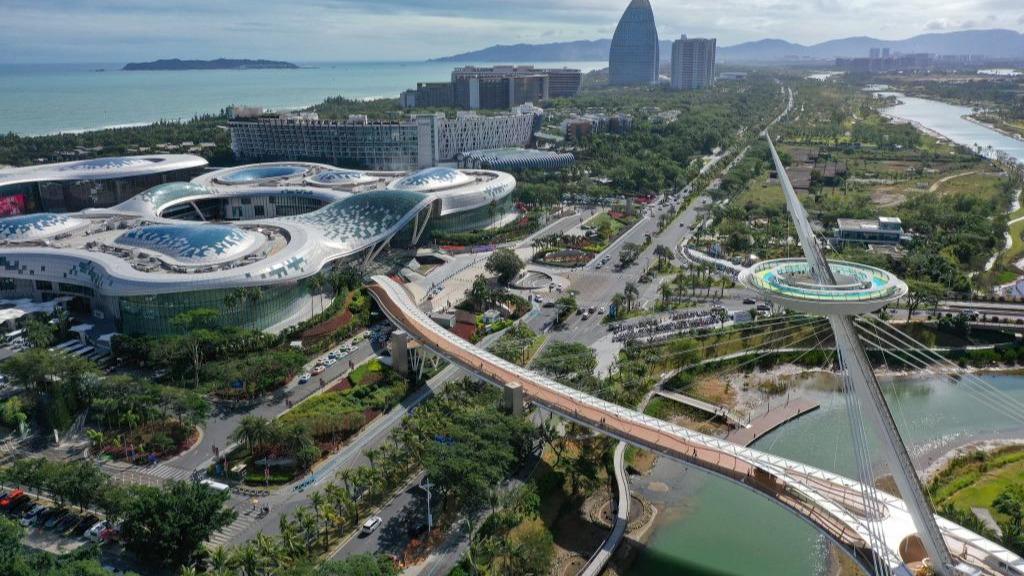
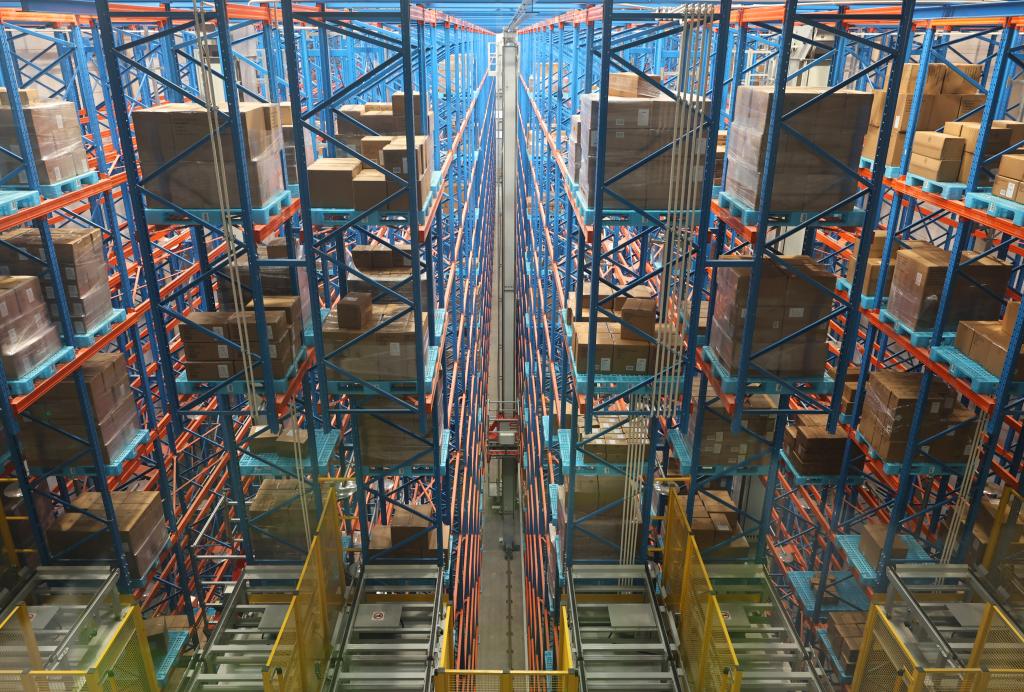
A stacker crane (C) places goods at an automated high-bay warehouse of the Maersk Lin-gang Flagship Logistics Center in east China’s Shanghai, on Nov. 26, 2025. (Xinhua/Fang Zhe)
* Chinese leaders set priorities for economic work in 2026 at a key meeting that concluded Thursday, signaling the country’s firm determination to navigate uncertainties with high-quality development.
* The meeting said domestic demand will remain a key focus in building a robust domestic market, a move analysts describe as a strong buffer by the world’s second-largest economy against rising external uncertainties.
* Policymakers also emphasized the need to “better coordinate domestic economic work with struggles in the international economic and trade arena” in the meeting, indicating that the world’s second-largest economy is bracing for sustained external pressures.
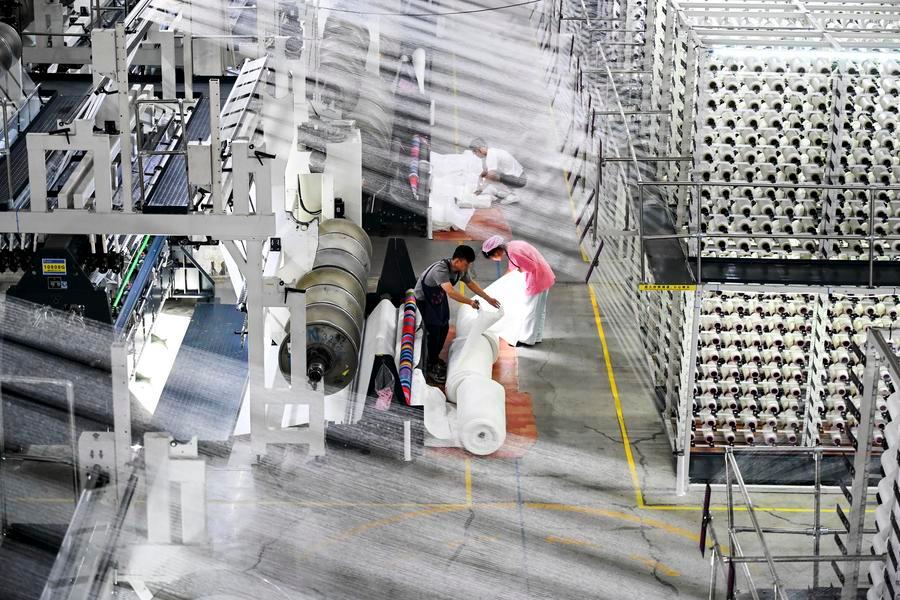
This photo taken on Aug. 20, 2025 shows a smart workshop of SinceTech, a shoe material textile company, in Jinjiang, southeast China’s Fujian Province. (Xinhua/Lin Shanchuan)
BEIJING, Dec. 12 (Xinhua) — Chinese leaders set priorities for economic work in 2026 at a key meeting that concluded Thursday, signaling the country’s firm determination to navigate uncertainties with high-quality development.
The Central Economic Work Conference delivered a sober assessment of the economy, confronting challenges head-on with a clear, problem-oriented agenda, as observers scrutinize its messages to understand the economic priorities of the world’s second-largest economy in 2026 and beyond, with 2026 marking the beginning of China’s 15th Five-Year Plan period (2026-2030).
During the 14th Five-Year Plan period (2021-2025), China contributed around 30 percent of global growth, reinforcing its position as a stabilizing force in the world economy.
The meeting addressed concerns ranging from domestic consumption to the balance between development and security. Analysts believe this approach will balance short-term needs with long-term goals, while stimulating internal momentum alongside expanding external opportunities.

A drone photo taken on Nov. 26, 2025 shows tourists viewing flowers at the Qingxiu Mountain scenic area in Nanning, south China’s Guangxi Zhuang Autonomous Region. (Xinhua/Zhou Hua)
PRIORITIZING DOMESTIC DEMAND
In terms of tasks of next year’s economic work, the meeting said domestic demand will remain a key focus in building a robust domestic market, a move analysts describe as a strong buffer by the world’s second-largest economy against rising external uncertainties.
Chen Lifen, a researcher at the Development Research Center of the State Council, said prioritizing the domestic market is an intrinsic requirement for constructing a new development paradigm.
The policy pivot comes as consumption cements its role as the primary economic driver. Final consumption expenditure contributed 53.5 percent to economic growth in the first three quarters of 2025, up 9 percentage points from the full-year figure of the previous year. With the economy showing resilience, China is widely expected to achieve its growth target of around 5 percent for the year.
Global financial institutions have responded positively to the trajectory. The World Bank, International Monetary Fund (IMF), and Asian Development Bank recently raised their 2025 growth forecasts for China by 0.4, 0.2, and 0.1 percentage points, respectively.
“The authorities are already taking steps to raise domestic consumption,” said Kristalina Georgieva, managing director of the IMF. “They have adopted an expansionary fiscal stance, eased monetary policy, and implemented some targeted measures to reduce excess saving and address ‘involution.'”
China’s economic resilience has bolstered global market confidence, extending optimism from immediate growth upgrades to the country’s medium-term potential. Foreign institutions are now looking toward 2026 with expectations that continued policy support will underpin a stable trajectory.
Ding Shuang, chief economist of Greater China and North Asia with Standard Chartered, said at an outlook briefing that the focus of economic work for 2026 has shifted from a short-term “risk response” mode to a long-term “economic transformation” mode, noting that the agenda is now placing greater emphasis on domestic demand and innovation.
Xiong Yi, chief China economist at Deutsche Bank, expects China’s economy to run on a defined track in 2026. He anticipates continued fiscal expansion and precise monetary policy, projecting that investment contributions will recover, exports will remain strong and consumption will continue to serve as the main engine of growth.