
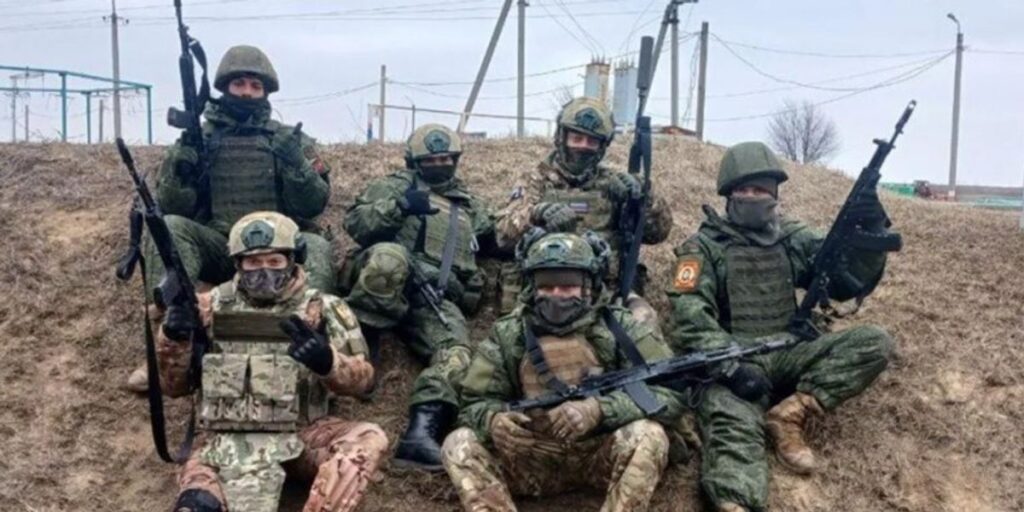
A new generation of Serbian nationalists is preparing for war in Bosnia and Herzegovina, with hundreds of militants already traveling to Ukraine to fight alongside Russian forces, writes The Telegraph.
They believe that “Mother Russia” will restore their honor and help them regain lost territories like Kosovo, Telegrafi reports.
Nationalists, including veterans of the war in Bosnia and Herzegovina, are using social media to encourage young Serbians to join them, offering up to 26,000 euros to go to the Ukrainian front, The Telegraph has learned.
There are growing fears that returnees from the Ukrainian front could spark a new paramilitary conflict in Bosnia, 30 years after the end of the war.
One such example is Dario Ristic, a Serbian nationalist who recently returned to Bosnia after being injured fighting in Ukraine with a Russian unit known as the “Bears.”
Ristic, who ironically earned the war nickname “Brzi” in Ukraine because of his prosthetic leg, has participated in sniper and drone attacks on towns such as Avdiivka.
He also used his skills on social media platforms like TikTok and the Russian network Vkontakte, where he glamorized the war and spread nationalist messages to rally support among politically disaffected Serbian youth.
His Russian unit even sent a birthday card to war criminal Ratko Mladic, who is serving a life sentence in The Hague.
In a video posted on Telegram, Ristic posed next to a friend who said: “When we are done with these NATO fascists here, we will return to reclaim our holy places and what is ours. Glory to God, glory to Mother Russia – until victory.”
Upon returning to Bosnia, Ristic was arrested at Sarajevo airport for joining a foreign paramilitary unit, but was released from prison and placed under house arrest pending trial.
Although far from the front lines, with more than 10,000 online followers, he is still considered a high risk for recruitment.
When The Telegraph contacted him at his home in Modrica, he said from the doorstep: “I would like to talk to you. But the law forbids me from talking to you, but maybe in the future.”
Ristić is joined online by other Serbian nationalists, mostly veterans of the Bosnian war, who continue to instill a divisive ideology in young people.
“There is a common belief among these extremists that Mother Russia will one day repay their blood debt by helping to rebuild a Greater Serbia,” said Sreqko Latal, a regional analyst.
“Their numbers are small, but they are helping to attract other disaffected Serbian youth who may be vulnerable to nationalist messages. Like the old IRA in Northern Ireland, you don’t need many armed individuals to threaten the balance of peace,” Latal added.
A prominent veteran with a major influence on young fighters, including Ristic, is Davor Savic, known as “Vuk.” During the wars of the 1990s, he fought in Arkan’s Tigers paramilitary unit, and later joined Russian forces in Crimea and Syria, and was part of the disbanded Wagner Group.
Leaked medical reports have revealed that he was also a colonel in the Russian intelligence service GRU, responsible for the Novichok attack in the UK in 2018.
Under his leadership, the GRU allegedly created a series of shell companies to help Serbian and other volunteers evade detection, issuing them work permits and arranging travel.
“We infiltrated some of their messaging services by posing as volunteers,” said Nino Bilajac, an investigative journalist in Sarajevo.
“The money on offer is increasing as battlefield losses make Russia more desperate for new fighters, and I was recently offered an upfront payment of around 26,000 euros to sign up, and a monthly salary of almost 2,800 euros,” he added.
For young people in towns like Modrica, where unemployment is high and wages hover around £500, the offer is tempting despite laws prohibiting fighting for a foreign power.
In Modrica, where the largest employer is a Russian-owned oil refinery, a passerby said Ristic boasted about his veteran’s pension from Moscow and plans to open a training center and a drone repair shop.
His return brings unrest among the Bosniak minority. Not far from his home is a mosque rebuilt after the war.
“I was only 10 years old when the tanks came in, and my father was dragged away by force, and my brother was almost killed when our neighbor’s house, right there, was blown to pieces,” said Edib Zilić (43).
“In some countries victims still have to meet their perpetrators, and even today, despite all the renewed friendships, there is still a minority of extremists who want to scare us and take us back to those evil times, but we refuse to live in fear,” he added.
There are also signs of possible state involvement. Milorad Dodik, the former president of Republika Srpska who still holds real power, was photographed with Davor “Vuk” Savicic before a meeting with Vladimir Putin in Moscow earlier this year.
There are also fears that Republika Srpska could become a training ground for Russian-backed paramilitary units, posing a threat to European security.
Evidence from the trial of saboteurs in Moldova has revealed that Republika Srpska has recently been used as a training base for hybrid warfare against the West.
The training has included methods for turning peaceful protests into violent riots and the use of drones to disrupt civilian and military infrastructure, techniques that have already been seen across Europe. /Telegraph/